
How to Refactor Legacy Code for AI Compatibility
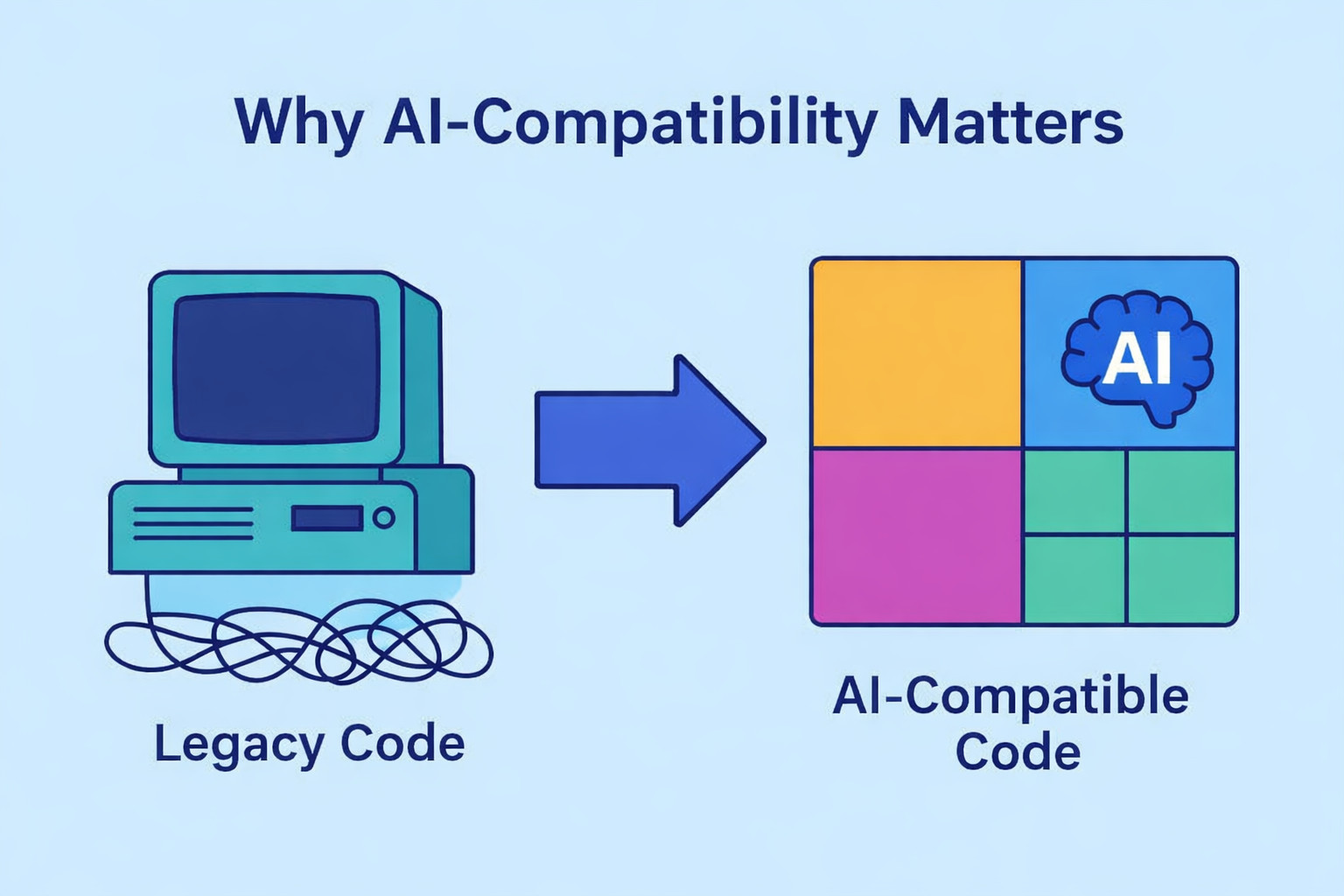
Why do legacy codes need to be AI-compatible? Well, hundreds and thousands of organizations depend on legacy code as their building blocks. These systems often range from mainframes that execute financial systems to obsolete web apps that continue to mint money. They regularly store decades’ worth of critical operational workflows, customer data, and business logic. Now, organizations are faced with a new challenge as artificial intelligence (AI) takes over the reins as the driving force behind modern software development. It is on organizations to figure out how to refactor legacy code for AI compatibility without compromising stability or performance.
The obvious answers of adding a chatbot or connecting an API are only one facet of AI compatibility. It is necessary to make your codebase discoverable, modular, and flexible if you are striving to ensure effective and secure communication with AI systems such as predictive analytics engines, autonomous agents, or code-generating assistants.
| Key Takeaways: |
|---|
|
What is AI-Compatible code?
Software that is developed to be understood, interacted with, and modified effectively by AI tools is called AI-ready or AI-compatible code. It is modular, well-documented, and has automated testing.
- Minimal coupling and clear segregation of concerns.
- Well-established APIs and interfaces.
- Self-explanatory and readable naming conventions.
- Comprehensive unit and integration tests.
When a codebase meets all these requirements, AI-driven tools like IBM Watson, GitHub Copilot, or custom LLM-powered assistants can navigate it in a more accurate manner, suggest relevant changes, and deliver supporting resources such as test scripts or documentation.
Why Refactoring for AI Compatibility is Different from Standard Refactoring
Traditional refactoring focuses on improving the readability, performance, or maintainability of code without modifying its functionality. Making your codebase “AI-friendly” for both AI-assisted development and integrating AI into your application is another advantage of refactoring for AI compatibility.
- A stronger focus on modularization to facilitate AI tools to function on unique components.
- Structured documentation and metadata to provide context for AI models.
- Higher test coverage to aid automatic validation of code changes generated by AI.
- Readiness for integration with AI-driven automation workflows, ML models, or AI APIs.
The Role of AI in Modern Refactoring
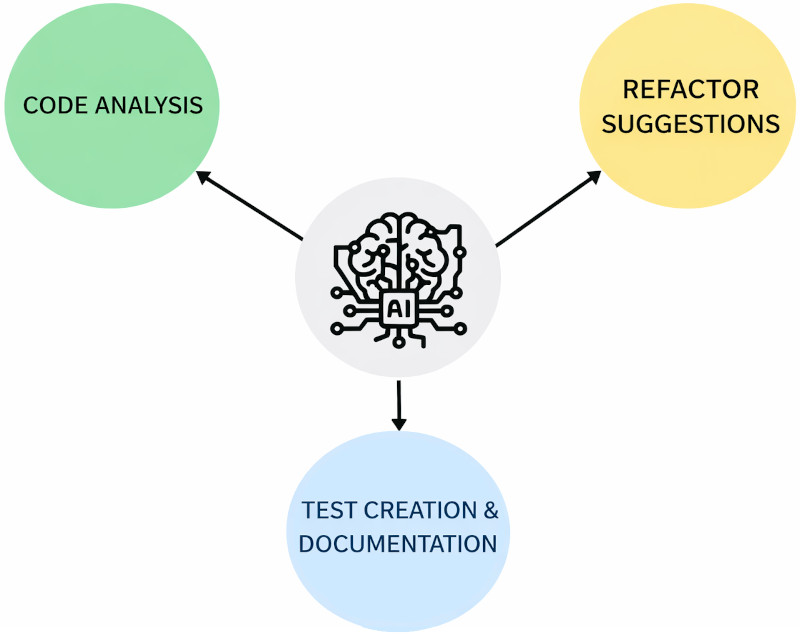
AI-Assisted Code Analysis
- Code smells (long methods, duplicated code, deep nesting).
- Dependency tangles that interfere with testing and modifications.
- Outdated patterns or deprecated API calls.
For example, IBM’s AI mainframe refactoring assistants are able to detect monolithic COBOL programs and suggest modularization steps. Projects that involve cloud migration and modernization gain momentum as a direct consequence.
AI-Generated Refactor Suggestions
- Function and variable renaming for clarity.
- Method extraction to streamline.
- Automated elimination of dead code.
- Creation of interface layers for legacy components.
While these recommendations save precious time, they necessitate thorough human review. AI can unintentionally modify business-critical logic because it lacks comprehensive domain knowledge.
- What is Code Optimization?
- How to Use Load Balancers and Horizontal Scaling: Optimizing Performance and System Reliability
- How to Write Scalable Code: Best Practices for Maintainable Software
AI for Test Creation and Documentation
Generating or updating test suites and documentation is one of the most promising applications of AI. Teams can refactor with confidence when strong testing is in place because they are aware that regressions will be identified promptly.
Steps to Make Legacy Code AI-Compatible
Here are the important steps to make your legacy code compatible with AI changes.
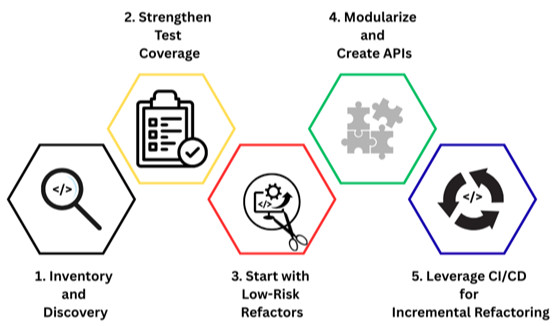
Step 1: Inventory and Discovery
- Build a map of your runtime environments, repositories, systems, and dependencies.
- To identify complex hotspots, leverage AI-empowered code scanners and static analysis.
Step 2: Strengthen Test Coverage
- Make sure you have the dependable tests prior to working with production code.
- Incorporate regression, integration, and unit tests.
- Employ AI tools to recommend missing test cases.
Step 3: Start with Low-Risk Refactors
- Rename confusing identifiers.
- Eliminate unnecessary and unused code.
- Extract small methods from large functions.
Step 4: Modularize and Create APIs
- Segregate intricate systems into modules with unique user interfaces.
- This makes it possible for AI systems to modify or scale on specific elements.
Additionally, it also aids in future migrations (e.g., microservices).
Step 5: Use CI/CD for Incremental Refactoring
- Define pipelines for continuous integration.
- Automated tests are used to validate each change.
- Deploy gradually to restrict the blast radius.
- Master Deployment Strategies: Blue-Green, Canary & More
- What is DevOps Lifecycle?
- Differences Between Continuous Integration, Continuous Delivery, and Continuous Deployment
- Which Version Control System is the Best?
Risks and Governance in AI-Assisted Refactoring
AI-powered refactoring introduces special opportunities as well as risks that are not as common in conventional modernization initiatives. The success or failure of your modernization processes will rely on your capability to understand these risks and establish governance procedures.
Hidden Regressions Beneath the Surface
AI models have the functionality to make hidden logical modifications that interfere with critical workflows, even when they initially appear to be correct. Refactoring a financial function, for example, might change rounding behavior and impact compliance reports without triggering obvious runtime errors.
- At every phase, ensure to implement rigorous regression testing.
- Adding skilled human domain experts who understand the underlying business logic to AI-generated modifications.
- Define code review guidelines needing high-impact modules to be reviewed by a minimum of two people.
Security Vulnerabilities introduced by AI
AI tools do have the potential to improve code structure, but they may also unexpectedly introduce unsafe patterns, like inadequate input validation, insecure API calls, or weaker encryption defaults.
- Ensure to include static application security testing (SAST) in your pipeline for continuous integration and delivery.
- Validate each AI-assisted commit using automated security scanners.
- Maintain a security playbook customized to modernization initiatives.
Loss of Implicit Knowledge
Legacy systems often store “Tribal Knowledge”, which are undocumented quirks that fulfill hidden business goals. AI systems are unable to infer these implicit guidelines, which leads to modifications that break compliance or operational expectations.
- To capture undocumented rules, bring together stakeholder interviews and refactoring.
- Before initiating AI-assisted changes, make hidden behavior explicit using code comments and inline documentation.
Overreliance on AI Recommendations
Teams that leverage AI tools too fast run the risk of adapting changes before fully comprehending them, which can lead to “cargo cult” modernization, code that is structurally new but functionally fragile.
- Build a policy for the use of AI that defines the acceptable range of modifications generated by AI.
- Motivate developers to consider AI outputs as recommendations rather than solutions.
Governance Framework for AI-Assisted Refactoring
- Gatekeeping for Approval: Clearly define who has the authority to approve modifications generated by AI (e.g., senior developers, architects).
- Traceability: Carefully record which model version, AI tool, and prompt generated each change.
- Testing Requirements: All automated and manual tests must be passed before an AI-generated change is merged.
- Security and Compliance Checks: Both automated scanning and human review of sensitive areas.
- Continuous Monitoring: Monitor metrics such as performance deterioration, error rates, and customer support incidents post-deployment.
Teams can safely integrate AI into their modernization workflows by combining process governance with technical safeguards.
Best Practice for AI-Compatible Refactoring
The checklist below is meant to be used as a live guide throughout the project, as well as a preflight tool before initiating a refactor.
Let us divide it into three main phases: planning, implementing, and testing.
Step 1: Preparation
- Inventory Legacy Assets: Record each database, integration point, repository, and runtime environment.
- Baseline Metrics: Measure operational KPIs, performance standards, and current defect rates for comparison post modernization.
- Stakeholder Interviews: Collate undocumented business logic from power users, support teams, and engineers.
- Test Coverage Audit: Before initiating large-scale refactoring, identify coverage gaps using a code coverage tool and resolve them.
Select AI Policies and Tools: Define the scope, review requirements, and AI assistants or analyzers you wish to use.
Step 2: Implementation
- Low-Risk First: To enhance your AI-assisted workflows, start with non-essential modules.
- Iterative Refactoring: Apply changes gradually and only integrate them into the main branch once all tests have been successfully completed.
- Continuous Testing: Execute regression suites automatically after each change with AI-powered tools.
- Code Review Discipline: Every AI suggestion should be evaluated by human review, particularly in critical code paths.
- Maintain Documentation: After each refactor, update the architectural diagrams, inline comments, and READMEs.
Step 3: Testing
- Performance Regression Testing: Validate that refactoring code adheres to or exceeds pre-refactor performance standards.
- Security Audits: Perform SAST scans and post-refactor tests.
- User Acceptance Testing (UAT): Ensure to involve real-time users to validate that behavior has not changed from their point of view.
- Rollback Readiness: Maintain the capability to swiftly revert to the pre-refactor state.
- Post-Deployment Monitoring: In the initial weeks post-release, keep an eye on customer feedback, latency metrics, and error logs.
When strictly followed, this checklist reduces risk and generates a modernization playbook that can be mimicked for upcoming projects.
About Future: AI-First Legacy Modernization
The idea of “AI-compatible code” will evolve from being a modernization goal to a design-time principle as AI tools advance. This is the direction the industry is taking:
Fully Autonomous Refactoring Agents
- Running static and dynamic analysis.
- Generating and executing test suites.
- Suggesting and applying changes.
- Self-reverting changes if regressions are identified.
While developers focus on newer features, these agents would operate continuously to enhance the code quality in the background.
AI and Test Automation Convergence
- AI generates a refactor.
- It is validated in real time by test automation.
- AI automatically reverses or suggests a solution if a test fails.
Without long QA cycles, this “closed loop modernization” might aid safe, near-real-time codebase optimizations.
Legacy Modernization as a Continuous Process
Organizations will leverage continuous modernization pipelines, which are similar to continuous integration, in place of large, risky, one-time modernization projects. AI will propose refactors as part of the standard development flow and keep an eye out for security threats, code smells, and obsolete patterns.
An Increased Focus on Explainability
- Clear justification for every suggested change.
- A clear connection between AI outputs and business needs.
- Audit logs that satisfy compliance requirements.
Vertical-Specific AI Modernization Solutions
We’ll observe AI tools customized to sectors like healthcare, finance, and government. For highly regulated industries, these tools will be more secure and more effective because they will be trained on domain-specific patterns, performance expectations, and compliance demands.
AI-human collaboration pipelines, where AI handles iterative, large-scale analysis and humans focus on strategic, high-impact decisions. This collaboration is the way of the future, not replacing humans in modernization. It enables organizations to continuously evolve their systems without sacrificing trust or stability if they have robust AI-powered test tools.
Conclusion
It is now a competitive necessity to refactor legacy code for AI compatibility, not a “someday” solution. Organizations can modernize faster, safely, and confidently by integrating robust, AI-powered test automation tools with modular design, thorough documentation, and AI-assisted tools.
The path forward is quite clear: Get your codebase AI-ready. Use AI to accelerate incremental, safe refactoring. Then, utilize automated tests to secure each modification. Yes, modernization is a risk, but it is also a chance to make your systems future-proof if you have the correct plan and the correct tools.
 |