
What Are Embedded Systems?
Today’s world is highly digitized, and technology is not just limited to developing software applications. Everything around us runs on software, including traffic, vehicles, industries, banking systems, and even appliances at home. But how does this happen? One of the latest technological advances that is driving this is Embedded Systems.
Embedded systems are the invisible engines that drive modern technology.
| Key Takeaways: |
|---|
|
In this article, we will learn the following:
|
The embedded system market is growing rapidly, and it is projected to grow to more than $190 billion by 2032, as against $110.3 billion in 2023.
Well-known technology companies such as Apple, IBM, Texas Instruments, and Intel are now manufacturing chips for embedded systems. Companies are also investing in artificial intelligence (AI) and mobile computing, which is driving the need for embedded systems for high-level processing.
This article explores the definition, components, types, applications, design considerations, and future trends of embedded systems, providing a detailed understanding of this technology.
Embedded Systems – Definition and Overview
An embedded system is a specialized computing system dedicated to performing specific functions or tasks, often within a larger system or a device.
The term embedded system comprises two words: Embedded and System.
Embedded means including something inside another thing for a specific purpose. In other words, embedded means an entity is integrated or attached to another entity.
A system is a set of components or parts that are interrelated and perform common functions for which the set is created.
Combining these two terms makes understanding embedded systems easier. Thus, an embedded system is a computing system designed to perform specialized tasks. Unlike general-purpose computers that can execute numerous applications, embedded systems perform specific tasks.
Embedded systems are also called embedded computers. These systems are small in form factor and perform specific computing tasks. While they are usually a part of a larger system or device, they can serve as standalone devices too. Embedded systems are used in applications that have power, cost, size, or weight constraints. For example, embedded systems are often used for sensing and real-time computing in Internet of Things (IoT) devices. These devices are internet-connected and do not require a user to operate.
Key Characteristics of Embedded Systems
- Dedicated Functionality: An embedded system performs a specific dedicated task. It does not perform general-purpose computing.
- Real-Time Operation: Embedded systems often operate under time constraints. They perform real-time operations that respond to events quickly and reliably. This has to be done under strict time constraints.
- Resource-Constrained: They also have limited resources such as processing power, memory, and energy.
- Reliability and Stability: Embedded systems are designed for continuous operation, often for years, with real-time output.
- Embedded Within Larger Systems: Embedded systems are usually embedded within larger systems or devices to perform specific functions.
- Integration: Embedded systems are integrated within the larger systems to perform a specific task and are often hidden from the user.
- Hardware and Software: Embedded systems consist of hardware and software components. They can be microprocessor—or microcontroller-based, and they can be integrated circuits (ICs) that give the system computing power.
Examples of Embedded Systems
- Microcontrollers in microwave ovens
- Engine control units in vehicles
- Pacemakers in medical devices
- Industrial control systems
- IoT devices
Components of Embedded Systems
Embedded systems comprise tightly coupled hardware and software components.
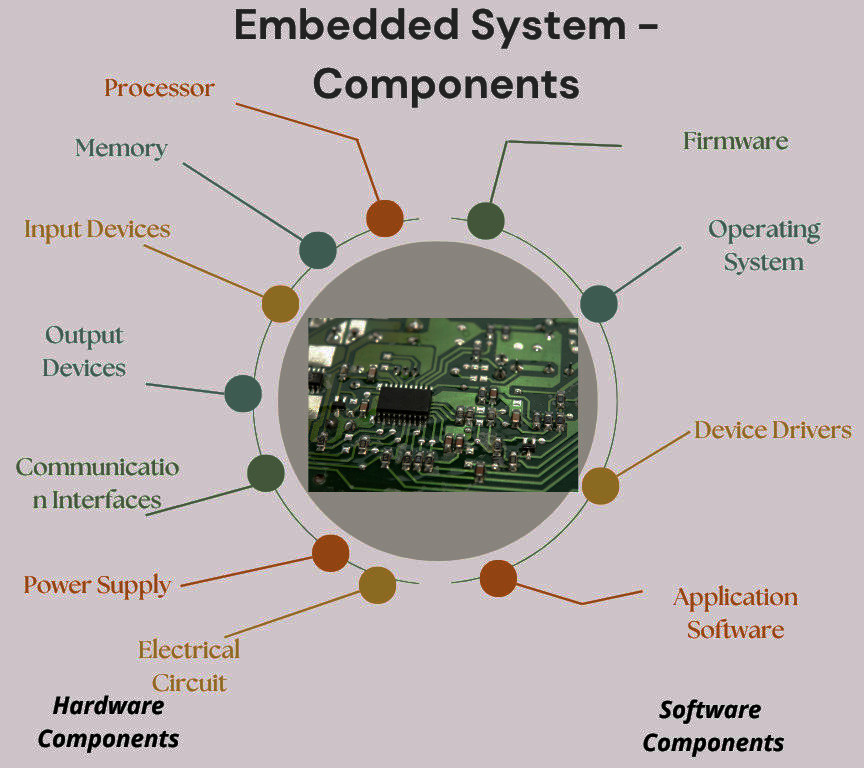
Hardware Components
The hardware components of the embedded system are various physical devices or elements, including the system infrastructure. These hardware components work together with software components to achieve the desired functionality in embedded systems.
- Processor (Microcontroller or Microprocessor): This is the brain of the embedded system. Embedded systems can either be microcontroller-powered or microprocessor-powered. These are the forms of ICs that provide computing power to the embedded systems. Processors range from 8-bit to 32-bit and differ in processing speed and throughput.
- Memory (RAM and ROM): Embedded systems utilize the following types of memory:
- ROM (Read-Only Memory): This is a non-volatile memory that stores firmware or software that doesn’t change.
- RAM (Random-Access Memory): This is a volatile memory and is used for temporary data during operation. It is wiped clean when the system powers off.
- Input Devices: These are the components or devices within a larger interconnected infrastructure that interact with embedded systems. Sensors (temperature, pressure, motion), buttons, touchscreens, and actuators are some of the input devices used in embedded systems.
- Output Devices: They are the devices that transmit the output generated by the system. Displays, LEDs, speakers, and motors are various output devices used in embedded systems.
- Communication Interfaces: Embedded systems communicate with each other and other components within the larger systems using communication interfaces. Different interfaces include USB, I2C, UART, RS-485, Ethernet, and SPI.
- Power Supply: This is optimized for low power consumption. The power supply powers up the electrical load of the embedded systems. A smooth and efficient power supply must ensure seamless system operation.
- Electrical circuit: Embedded systems can contain electrical circuits depending on the application. Electrical circuits have the following basic components:
- Printed circuit board (PCB): A Mechanical circuit board links other components electronically. It uses conductive copper traces for linking.
- Resistor: This is an electrical component primarily responsible for producing resistance in the current flow to adjust signal levels.
- Capacitor: This is an electrical circuit component with two terminals and is used for energy storage and release as per the circuit requirements.
- Diode: This component allows current to flow in only one direction. Mostly used in switches, signal mixers, logic gates, etc.
- Transistor: They are responsible for switching and amplification in electrical circuits.
- Integrated circuit: This component combines the numerous electrical components within one chip. It provides a ready-made chip that can be directly incorporated into embedded systems.
- Light-emitting diode (LED): These are widely used electrical circuits to indicate whether the circuit is functioning correctly.
- Inductor: This electrical component is used for energy storage in an electric field. It blocks alternating current and allows direct current to flow.
Software Components
Embedded software is specifically written for a particular type of device, unlike computer software, which can be installed on different devices to achieve the same goal. The embedded software has a limited scope. For example, embedded software to control Fuzzy logic in washing machines will work only in washing machines of a specific type for which they are designed. It will not work on any other device.
- Firmware: This is the software embedded into hardware, stored in non-volatile memory.
- Operating System: Embedded systems may operate on various types of OS, such as:
- Real-Time Operating Systems (RTOS): These are systems like FreeRTOS or VxWorks that support applications that work in real-time.
- Bare-Metal: These are systems without an OS and usually work with devices.
- Device Drivers: Software programs that control the hardware peripherals, including audio, video, and graphics.
- Application Software: This program, with high-level logic, performs the embedded system’s primary function.
How do embedded systems work?
- Embedded systems use PCBs programmed with software.
- These PCBs guide the hardware in operation and data management using memory and input/output communication devices.
- A specific function is performed with the help of a processor using input data, and the result is communicated to the output device.
- The end user interprets the result and verifies if it is correct.
Types of Embedded Systems
Embedded systems are classified considering functional and performance requirements.
The following table summarizes the various types of embedded systems based on functional, performance, and architectural requirements:
| Requirements | Types of Embedded Systems |
|---|---|
| Functional | Mobile Embedded Systems
|
Networked Embedded Systems
|
|
Standalone Embedded Systems
|
|
Real-time Embedded Systems
|
|
| Performance | Small-Scale Embedded Systems
|
Medium-Scale Embedded Systems
|
|
Sophisticated-Scale Embedded Systems
|
|
| Architecture | Simple Control Loops
|
Interrupt Controlled Systems
|
|
Cooperative Multitasking
|
|
Preemptive Multitasking or Multithreading
|
Applications of Embedded Systems
Embedded systems are crucial in several technologies, including the Internet of Things (IoT) and machine-to-machine (M2M) devices. They are used in almost every smart device in some capacity or other. A few real-world applications of embedded systems are:
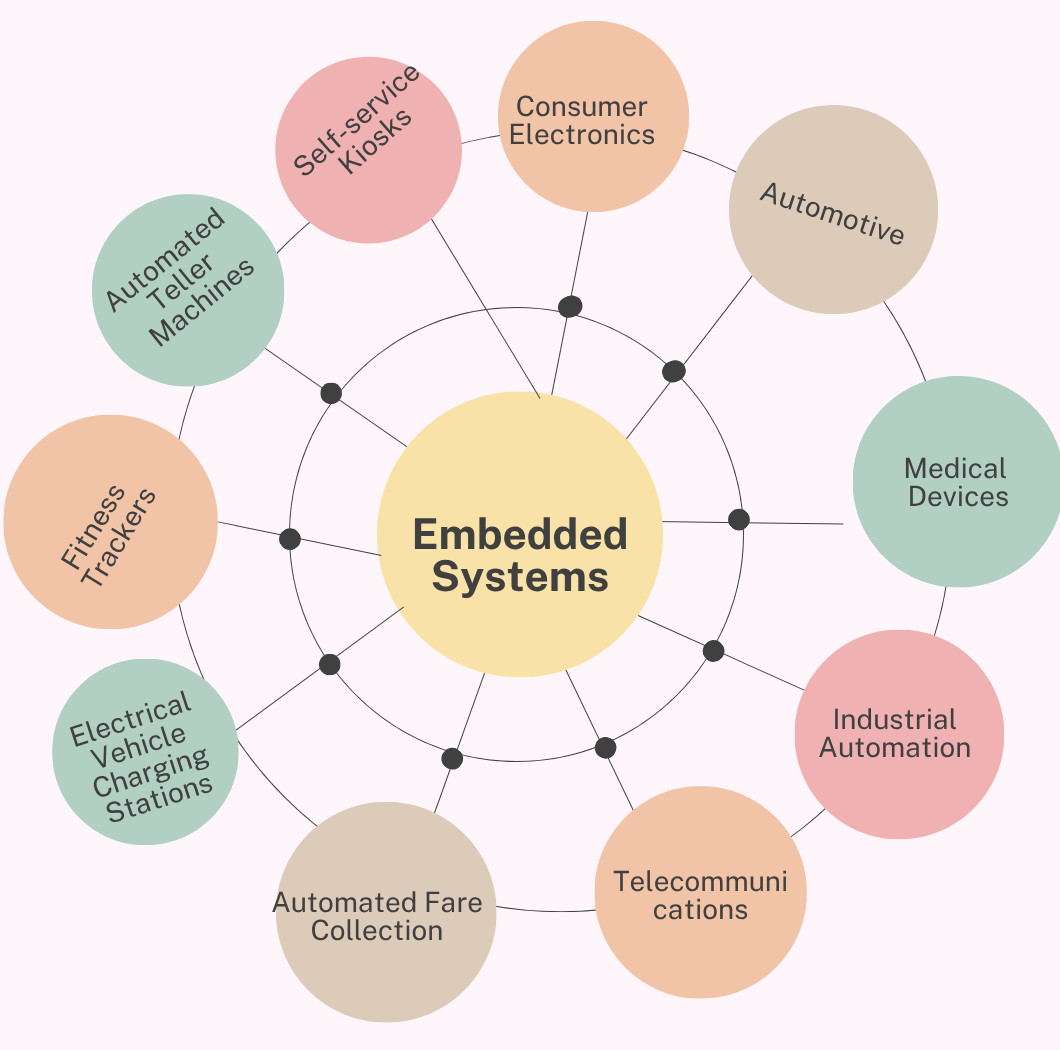
Consumer Electronics
Entertainment systems such as televisions use embedded systems to read inputs from connectors like antenna, DisplayPort, HDMI, and Ethernet. Smart televisions have an operating system that supports the internet and streaming applications. Other home entertainment and daily appliances like washing machines, cameras, gaming consoles, and remote controls use embedded systems to perform their primary functions.
Automotive
Modern cars use embedded systems to perform different functions within the vehicle. Some of these functions are basic utility functions, while others provide user-facing and entertainment functions. As modern cars become computerized, their use of embedded systems has increased. In general, embedded systems perform automotive functions such as Engine control, anti-lock braking systems (ABS), infotainment systems, navigation systems, pedestrian recognition, car breakdown warning, airbag control, and ADAS.
Medical Devices
The medical industry uses various medical devices and equipment with embedded systems for patients requiring constant monitoring. For instance, embedded sensors are used to collect health data, such as reading from implants, heart rate, and pulse rate. The collected data is then transmitted to a private cloud for review. Pacemakers, diagnostic tools, infusion pumps, and CT/MRI machines are some examples of medical equipment using embedded systems.
Industrial Automation
Industrial machines nowadays have embedded automation systems that perform specific control and monitoring functions. Factories also use robots in several processes requiring high-precision tasks or operating in dangerous working conditions. Common automated jobs use robots fitted with sensors, actuators, and software to perceive the environment and derive the required output. Some of the industrial devices using embedded systems include Robotic arms, PLCs (Programmable Logic Controllers), SCADA systems, and conveyor systems.
Telecommunications
Many telecommunications devices use embedded systems for their operations, including GUI software and hardware, operating systems (OSes), cameras, microphones, routers, switches, and Universal Serial Bus I/O modules.
The global positioning system (GPS) uses satellites and receivers to synchronize location, velocity, and time data to provide a navigation system that the world can use. GPS systems are commonly used in vehicles and mobile devices. All receiver devices are integrated with embedded systems to enable the use of the global positioning system.
Automated Fare Collection
People using public transportation can pay their fares through automated machines or online. The automatic transit fare collection ecosystem consists of ticketing machines, magnetic stripe cards, and smart cards for regular travelers, ticket and card checking machines, and automatic gate machines. These components use embedded systems to communicate with each other and thus keep the mechanism operational.
Fitness Trackers
Fitness trackers are wearable devices like smartwatches and smart rings that monitor health metrics (heart rate, blood oxygen, blood pressure) and track activities such as running, walking, and sleeping. These devices make use of embedded systems for data collection, such as heart rate, body temperature, and steps walked. This data is transmitted to servers via a wide area network (WAN) such as LTE or GPRS.
Automated Teller Machines
Automated teller machines (ATMs) are large computerized electronic devices used globally in the banking sector. ATM communicates with its host bank computer over a network connection to perform functions like checking balance, withdrawal, etc. The ATM uses embedded systems to process user inputs from the field and display the transaction data from the bank computer.
Electric Vehicle Charging Stations
Electric vehicle charging stations recharge the batteries of connected electric vehicles. Charging stations use embedded systems to provide computing power for graphics displays, automatically highlight technical issues, and alert technicians about upcoming maintenance requirements.
Self-service Kiosks
There are interactive self-service kiosks that offer users information and services in environments where a human employee’s presence is unfeasible. For example, a ticketing kiosk catering to moviegoers for a 2 a.m. screening at a mostly empty theater. Self-service kiosks are used in various forms to simplify the user experience. These kiosks can be found at airports, retail stores, hospitals, government buildings, and many other locations. They function using embedded systems that provide the computing power required for these kiosks to offer customers an interactive experience.
Design Considerations in Embedded Systems
- Real-Time Performance: Systems must meet strict time deadlines. Predictability is considered more important than raw speed.
- Power Consumption: Consideration should be given to battery-powered or remote devices, as power consumption is critical in such devices.
- Cost Constraints: Embedded systems should be cost-efficient when used for mass production.
- Reliability and Safety: Systems should be reliable as their applications are critical. For example, failures of medical devices or cars could be catastrophic.
- Size and Weight: Embedded systems must be compact and lightweight for their integration into host systems.
- Software Updates: Modern embedded systems should have OTA(Over-the-Air) update capabilities.
- Security: As more systems become connected (IoT), embedded systems must be secured from unauthorized access, malware, and data breaches.
Embedded Systems Tools and Languages
The following table provides the various tools and languages used for embedded systems development:
| Tools/Languages | Examples |
|---|---|
| Programming Languages | C and C++: Most widely used for control over hardware and efficiency. |
| Python and JavaScript: High-level control or IoT prototyping. | |
| Assembly: Performance-critical tasks. | |
| Development Tools | Compilers: GCC, IAR, Keil. |
| IDEs: MPLAB, STM32CubeIDE, Arduino IDE. | |
| Simulators and Emulators: For code testing without hardware. | |
| Debuggers: JTAG, SWD for on-chip debugging. | |
| RTOS: FreeRTOS, Zephyr, VxWorks. |
Challenges in Embedded Systems
- Resource Constraints: Embedded systems often face scarcity of resources such as limited CPU, memory, and power, which can restrict their capabilities.
- Debugging Difficulty: The embedded code is more complex to debug, as this is system-level code that targets the hardware.
- Integration Complexity: Integrating the software code with specialized hardware is challenging.
- Real-Time Constraints: Error handling and scheduling are complex as systems need deterministic behavior.
- Long Lifecycle Support: Embedded systems operate for years, and long lifecycle support is needed for them to be reliable over a long period of time.
Future Trends in Embedded Systems
- Artificial Intelligence Integration: Edge AI and TinyML allow inference on small devices such as smart cameras and voice recognition.
- IoT and Edge Computing: Edge computing reduces latency and improves efficiency as billions of embedded devices communicate via the internet.
- 5G and Connectivity: 5G connectivity enhances the bandwidth and reduces latency for real-time, mobile, and connected systems.
- Open-Source Hardware and Software: Embedded development is more accessible through open-source projects like RISC-V and Zephyr RTOS.
- Security Enhancements: Embedded systems are more secure with hardware-based security like TPM and Secure Boot, which are becoming new standards.
- Energy Harvesting and Low-Power Designs: Embedded systems operate without batteries with the help of solar, vibration, and thermal energy.
Conclusion
Embedded systems enable automation, intelligence, and control in countless digital applications, making them an integral part of the digital ecosystem. From simple household appliances to sophisticated medical and aerospace systems, embedded systems drive the services and devices used every day.
As technology evolves, embedded systems grow in complexity, capability, and connectivity. Understanding their workings, development, and maintenance opens up new opportunities in engineering, innovation, and product development.
 |