
Prompt Engineering for Beginners: How to Write Better AI Prompts
Artificial Intelligence (AI), with its fleet of agents and bots, has become an integral part of modern workflows. From writing content and generating code to answering questions and automating tasks, AI is everywhere. The rise of large language models (LLMs) has paved the way for exciting possibilities of human-machine interaction. However, to use AI models to their full potential and interact effectively, they require a crucial skill: Prompt Engineering.
| Key Takeaways: |
|---|
|
This beginner’s guide will walk you through the fundamentals of prompt engineering, practical techniques, common mistakes, and step-by-step strategies to help you write better AI prompts.
What is Prompt Engineering?
Prompt engineering is the art and science of crafting and optimizing clear, structured, and effective prompts to guide AI models, particularly LLMs, towards generating the desired outputs.
By carefully crafting prompts, you provide the AI model with context, instructions, and examples to help it understand your intent and respond responsibly.
- Instructions
- Questions
- Context
- Constraints
- Examples
"Write about AI.""Write a 500-word beginner-friendly article explaining what AI is, including examples from healthcare and finance."
The first prompt lacks detail, is unclear, and provides no clear direction. An AI model will not know where to stop writing about AI. The second prompt, however, provides clarity, structure, and direction. It is a strong prompt and will result in a better response.
Read more about prompt engineering in our article: What Is Prompt Engineering?
What is a Prompt for AI?
A prompt, in the context of AI, is the input you provide to the AI model to generate a specific output.
You can say prompts are conversation starters and can take various forms, ranging from simple questions or keywords to complex instructions, code snippets, or even creative writing samples. It can be as simple as a phrase or as complex as multiple sentences and paragraphs.
The effectiveness of your prompt directly affects the quality and relevance of the AI’s output.
How AI Understands Prompts
To process prompts, AI models identify intent, understand context, and predict the most likely response.
However, AI models do not “think” like humans. They rely on patterns in language, statistical probabilities, and provide context. This means the clearer your prompt, the better the model’s response.
Why Prompt Engineering Matters?
Prompt engineering is crucial as it acts as a bridge between human intent and AI understanding. It determines the quality, accuracy, and relevance of AI outputs, reducing hallucinations and bias. Effective prompt engineering reduces costs, saves time, and ensures AI adheres to specific constraints and contexts.
- Enhanced Accuracy and Quality: Well-designed prompts enable models to generate precise, relevant answers rather than generic or incorrect responses, ensuring the output aligns with the desired goals.
- Improved User Experience: Prompt engineering enables users to achieve better results in fewer attempts, reducing the need for trial-and-error. AI interactions are faster and more productive.
- Greater Security and Control: Developers can set boundaries for AI to prevent misuse, manage tone and format, and reduce the risk of inappropriate content.
- Efficiency and Cost Reduction: You can refine prompts to minimize computational workload, saving time and money, particularly in enterprise applications.
- Overcoming AI Limitations: Prompt engineering reduces biases in AI training data and provides the necessary context. A model can thus solve complex problems through iterative testing.
Core Elements of a Good Prompt
A good prompt has clear instructions, relevant context, persona adoption, and specific output formatting that effectively guides the AI model. The core elements of a good prompt discussed here ensure the response is accurate, well-structured, and relevant, minimizing AI guesswork.
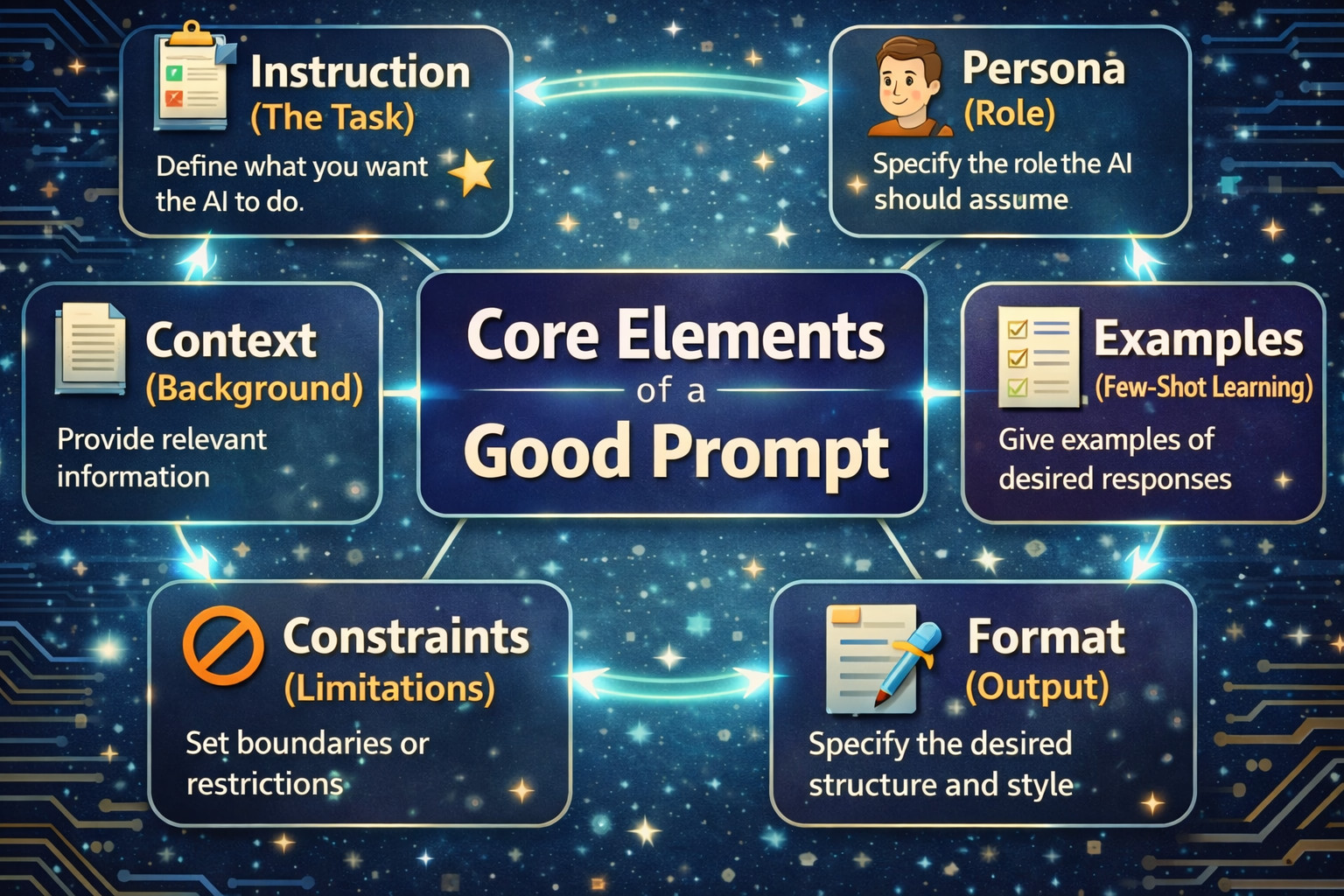
Instruction (The Task)
The task or instruction tells the AI exactly what to do. It summarizes your requirements for the prompt. Remember, writing a great task involves a lot of creativity.
Instructions usually inform the GenAI tool how to complete the task. It can also include examples of how it is supposed to work, any useful information, or any steps it can follow.
For example, the prompt "Summarize the following article in 5 bullet points." is an instruction to the AI model.
Context (Background)
A context consists of background information, including details such as the target audience, goal, or topic background, to help the AI understand the scenario.
An example of a prompt containing context is "Explain quantum computing to a high school student.". Here, the prompt is related to the context of high school students.
Persona (Role)
Persona is a role you want the AI model to adopt. It dictates the voice and expertise level. When you assign a specific role to a given prompt, the likelihood of more accurate information increases.
For example, the prompt "Act as a senior marketing expert" expects the AI to act in a senior marketing expert role, ensuring the output aligns with the specified role.
Constraints (Limitations)
Constraints are used to set limits on output. They define the boundaries such as length (e.g., “under 100 words”), format (e.g., “bullet points,” “JSON”), or tone (e.g., “professional,” “humorous”).
Some of the constraints used are word count, tone, and format.
For example, a prompt "Write a 2000-word blog on 'Software QA Automation" limits the blog to 2000 words.
Format (Output)
Format is an optional element that specifies how the output should be structured. Different AI models may respond differently to specific formats, such as natural-language questions, direct commands, or structured inputs with defined fields.
The format of a prompt determines how the AI interprets your request. Once you understand the model’s capabilities and preferred format, you can craft effective prompts.
For example, this prompt "Provide the answer in a table format" instructs the model to structure the output in a tabular format.
Examples (Few-Shot Learning)
Use this component in your prompt to show examples of the desired output. It is provided to guide the structure or style of the output. The prompt below instructs the model to write a description of the product using the given example.
"Here's an example of a product description... Now write one for this product."
Step-by-Step Guide to Writing Better Prompts
A strategic approach is needed to write better, more effective prompts. Here is a step-by-step guide to developing better prompts:
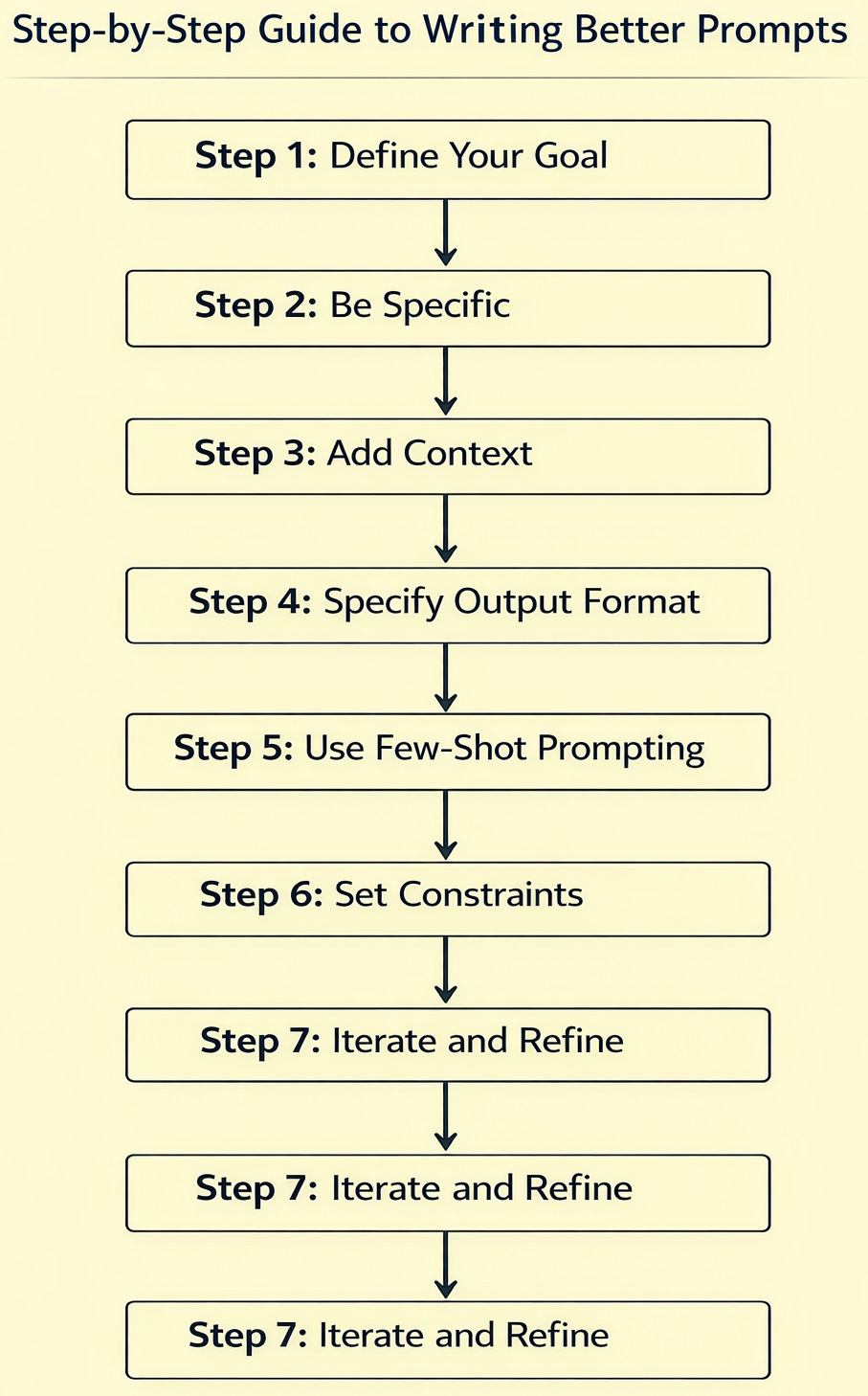
Step 1: Define Your Goal
- What do I want?
- What should the output look like?
Follow the steps below to define desired goals:
| Step | Example Prompt |
|---|---|
| Use action verbs that specify the desired action | “Create a bulleted list to summarize the key findings of the attached research paper on sustainability.” |
| Provide the desired length and format of the output | “Compose a 500-word essay discussing the impact of sea erosion on coastal communities.” |
| Specify the target audience | “Write a product description for a new line of organic skincare products, targeting teenagers concerned with acne.” |
Step 2: Be Specific
Avoid specifying vague prompts or general topics that may make it difficult for the AI model to produce output. Use precise language and try to avoid ambiguity. Whenever possible, quantify your requests and break down complex tasks into smaller tasks.
For example, the prompt "Explain marketing" is very vague as it fails to specify what exactly it expects the model to generate.
On the other hand, the prompt "Explain digital marketing strategies for small businesses in 300 words." has a clear, specific requirement.
Step 3: Add Context
Provide appropriate context and relevant details when writing prompts. Include relevant facts and data related to the subject, and if necessary, reference specific sources or documents. It is also helpful to define key terms and concepts.
For example, the prompt "Explain the concept of quantum computing in simple terms, suitable for a non-technical audience." is a specific prompt providing a proper context (non-technical audience) for the AI model.
Step 4: Specify Output Format
Specify the output format that tells the AI how to respond. Though optional, specifying the output format makes the output more readable and helps to understand the response.
For example, the prompt "Create a bulleted list showing principles of programming languages" will give you a bulleted list of the specified topic.
Step 5: Use Few-Shot Prompting
It is advisable to provide a few examples of desired input-output pairs or demonstrate the desired style, tone, or level of detail. As an example, have a look at the example below:
Example 1 (humorous): "The leader's speech was so monotonous, it could cure insomnia."
Example 2 (formal): "The CEO delivered an address that was both informative and engaging."
Prompt: "Summarize this CEO's speech, keeping the language formal."
Step 6: Set Constraints
You can limit the details the AI model generates using constraints. So if you want a specific output in terms of number of words, geographic location/region, language, or any other factor, define boundaries while writing the prompt.
For example, "Create a blog of 2000 words for <topic_name> catering to the US audience" is the prompt that sets constraints.
Step 7: Iterate and Refine
Prompt engineering is not a one-time process. It is an iterative process. If the prompt output is not perfect, try different phrasings and keywords, using synonyms or alternative sentence structures.
Add more clarity or provide more examples so that the AI model has a clear idea of the expected output. In addition, add or remove information to fine-tune the output and experiment with both shorter and longer prompts to find the perfect balance.
Real-World Prompt Engineering Examples
Here are some specific examples and use cases that show how prompt engineering helps produce customized, relevant output.
Image Generation
- Photorealistic Images:
"A photorealistic image of a sunset over the ocean with palm trees showing against the sky." - Artistic Images:
"A painting of a bustling city street showing a busy market with people walking under umbrellas in the rain." - Abstract Images:
"An abstract image representing the concept of hope, using earthy colors and flowing geometric shapes." - Image Editing:
"Change the background of this image to a starry night sky and add a full moon,"or"Remove the person from this image and replace them with a cat."
Language and Text Generation
- Creative Writing:
"Write a short story about a young woman who discovers a magical lamp in her field." - Summarization:
"Summarize the main points of the following news article on climate change."or"Summarize the following article in 5 concise bullet points highlighting key insights." - Translation:
"Translate the following text from English to Latin: 'The quick brown fox jumps over the lazy dog.'" - Content Writing:
"Write a 1000-word SEO-friendly blog post on 'Benefits of Prompt Engineering' with headings, bullet points, and examples."
Code Generation
- Code Completion:
"Write a Python function to calculate the factorial of any 3-digit given number." - Code Translation:
"Translate the following Python code to JavaScript: def welcome(myName): print('Hello,', myName)" - Code Optimization:
"Optimize the following Python code to minimize its execution time." - Code Debugging:
"Debug the attached Java program and summarize why it is throwing a NullPointerException."
Common Mistakes to Avoid When Writing Prompts
Writing effective prompts is a creative skill that involves specific instruction-giving. Users often make mistakes when developing prompts, leading to incorrect/inaccurate outputs.
- Being Too Vague: Prompts that have one sentence or are keyword-heavy will produce generic, superficial, or irrelevant output. For example, the prompt “Write Python Code” is very vague.
- Not Assigning a Role or Persona: The user may treat the AI model as a generic search engine, leading to bland, AI-sounding responses. Tell the AI who to “be” or a specific role for which output is to be generated. Assigning a role guides the expertise, tone, and perspective of the output.
- Overloading the Prompt: A prompt with too much information can confuse the model. Simplify the prompt by breaking complex tasks into smaller, sequential steps using prompt chaining.
- Ignoring Format: If you do not provide a format, outputs may be unstructured and unreadable. Suggest suitable formats when writing prompts, such as tables, markdown, JSON, or bulleted lists.
- Not Iterating: Remember, the first output for a prompt is rarely perfect. Hence, refine and adjust your prompt till you get a satisfactory output.
- Lack of Context: Missing background information and relevant details reduce output accuracy and relevance. Make it mandatory to specify context by specifying who the target audience is, what the objective is, or why you need the information.
You should be specific about the topic, goal, length, and format of the prompt.
Best Practices in Prompt Engineering for Beginners
- Be Clear and Specific: Clearly define the topic, set the depth of explanation, and limit the scope to avoid ambiguity and irrelevant information.
- Use Simple Language: Avoid complex language constructs; keep it simple and easy to understand.
- Assign a Role (Persona): Assign a specific persona to tailor its knowledge base and tone.
- Add Context when Needed: Provide background details to help the AI understand the scenario.
- Specify Format and Constraints: Specify whether you need a bulleted list, a JSON object, a table, or a specific word count.
- Experiment and Refine: Do not be satisfied with the first result. Instead, refine your prompt and experiment.
- Use Examples for Complex Tasks: If a prompt is complex, add appropriate examples for the AI model.
Prompt Engineering vs. Context Engineering
The following table summarizes the key differences between prompt engineering and context engineering:
| Feature | Prompt Engineering | Context Engineering |
|---|---|---|
| Primary Goal | To develop and optimize the prompt for the AI model | To optimize information delivered to the AI model |
| Focus | Focus is on instructions, behavior, and wording. | Primarily focuses on data, tools, memory, and metadata. |
| Scope | Limited to single prompt/response (atomic). | Spread over multiple turns, across sessions, or RAG. |
| Analogy | Crafting the perfect question. | Giving the AI an open-book library. |
| Methods | Few-shot prompting, Chain-of-Thought. | RAG, GraphRAG, Vector DBs, System Prompts. |
| Persistence | Low – manual tweaks for each task. | High – systemic and reusable. |
| Best For | Simple tasks, creative writing, chat. | Complex workflows, enterprise data. |
Prompt engineering is considered the starting point, while context engineering is the next level for building advanced AI systems.
The Future of Prompt Engineering
- Prompts may become more structured and specific by adding more details and topics.
- Tools will assist in prompt generation just by providing context or relevant information.
- Context-aware systems will dominate, and prompts will be replaced by a wider context.
- AI systems will be able to generate and optimize their own prompts, reducing the need for human-written prompts.
Conclusion
Prompt engineering is a fundamental skill for AI users. Understanding prompt engineering and learning how to write clear, structured, and intentional prompts, you can dramatically improve the quality of AI-generated responses.
As more users seek to use AI models and agents, crafting better prompts becomes an essential skill for achieving desired outcomes and ensuring optimal results.
AI systems like ChatGPT, Claude, and others adapt and learn from your carefully crafted inputs, mimicking human conversation and generating pertinent outputs. Yet, be vigilant about potential flaws, biases, and the implications of over-relying on these systems without critical scrutiny.
Read: Code Generation: From Traditional Tools to AI Assistants.
Frequently Asked Questions (FAQs)
- What makes a good AI prompt?
A good prompt is specific, clear, includes relevant context and a persona, defines the output format, and may include constraints or examples.
- How can beginners improve their prompts?
Beginners can improve by being more specific, adding context, specifying format, and refining prompts based on results.
- What is few-shot prompting?
Few-shot prompting provides examples within the prompt to help the AI understand the desired output format and style.
- How does context affect AI responses?
Providing context helps the AI better understand the request, leading to more accurate and relevant outputs.
- Can prompt engineering reduce AI errors?
Yes, well-structured prompts reduce ambiguity and help minimize incorrect, inaccurate, or irrelevant responses.
- Do I need technical skills to learn prompt engineering?
No, prompt engineering can be learned by anyone. It mainly requires clear thinking and effective communication.
 |