
In the Age of AI, Are We Skipping the Learning Phase?
The rise of artificial intelligence (AI) has fundamentally altered how we access, process, and apply knowledge. Earlier, we took hours of study, practice, and refinement to complete a particular task. Now, with the help of AI tools, it just takes us seconds to complete the same tasks.
With this efficiency, it feels like we are moving forward faster than ever. However, in this rapid pace, do you feel we are missing out on the very essence of the learning process?
Are we skipping the crucial “How to gain and grow knowledge” part?
This article tries to answer these questions by discussing the learning process in the age of AI.
| Key Takeaways: |
|---|
|
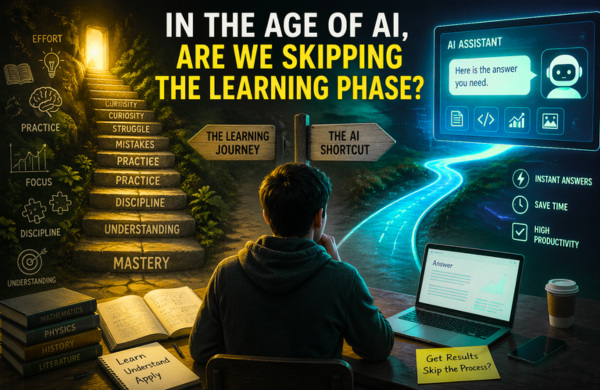
The Traditional Learning Journey
Before we dig into how AI is changing the learning process, it’s useful to reflect on how learning has traditionally worked. Learning or gaining knowledge has never been a linear or frictionless process. Instead, it involves struggle and confusion, trial and error, gradual accumulation of knowledge, deep engagement with concepts, time, and repetition.
It was never a simple process of acquiring information but was about building a mental framework, developing critical thinking, and cultivating problem-solving skills. It is the phase where understanding takes root, and often involves lots of patience and discomfort.
The traditional learning journey without AI is a lengthy one and relies on linear, instructor-led, and physically interactive methods, emphasizing cognitive effort, rote memorization, and structured, face-to-face classroom engagement.
Here are the core components of the traditional learning journey:
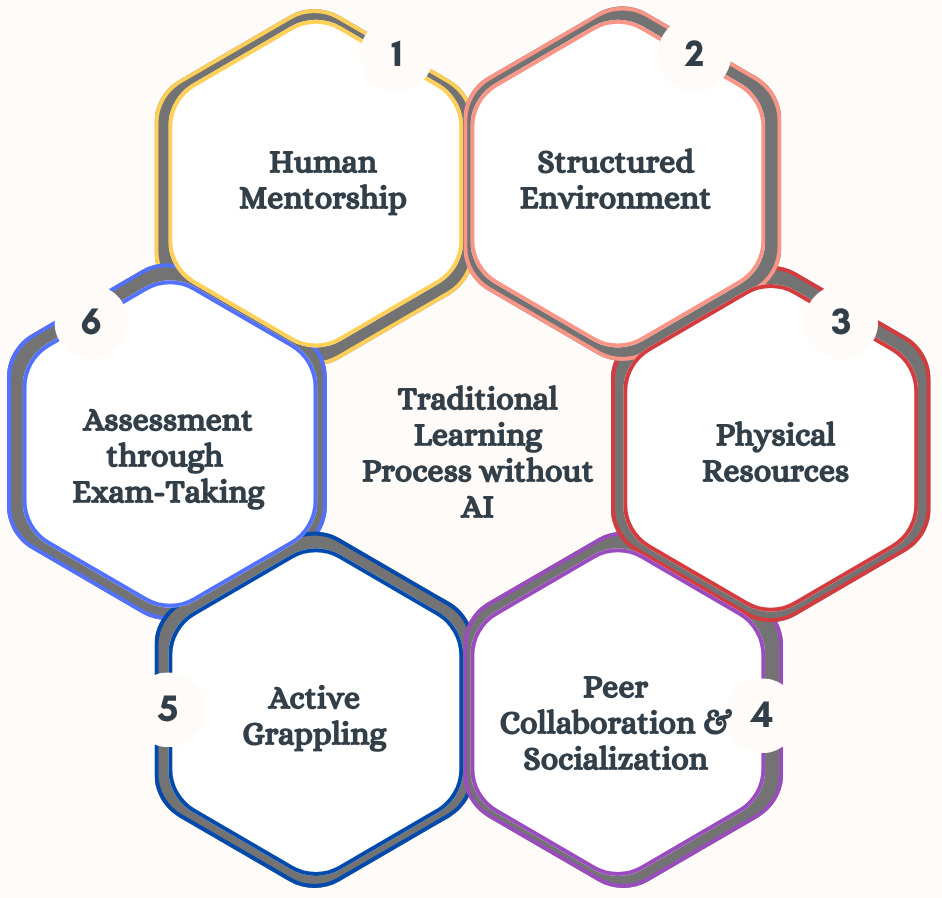
- Human Mentorship: Teachers or mentors (senior, experienced professionals) are the primary source of knowledge. They lecture and guide students through a structured curriculum.
- Structured Environment: Traditional learning is scheduled and takes place in physical classrooms, conference rooms, or labs, promoting discipline and routine.
- Physical Resources: Learners utilize textbooks, libraries, encyclopedias, printed notes, and physical lab equipment to conduct research and experiments.
- Peer Collaboration & Socialization: Learning requires face-to-face interaction, group studies, and in-person discussions to build teamwork skills.
- Active Grappling: Students have to learn through the personal struggle of solving problems, brainstorming, and writing assignments from scratch, bringing in genuine cognitive development.
- Assessment through Exam-Taking: Memorization and understanding of a particular topic/subject is then measured with high-stakes, in-person examinations, with feedback often coming days or weeks later.
- Human Connection: No technology can match the emotional support provided by mentorship from teachers and professionals, which fosters resilience and empathy.
- Deepened Understanding: Without a way out, students “grapple” with concepts, which can lead to deeper long-term understanding and higher-level cognitive skills.
- Discipline and Focus: Instead of self-paced, online, or AI-based learning, there is a set, in-person routine that reduces distractions.
- Soft Skill Development: Face-to-face interaction helps develop soft skills, including communication, emotional intelligence, and teamwork.
AI as a Shortcut to Answers
- Ask AI to explain any concept or logic instantly
- Get completed assignments or projects directly using an AI tool without putting in any effort.
- Receive step-by-step solutions to any problem without attempting to solve it first
- Automate creative and analytical tasks directly using AI without using one’s own critical thinking ability
- Simulate real-world challenges and roleplay scenarios using AI tools
- Dependency and Reduced Learning: By relying on AI for learning, learners skip the hard work of coding, writing, or solving problems on their own. This leads to a superficial understanding.
- Reduced Retention & Persistence: Learners cannot persist when tasks are difficult, and subsequently, their independent, long-term performance is decreased as they are used to getting quick answers from AI.
- Blind Trust: With overreliance on AI, learners tend to uncritically accept incorrect or biased answers (AI hallucinations).
- Lazy Learning: Rather than viewing AI as a partner, learners see it as a replacement for effort, leading to a fixed mindset.
- Validate Inputs: Verification of AI inputs requires critical thinking.
- Focus on the Process: Assessments should not focus solely on the final output, but assess how the learner arrived at an answer, using AI to aid in drafting and brainstorming.
- Use Prompt Engineering: Using prompts requires critical thinking on how to correctly structure the prompts to get the best answers.
Ultimately, when AI is used as a learning companion, it helps learners understand why something works rather than just what the answer is.
In general, when the emphasis moves from process to outcome, the learning phase becomes optional or even bypassed entirely.
Next, we will discuss several aspects and how they affect when using AI in the learning process.
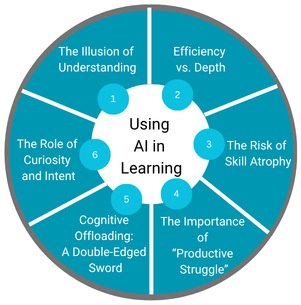
The Illusion of Understanding
When learners use AI to seek answers, it provides clear, polished answers that create an impression that the user understands the material, even when in reality they don’t. This leads to a “copy-paste” habit that results in minimal cognitive growth. This is a significant risk in the AI era and is called the illusion of understanding or shallow understanding.
- When you read an AI-generated explanation, you may feel like it is a comprehension, but in reality, without any active engagement, the knowledge retention is often shallow.
- If AI generates a working program for you, it does not mean you understand how or why it works.
- When you write an essay using AI, it may generate a high-quality output, but it does not develop your writing skills.
From the above examples, we can infer that what we are creating here is just an illusion of understanding. We are relying on borrowed intelligence of AI. This is an unrecognized ignorance, and when learners believe they understand something they don’t, they are less likely to question, explore, or learn further.
Efficiency vs. Depth
Using AI is efficient as it reduces time, effort, and cognitive load. However, when it comes to learning, it requires time, effort, and cognitive load.
- Efficiency (getting results quickly)
- Depth (understanding concepts thoroughly)
When it comes to many real-world scenarios, efficiency is valuable. Professionals, especially in the software field, use tools to save time, automate repetitive tasks, and focus on higher-level thinking. However, in the learning process, skipping foundational understanding can be detrimental to learners, especially beginners.
- Using translation tools may help you communicate quickly, even if you have to talk about complex sentences.
- However, when you translate, you just get the output directly. You do not practice grammar, vocabulary, and structure. Hence, fluency remains out of reach.
Similarly, in fields like mathematics, programming, or science, skipping early steps weakens the entire structure.
The Risk of Skill Atrophy
Skill atrophy (Skill Decay) is one of the legitimate concerns individuals face with too much AI use. In this, individuals, even experts, face a gradual loss of abilities due to disuse.
- Practice less
- Rely more on automation for readymade answers
- Lose confidence in your own abilities
However, this is the phenomenon that often occurs when new technology is launched. For example, calculators reduced the need for mental arithmetic, and GPS reduced navigational skills. AI operates at a much broader cognitive level and affects a wider range of skills.
- You can use AI to enhance productivity
- However, maintain enough practice and practical knowledge to retain core competencies
If you don’t strike this balance, you may risk becoming overly dependent on systems you don’t fully understand.
The Importance of “Productive Struggle”
Learning is always perceived as a productive struggle, a concept that difficulty and effort are essential for deep learning and acquiring knowledge.
- They build resilience and determination
- They develop problem-solving skills
- They form stronger neural connections
When AI provides you with immediate answers, this productive struggle is completely eliminated. This is not at all an effective learning experience, though it reduces frustration.
Therefore, you can manage this productive struggle intelligently instead of eliminating it.
- Use AI as a guide, not a support or crutch you rely on completely
- Try to solve problems before seeking solutions
- Do not accept answers blindly; reflect on them first
Cognitive Offloading: A Double-Edged Sword
Humans have always used physical actions or external tools, such as writing notes, setting reminders, or using AI, to reduce the mental effort required for tasks. This is cognitive offloading.
- It reduces mental burden
- It provides faster access to information
- Productivity is increased
- Cognitive offloading reduces internal knowledge retention
- It results in weaker memory and recall
- You have less practice in critical thinking
Hence, you have to draw a line and analyze: how much cognitive offloading is too much.
The Role of Curiosity and Intent
Ultimately, it is the user who decides whether AI leads to skipped learning.
- One learner may use AI to avoid effort and get quick results
- Another may use it to explore, question, and deepen understanding
The difference lies in Curiosity, Intent, and Discipline of the individual.
If you approach AI with a learning mindset, it is a powerful educational companion. However, if your approach is to use it as a shortcut, it can hinder development.
The Changing Role of Education
Educational systems are now struggling to adapt to this shift from traditional learning to AI-based learning. The traditional models based on memorization, repetition, and standardized assessments are increasingly misaligned with the modern world, where AI can perform these tasks instantly.
- If AI can perform most of these tasks, then what should students learn?
- How can you assess learning?
- What are the skills unique to humans?
- Critical thinking
- Problem framing
- Creativity
- Ethical reasoning
- Interpretation and evaluation of AI outputs
This is a combination of traditional and AI-based learning wherein AI becomes a tool rather than a replacement. Students are expected to collaborate with AI intelligently and not to compete with it.
- Explain Concepts: Ask “why” or “how” instead of just for the final answer.
- Debug/Verify Logic: Use AI to check the code or reasoning a human has already produced.
- Brainstorming: Generate ideas, then choose and refine them independently.
Are We Really Skipping Learning or Redefining It?
So, are we truly skipping the learning phase, or are we redefining what learning looks like?
- It can tailor interactive explanations to individual needs
- AI gives instant feedback and iteration
- It provides access to diverse perspectives and resources
- AI is useful in simulation-based learning environments
Using these correctly enhances your understanding.
- Passive use: When you accept answers without questioning
- Active use: In this, you engage, challenge, and build upon AI outputs.
When you use AI actively, learning doesn’t disappear; it shifts from doing everything manually to knowing how to guide and evaluate intelligent systems.
Conclusion
So, are we really skipping the learning phase in the age of AI?
The answer is not a simple yes or no.
- Short-circuit traditional learning processes
- Create illusions of understanding
- Encourage dependency and superficial engagement
- Enhance learning experiences
- Personalize education
- Accelerate mastery when used thoughtfully
So the real issue here is not the technology itself, but how we choose to use it.
If you use AI passively as a replacement for thinking, you risk losing essential cognitive skills. However. If you look at it as a partner in learning, one that challenges, supports, and extends your abilities, you can achieve a deeper understanding than ever before.
The learning phase is not extinct. It is evolving.
The responsibility now lies with us. It is we who ensure that in our pursuit of speed and efficiency, we do not abandon the very process that makes knowledge meaningful.
Frequently Asked Questions (FAQs)
- Is using AI for learning considered cheating?
Not necessarily. It depends on how it’s used. If AI is used as a support tool to enhance understanding, it’s beneficial. But if it replaces effort and critical thinking, it becomes a shortcut and eventually cheating.
- Can AI actually improve learning instead of harming it?
Yes. AI can personalize learning, provide instant feedback, and explain complex concepts in simpler ways, if used actively and thoughtfully.
- What is the “illusion of understanding” caused by AI?
It’s when users feel they understand a topic after reading AI-generated answers, even though they haven’t deeply engaged with or internalized the information.
- Does AI reduce critical thinking skills?
It can, if users passively accept outputs without their own opinion. However, if users question, analyze, and refine AI responses, it can actually strengthen critical thinking.
- What skills are becoming more important in the AI era?
Skills like critical thinking, problem-solving, creativity, adaptability, and AI literacy are increasingly important.
 |