
What is Software Architecture?
One of the most basic subjects that every software engineer, team leader, or architect should be knowledgeable about is software architecture. It links business needs with tangible implementation in a manner that is both abstract and incredibly useful. The definition of software architecture, its role in software engineering, the duties of a software architect, the importance of architecture, and important ideas, trends, and problems will all be covered in this blog.
We can’t depend on ad hoc hacks or code-level creativity alone to keep things manageable as software systems get bigger, more complex, and have higher user expectations. A blueprint that directs the system’s behavior, structure, and long-term development is what we require. We refer to that blueprint as software architecture.
| Key Takeaways: |
|---|
|
Software architecture defines the high-level structure of a system: its modules, interactions, and guiding principles.
|
To start, let’s establish the basics: what is software architecture?
What is Software Architecture?
A succinct response to the question “What is software architecture?” would be: Software architecture is the high-level structure of a system, the components, their relationships, and the principles guiding their design and evolution.
But that description is just the beginning. Let’s dissect it.
Architecture as Structure, Behavior, and Decisions
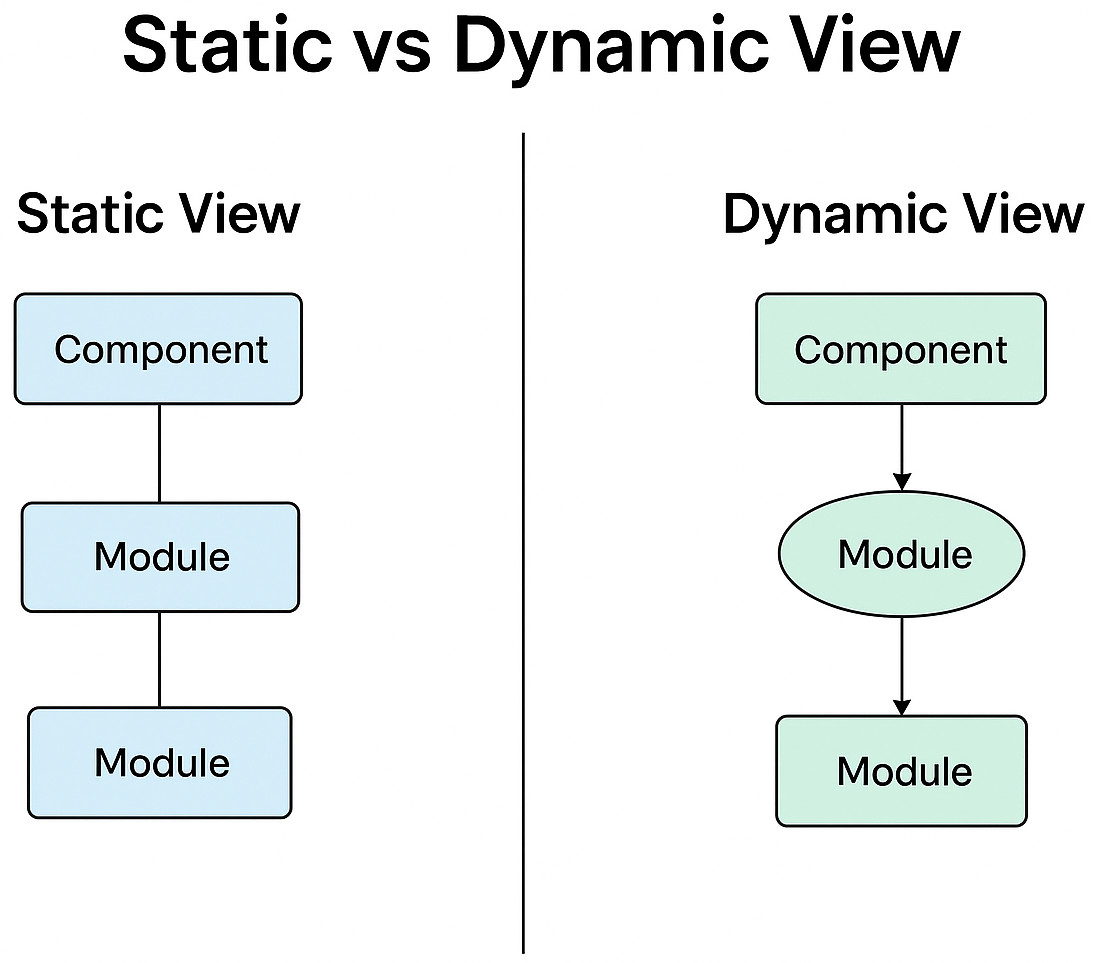
- Structure: Which subsystems, services, or modules are there? What limits do they have?
- Interactions and Relationships: How do these elements communicate with one another through events, synchronous calls, and messaging?
- Behavior: Which data and control flows are the most important throughout the system?
- Design Decisions and Constraints: What limitations, guidelines, or trade-offs apply to this structure?
Functional requirements (what the system does) and non-functional (quality) requirements (how well it does it: performance, reliability, scalability, etc.) are balanced in a good architecture.
Architecture vs Design
- Software design dives deeper into the implementation of specific components, algorithms, and data structures.
- Software architecture addresses only high-level structures, important choices, broad partitioning, and how parts connect.
In practice, decisions made at one level have an impact on those made at another, and architecture and design overlap. However, architecture serves as the framework for the intricate design.
Why “Architecture”?
The metaphor serves a goal. Similar to how the architecture of a building dictates load paths, structural integrity, and space allocation. Software architecture makes sure that the program can adapt to evolving needs, grow, and change without becoming too complicated.
Architecture as Expensive Decisions
Another helpful perspective is that architecture is about the big, costly choices that are difficult to undo later. After implementation, it is difficult to make changes to the modules, service boundaries, communication protocols, data models, and infrastructure choices.
“Architecture is about the important stuff. Whatever that is.” A well-known quote by Ralph Johnson.
Many discussions of software architecture echo this idea: long-term weight is attached to architecture decisions, while cheap decisions can be altered.
Software Architecture in Software Engineering
In software engineering, the term “software architecture” refers to the larger field of creating scalable, maintainable, and dependable software.
Role within the SDLC
- Before detailed coding is kick-started, architecture is usually established during the Software Development Life Cycle’s (SDLC) design phase.
- It serves as a roadmap that directs subsequent stages, entailing deployment, testing, integration, implementation, and maintenance.
- The architecture must change as the project progresses, ideally without sacrificing structure and coherence.
Abstraction, Decomposition, Composition
- Abstraction: Concealing minor details while revealing just enough information to allow for architectural reasoning.
- Decomposition: Breaking the system up into useful parts or modules.
- Composition: Arranging those modules so they work as a cohesive unit.
Addressing Complexity & Quality
One of the primary functions of architecture is to control complexity by keeping issues apart, establishing limits, and making sure that changes to one area don’t cascade uncontrolled into other areas.
Performance, resilience, scalability, security, maintainability, and other non-functional or quality attributes are also addressed in architecture.
Architecture as a Stakeholder Communication Tool
- Architect artifacts are consulted by operation teams, developers, testers, and architects.
- It ensures that technical execution and business goals are in line.
- Effective architecture documentation helps maintenance, manages change, and onboards new team members.
Thus, in software engineering, software architecture is not a secondary issue; rather, it is essential to making sure that the system sustainably meets both functional and non-functional objectives.
Explain Software Architecture: Core Concepts
Let’s assess software architecture’s fundamental components, characteristics, and methods of reasoning in more detail.
Architectural Elements & Components
- An interface: what it offers to other components.
- Dependencies: what it uses.
- Internal substructure (which is abstracted away at the architectural level).
- Constraints or invariants (rules).
Connectors or communication mechanisms, such as method calls, messaging, events, APIs, RPC, etc., are how components interact with one another.
Interfaces, Boundaries & Contracts
The decoupling of components is a major architectural concern. Separation of concerns is enforced by boundaries. Contracts and interfaces specify how one module can rely on another while concealing internal information.
Communication Patterns & Interaction Styles
- Event-driven or asynchronous messaging.
- Synchronous calls (such as REST, RPC).
- Streams/reactive pipelines.
- Publish/subscribe.
Latency, coupling, resilience, and complexity are all affected by the interaction style selected.
Data Flow and Control Flow
What is the system’s data flow? How do control signals or commands propagate? In order to maintain accuracy and performance, architectures must express these flows.
Quality Attributes (Non-Functional Requirements)
- Scalability: Can the system expand?
- Performance/latency
- Reliability/fault tolerance
- Availability/uptime
- Security/confidentiality/integrity
- Maintainability/modifiability
- Extensibility/flexibility
- Testability/observability/monitoring
Trade-offs between these qualities are nearly always a part of architectural decisions.
Views and Viewpoints
- Logical view (what modules and their relationships)
- Deployment view (how software is mapped onto infrastructure)
- Process / runtime view (how components behave over time)
- Use-case/scenario view
- Physical / infrastructure view
A traditional method for addressing stakeholder concerns is Kruchten’s 4+1 View Model, which uses five concurrent views.
A modern, lightweight method that uses hierarchical levels of context, container, component, and code views is the C4 model.
Architectural Styles & Patterns
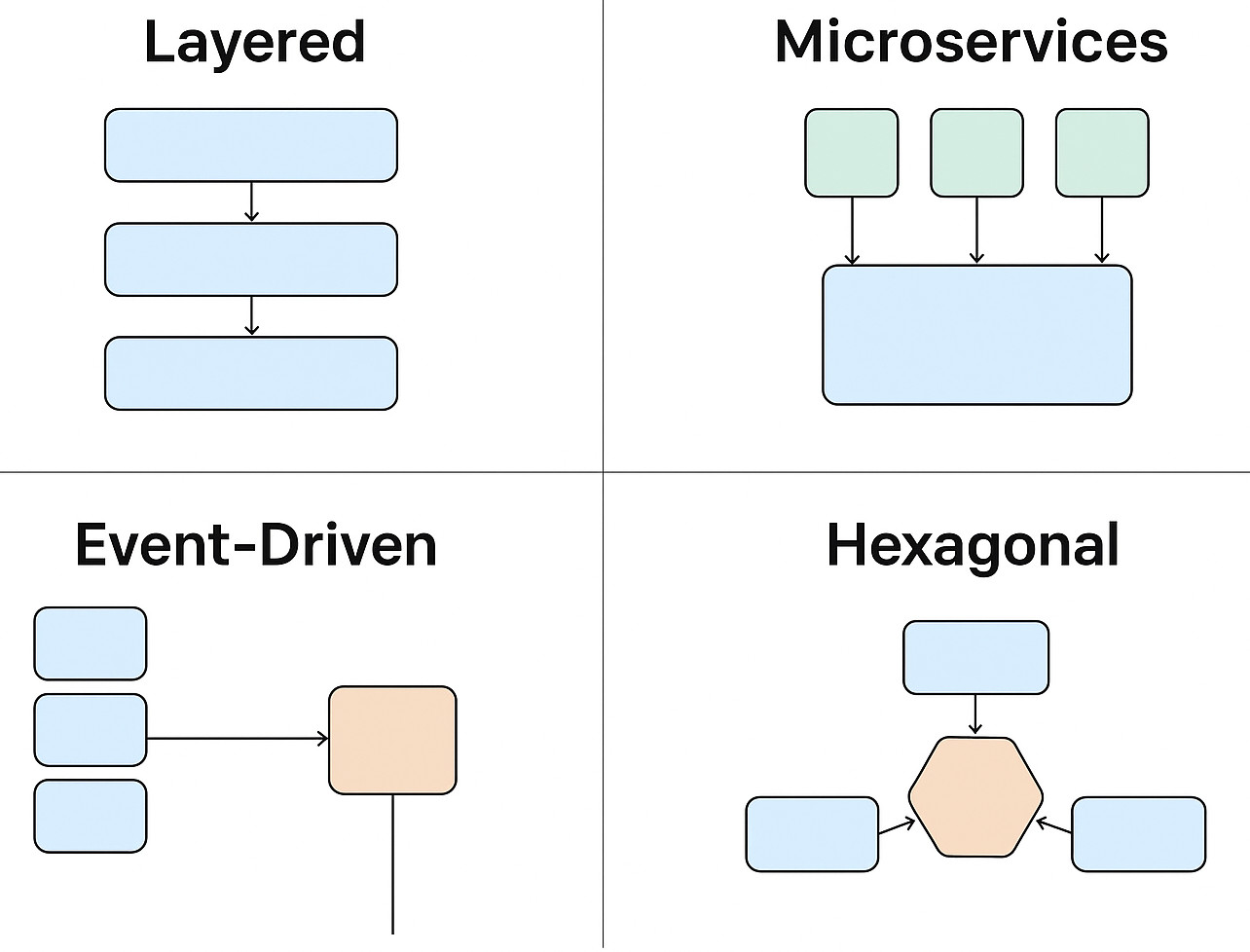
- Layered (Tiered) architecture — segregates into presentation, business, and data layers.
- Microservices Service-Oriented Architecture (SOA) — many small, independently deployable services.
- Event-Driven Architecture (EDA) — components communicate via events.
- Hexagonal/ports-and-adapters/clean/onion architectures — isolating core logic from external concerns (I/O, UI, databases).
- Microkernel/plugin architecture
- Space-based/data-centric architectures
- Modular monoliths (a monolith internally structured in modules).
Each style has advantages and disadvantages. The key is to match a style (or composite of styles) to your system’s needs.
Importance of Software Architecture
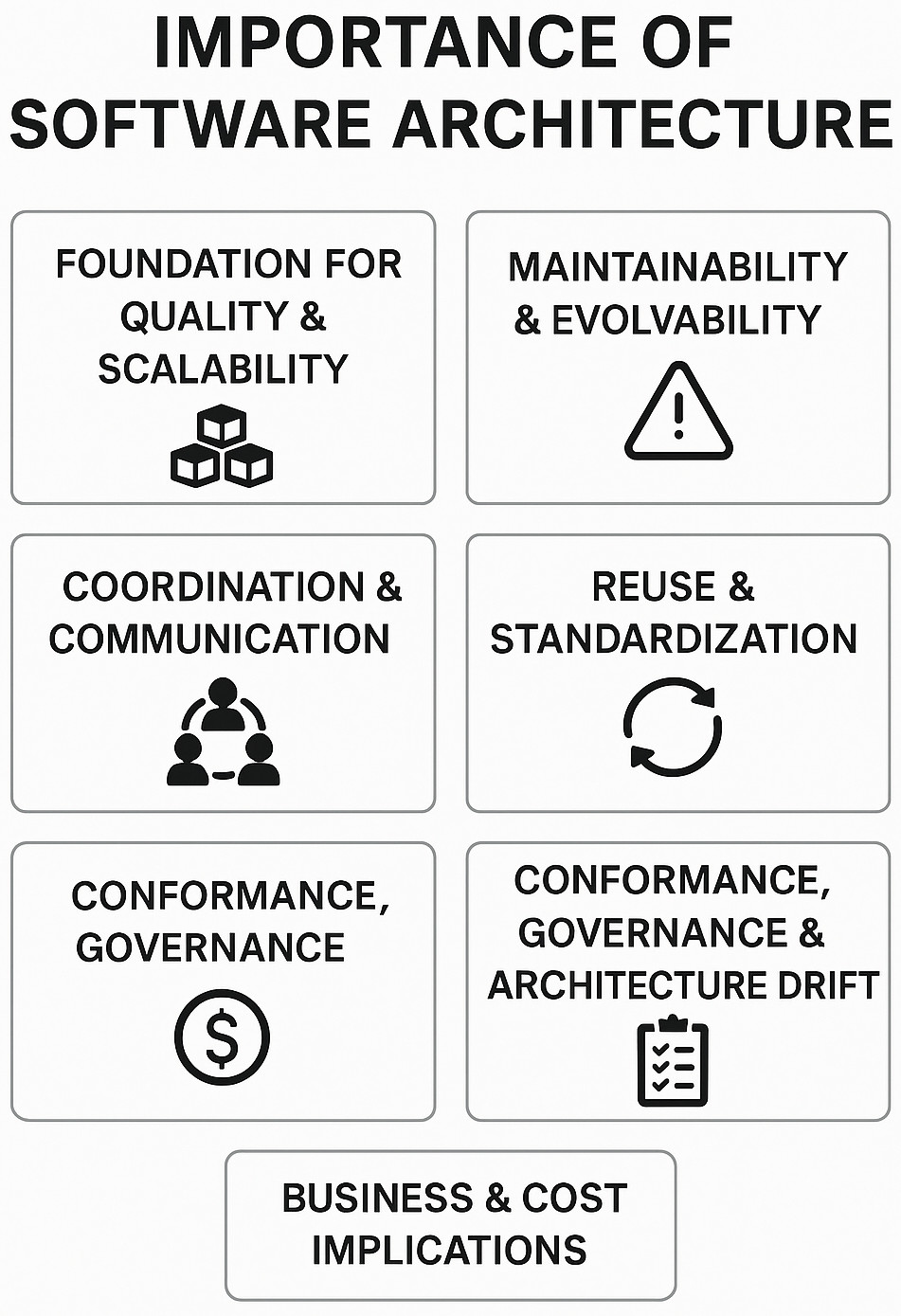
- Foundation for Quality & Scalability
- Maintainability & Evolvability
- Early Risk Mitigation & Prototyping
- Coordination & Communication
- Reuse & Standardization
- Conformance, Governance & Architecture Drift
- Business & Cost Implications
Architectural Patterns and Styles
Let us now take a look at some prominent architectural patterns and styles, along with the benefits and drawbacks of each.
Layered Architecture (N-Tier)
What it is: Layering the system (e.g., presentation, business logic, persistence). Every layer primarily interacts with its neighboring layers.
- Simple to understand and implement the separation of concerns.
- Suitable for medium-scale or monolithic systems.
- Clearly defined roles and boundaries.
- Layering may become a hurdle as the system scales.
- It may become rigid and deeply coupled if layers cross-invoke.
- It may experience performance overhead if data travels through multiple layers.
Read: What is Three-tier Architecture?
Microservices / SOA
What it is: A system made up of multiple tiny, independent services, each with its own data and domain logic, that are often deployed independently.
- End-to-end service ownership by teams.
- Supports scaling, resilience, and polyglot development.
- Strong modularity and independent deployability.
- Operational overhead.
- Requires strict discipline, monitoring, and inter-service communication design.
- Complexity inherent in distributed systems (latency, consistency, network faults).
Event-Driven / Message-Based Architecture
What it is: Asynchronous events or messages (publish/subscribe, event buses) are used by components to interact with one another.
- High concurrency is good for reactive systems.
- Loose coupling and asynchrony.
- Can buffer traffic spikes and decouple producers and consumers.
- More complicated debugging and error handling.
- Needs a strong message infrastructure.
- Harder reasoning about flows and eventual consistency.
Hexagonal (Ports & Adapters) / Clean / Onion
What is it: An architecture in which external concerns (such as UI, DB, and messaging) are connected by ports or adapters, while the core domain logic is isolated.
- Domain logic and infrastructure are decoupled.
- Testing the core is simpler.
- External systems can be altered more easily.
- Architects and developers need to discipline dependencies.
- The design is more complex up front.
Modular Monolith / Monolith with Modules
What is it: A monolithic deployment that is internally divided into modules with unique user interfaces.
- Simpler deployment (one executable).
- Modularity is maintained while distributed complexity is avoided.
- Microservices can be easily appended if needed.
- May deteriorate if modular boundaries are not properly upheld.
- Microservices may eventually be needed for scaling.
Other Patterns
- Microkernel/plugin architecture: Beneficial for systems needing expandability.
- Space-based architecture: Eliminating centralized hurdles for extremely high throughput and concurrency.
- Composite and hybrid architectures: Multiple styles are combined in many real systems.
Selecting the right style is often a contextual choice based on constraints, technology, team maturity, and requirements.
Key Challenges & Pitfalls in Software Architecture
- Choosing Too Much Too Early (Over-architecting)
- Underestimating Distributed Complexity
- Architecture Erosion / Drift
- Poor Documentation and Forgotten Decisions
- Misaligned Trade-offs
- Stakeholder Misalignment
- Legacy Systems & Integration
- Changing Requirements & Uncertainty
Evolving Architecture & Modern Trends
The architecture of software is dynamic. Let’s examine some of the latest developments and the ways that architecture is evolving.
Cloud-Native & Distributed Systems
A higher number of modern systems, such as microservices, containers, serverless Kubernetes, auto-scaling, and resilient distributed services, are being developed for cloud infrastructure. Architecture needs to support dynamic scaling, elasticity, and failure tolerance.
Automating Architecture Evaluation and Drift Detection
There are new tools and methods for analyzing impacts, identifying drift, and automating architecture conformance. Some include guidelines or “fitness functions” that keep track of whether system components follow architectural guidelines.
AI / LLMs in Architecture
The use of large language models (LLMs) to help with architectural tasks, such as building architecture sketches from requirements, finding design patterns, or categorizing design choices, has been investigated recently.
Although promising, completely automating architectural thought is still a difficult task.
Modular Monoliths & Hybrid Approaches
A modular monolith or hybrid architecture is used by many teams. It starts inside a monolithic boundary but implements clear module boundaries before branching out into microservices when necessary.
Observability, Resilience, Self-Healing Systems
Monitoring, logging, tracing, and automated recovery features (circuit breakers, fallback, replication) are often integrated into modern architectures as top priorities rather than afterthoughts.
Domain-Driven Design & Bounded Contexts
Domain-driven design (DDD) concepts are being utilized by architects more and more to break down big systems into bounded contexts, ensuring that services match domain boundaries and reduce coupling.
How to Start Thinking in Architecture
- Begin small and iterate.
- Develop diagrams in advance.
- Record rulings in ADRs.
- Create a critical path prototype.
- Discuss with stakeholders and peers.
- Implement modular boundaries.
- Create an evolution plan.
- Keep monitoring and refactor.
- Remain informed and never stop learning.
Conclusion
What software architecture is, how it fits into software engineering, the role of the software architect, fundamental ideas, patterns, difficulties, and modern trends have all been covered in this comprehensive guide.
Since architecture is the base that keeps complex software systems cohesive over time, it cannot be ignored. Effective architectural choices increase the speed of development, reduce technical debt, and improve the scalability, maintainability, and robustness of systems. However, architecture is also a craft that involves constant attention to detail, changing requirements, and trade-offs.
 |