
What Is Back End for Front-End (BFF)? Understanding the BFF Architecture Pattern
Software today is no longer equivalent to a single-platform solution. People access applications from a variety of devices — from desktops to mobile phones and tablets, even smartwatches. Each implementation on any platform should provide a custom experience with specific interface considerations and performance optimizations. This has created a new architectural design pattern — Back-End for Front-End (BFF).
| Key Takeaways: |
|---|
|
This article provides a detailed explanation of the BFF pattern, discussing its use cases, benefits, challenges, and best practices for implementation.

Basics of Back-End for Front-End Pattern
The Traditional Approach: A Single Backend for All Clients
Traditional applications rely on a monolithic or shared backend API that serves all client interfaces. For example, a web API serving a web client as shown below:
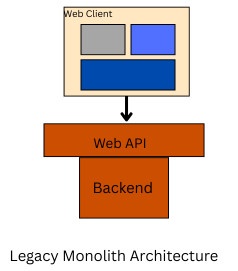
This works smoothly as long as there is only one interface. However, there is a requirement to add a mobile interface to the application, specifically for Android and iOS systems. With monolithic architecture, a single web API must support these multiple interfaces. While this seems convenient, this will lead to problems as applications scale and client requirements diverge. In such situations, it is challenging to maintain this system.
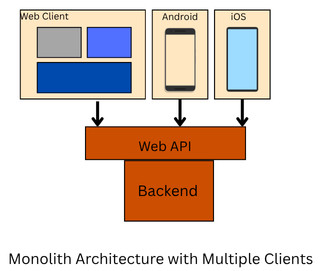
This is because different front-end clients require different data shapes, frequencies, and authentication mechanisms. A web client might request detailed data for large screens, while a mobile interface may prioritize smaller payloads to optimize bandwidth and battery use.
When a single, shared backend accommodates all these demands, it results in bloated endpoints, complex conditional logic, and slower development cycles.
The best solution to this is the BFF.
The BFF Architecture: Tailored APIs for Each Client
The Back-End for Front-End approach solves the above situation by creating a dedicated backend layer for each client or frontend type. A typical BFF architecture to solve the situation narrated above looks like this:
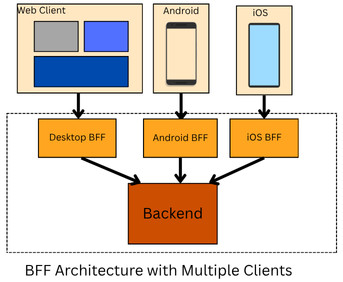
- A Web BFF for the browser interface
- A Mobile BFF for iOS/Android apps
As you can see, each BFF communicates with shared backend services (microservices, databases, or APIs) but accesses data and logic explicitly tailored for its frontend.
Why the BFF Pattern Exists
In modern applications that support multiple client interfaces, such as web, mobile, tablets, and smartwatches, it becomes challenging to have a monolithic setup that caters to various interfaces through a single API. The BFF pattern provides a bridge between the client interface and the backend by offering tailored APIs that cater to each client’s specific needs.
The following are the reasons the BFF pattern is essential for modern applications:
1. Diverging Front-End Needs
The requirements for distinct user flows, feature sets, and data formats vary for each platform. For instance, a mobile app might require compressed images and limited data to achieve optimal speed, while a web dashboard could demand extensive datasets for analytics visualization.
Without a BFF, developers must write excessive logic on the front-end or maintain cumbersome conditional code in a shared API to fulfill these requirements from mobile and web platforms.
2. Separation of Concerns
Each of these interface clients will have a BFF layer, which allows the teams to decouple front-end-specific code from their core business services. This implies that your front-end teams are free to work in silos, iterating fast on UX/UI, while the back-end services are stable and focused on core business logic.
3. Security and Access Control
Along with different functional requirements, various clients may have distinct security needs. For example, a web client may use OAuth flows, while a mobile app might use tokens with shorter lifetimes. These variations can be handled securely only with a BFF architecture. A BFF can prevent direct access to internal services and enforce access control at a higher level.
4. Performance Optimization
Each BFF is customized for its frontend, and it can optimize API responses, minimizing data transfer, caching frequently used data, and aggregating responses from multiple services into a single payload. As a result, performance is significantly enhanced, particularly for mobile and low-bandwidth users.
How the BFF Architecture Works
High-Level Overview
A high-level architectural overview for BFF is shown below:
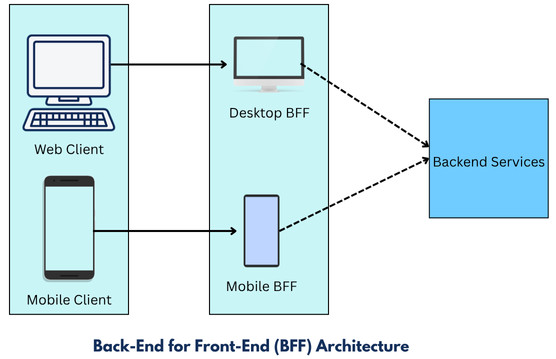
- Authenticates the request.
- Orchestrates calls to multiple services.
- Aggregates and transforms data.
- Sends a simplified, frontend-ready response.
Example Scenario
- The Web App (opened in a web browser on a desktop) displays product details, user reviews, and complex filters.
- The Mobile App focuses on lightweight browsing and quick checkout.
- Web BFF: Aggregates data from the product, review, and recommendation services.
- Mobile BFF: Fetches essential data only, optimizes payloads, and handles mobile-specific authentication.
Both BFFs consume the same backend microservices but serve distinct purposes.
Real-World Examples
- Netflix: BFFs are used to customize experiences across smart TVs, mobile apps, and browsers, optimizing performance and UI-specific data.
- Spotify: This firm utilizes dedicated backend layers for each platform, thereby reducing data load times and enhancing UX consistency.
- Airbnb: The travel company uses BFFs to isolate web and mobile concerns, enabling independent frontend iterations.
These companies demonstrate BFF’s potential to empower teams to move faster while maintaining flexibility and control over user experiences.
Benefits of Using a BFF
- Improved Developer Velocity: Teams can independently build and deploy their own BFF for each frontend. This results in faster iteration, experimentation, and parallel development, eliminating the need to wait for changes in shared APIs.
- Cleaner APIs and Codebases: By introducing a BFF layer, frontend-specific concerns such as data shaping and caching are abstracted away from backend microservices. These business services are kept clean, allowing them to focus solely on business logic, while BFF handles the client presentation logic.
- Enhanced Performance and User Experience: BFF delivers data optimized for each client, reducing network latency, improving load times, and enhancing responsiveness, especially for mobile or edge devices.
- Flexibility for Future Platforms: Applications with the BFF layer are easily scalable and flexible. Thus, if the organization later develops a new interface (for example, a smart TV app or voice assistant), it is simple and easy to create a new BFF for it without changing existing backends or clients.
- Stronger Security Model: For backend services, BFF acts as a gatekeeper. They can implement custom authentication, rate limiting, input validation, and request sanitization, minimizing exposure and risk.
Common Challenges and Trade-Offs
- Increased Infrastructure Complexity: Introducing multiple BFFs results in managing more services, deployment pipelines, versioning, scaling each independently, and monitoring. This results in operational overhead, particularly for small teams.
- Duplication of Logic: Although different BFFs have distinct functionalities, certain logic, such as authentication methods or error handling, may be repeated across these BFFs. This duplication may lead to maintenance headaches if not properly governed.
- Coordination Between Teams: Any change in underlying services requires coordinated updates across all BFF layers. For this purpose, proper documentation and versioning are essential.
- Potential Latency Issues: The BFF must be designed efficiently; otherwise, it may introduce an extra network hop, resulting in added latency. Efficient orchestration and intelligent caching are essential.
Best Practices for Implementing a BFF
- Design BFFs by Frontend Type, Not Per Device: Design a BFF around frontend types, such as web, mobile, tablet, or external API, to make your application flexible and maintainable. Avoid creating a BFF for every minor variation of your frontend.
- Keep BFFs Lightweight: A BFF should not contain heavy business logic; instead, it should primarily orchestrate and transform data. Business logic should be part of backend domain services.
- Use GraphQL or Aggregation Techniques: Use technologies like GraphQL, gRPC, or API Gateway aggregations to make BFFs more efficient by enabling precise data fetching and reducing over-fetching or under-fetching.
- Automate Deployment and CI/CD: Each BFF is to be treated as a microservice with its own CI/CD pipeline. Hence, automate testing, linting, and deployment for each BFF to avoid integration bottlenecks.
- Implement Monitoring and Observability: Include logging, metrics, and tracing for each BFF to identify performance bottlenecks, failed requests, and issues across the stack.
- Share Common Libraries: Extract shared logic, such as error handling/formatting, authentication, and logging, into reusable libraries to prevent code duplication. All BFFs can consume this shared logic.
BFF in the Microservices Architecture Context
Microservices focus on decomposing backend functionality into small, reusable, and independent services. The BFF pattern naturally fits into this microservices architecture, as it provides a client-centric gateway to these services.
BFF vs API Gateway
- API Gateway: Manages routing, rate limiting, load balancing, and service discovery for all clients. It’s a generic entry point.
- BFF: Provides client-specific logic and data transformation for a specific frontend.
In many architectures, the BFF is placed behind the API Gateway, combining the scalability of gateways with the flexibility of client-specific backends.
When Not to Use a BFF
- There is a single frontend consuming the backend.
- The backend already provides well-optimized APIs suitable for all client platforms.
- The team is small and cannot effectively maintain multiple BFFs.
In these cases, a well-designed REST or GraphQL API may be a sufficient alternative to a BFF.
Future of BFFs
As frontend ecosystems evolve with newer technologies/frameworks like React Native, Flutter, Progressive Web Apps, and IoT devices, the BFF pattern will continue to gain prominence. The trend toward micro frontends further reinforces the need for backend layers that serve specific UI modules efficiently.
Additionally, serverless architectures and edge computing are transforming the deployment of BFFs. Modern BFFs can now live as lightweight, event-driven functions, scaling automatically with demand while minimizing latency.
Conclusion
The Back-End for Front-End (BFF) architectural pattern offers a pragmatic solution to the challenges of multi-platform development in modern applications. By creating dedicated backend layers for each frontend type, organizations can simplify frontend development, optimize performance and data delivery, and strengthen the application security.
However, for a BFF to be successful, it requires a disciplined implementation, maintaining lightweight logic, enforcing clear boundaries, and automating operations. When implemented effectively, the BFF pattern becomes a vital enabler of scalable, maintainable, and user-centric application design.
A BFF pattern stands as one of the most effective ways to deliver tailored, high-performing applications that genuinely meet the needs of every platform, a crucial requirement in today’s world.
 |