
Top 25 DevOps Interview Questions and Answers for 2025: Prepare for Your Next DevOps Role
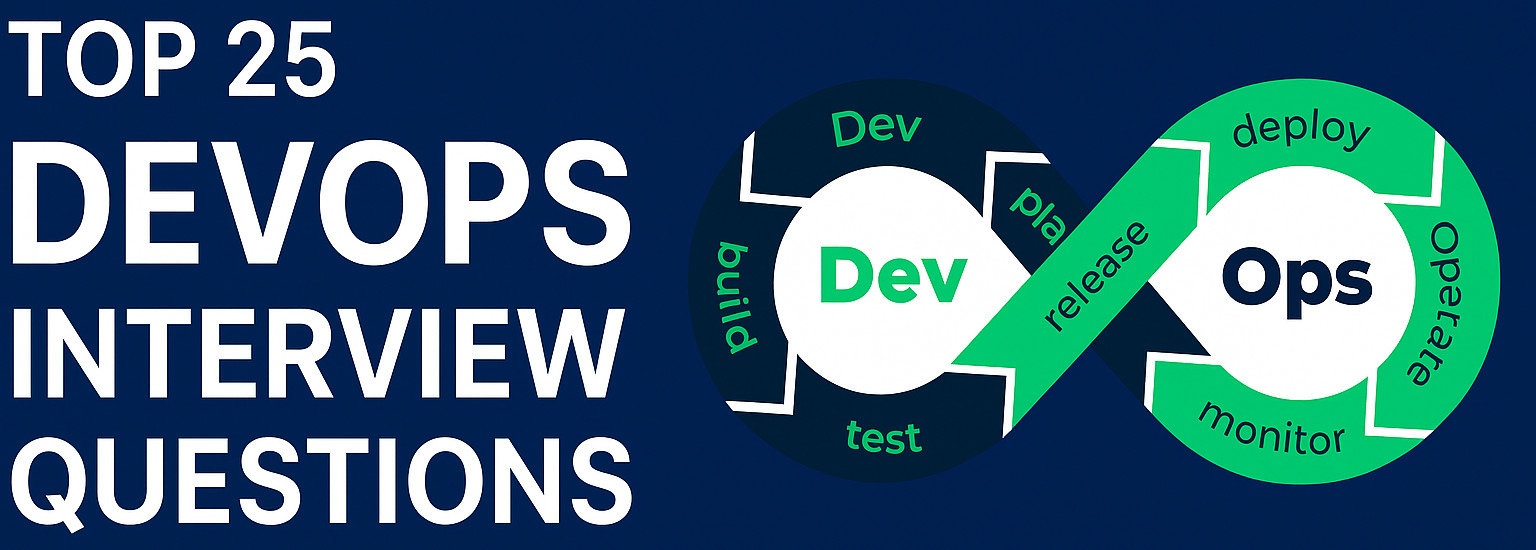
Having a clear understanding of DevOps practices is becoming more and more important in the fast-evolving software industry of today. A DevOps engineer should be well-versed in automation, infrastructure, culture, teamwork, and continuous feedback, along with tooling. Whether you are preparing or conducting a DevOps interview, this list of the common 25 questions will help you hone your answers, predict what the recruiters may ask, and focus your thoughts.
The questions below are followed by a Suggested Approach (a possible format for the response) and a Sample Answer (a short example response that you can alter as needed). Leverage these to build more in-depth answers that are based on your personal experience and background.
DevOps Interview Questions and Answers
What is DevOps and why is it important?
Suggested Approach: Give a definition first, then emphasize how it will accelerate delivery, improve quality, and encourage teamwork.
Sample Answer: DevOps is a collection of procedures that brings together IT operations (Ops) and software development (Dev) to automate and improve the build-test-release process. It helps boost team collaboration, reduce failure recovery time, and increase deployment frequency. It is critical because organizations can deliver software faster, reliably, and with lower risks by eliminating silos, enabling automations (like CI/CD), and integrating monitoring and feedback.
How is DevOps different from Agile methodology?
Suggested Approach: Clarify the difference between DevOps and Agile. Highlight that DevOps is more than just a development method. It is the use of culture, practices, and tools throughout the lifecycle.
Sample Answer: Agile is a development method that prioritizes iterative development. It delivers software increments more regularly and reacts to change. DevOps expands the perspective by integrating operations, deployment, feedback, and infrastructure.
In other words, DevOps concentrates on the full lifecycle, from planning and coding to operations and monitoring, whereas agile focuses on how development takes place. DevOps emphasizes continuous value delivery, automation, and cooperation between Dev and Ops.
What are the phases of the DevOps lifecycle?
Suggested Approach: List the critical phases (Plan à Code à Build à Test à Release/Deploy à Operate à Monitor) and succinctly describe their features.
Sample Answer: The following phases make up a typical DevOps lifecycle.
- Plan: Specify features, sprints, requirements, and backlog.
- Code: Write the code and keep it under version control.
- Build: Gather, package, and produce artifacts.
- Test: Verify quality, conduct integration tests, and run automated tests.
- Release/Deploy: Put the code into environments that are pre-production or production.
- Operate: Manage, scale, and configure the operational system in production.
- Monitor: Observability, logging, and feedback loops.
These stages often loop continuously as compared to linearly, allowing for fast iteration and feedback.
What is Continuous Integration (CI) and Continuous Delivery/Deployment (CD)?
Suggested Approach: Define CI and CD, clarify the difference between delivery and deployment, and emphasize the benefits.
Suggested Answer: Continuous Integration (CI) is the process of automatically creating and testing code changes, along with frequently integrating them into a shared repository. This detects integration problems early. Continuous Delivery (CD) ensures that the codebase is always in a deployable state by using the output of Continuous Integration (CI) to allow releases at any given time.
The next phase is Continuous Deployment, in which all changes that pass automated testing are automatically pushed to production without needing manual approval.
CI/CD pipelines work together to deliver software faster, reliably, and consistently.
What is infrastructure as code (IaC), and why is it essential in DevOps?
Suggested Approach: Give an explanation of IaC. List its benefits and offer examples of common tools.
Sample Answer: Instead of using manual configuration, Infrastructure as Code (IaC) uses machine-readable definition files to define and provision infrastructure (servers, networks, and storage). It is critical to DevOps because it aids in version control of infrastructure, automated provisioning, consistency across environments, and iterative deployments. Common tools include Terraform, Ansible, and CloudFormation.
What is the difference between containers and virtual machines?
Suggested Approach: Compare architecture, kernel sharing, resource utilization, startup time, and portability.
Sample Answer: On virtualized hardware, a virtual machine (VM) mimics an entire operating system. Each VM has its own virtual hardware and OS kernel. Applications are made lighter, faster to initiate, more portable, and more resource-efficient by utilizing containers. These isolate them in the user space and share the host OS kernel. While virtual machines (VMs) still have benefits for full-sandbox isolation and legacy setups, containers are ideal for microservices and portable workloads.
What is container orchestration, and why is it necessary?
Suggested Approach: Describe orchestration, talk about container scale and management concerns, and mention tools like Kubernetes.
Sample Response: The automated deployment, scaling, networking, and management of containers is called container orchestration. Manual management becomes non-feasible as organizations deploy hundreds or thousands of containers. Scheduling containers on nodes, scaling them up or down, self-healing (restarting failed containers), and load-balancing are all automated by orchestration tools such as Kubernetes. This makes containerized architectures scalable and resilient.
What is version control, and why is it foundational in DevOps?
Suggested Approach: Explain version control and mention branching strategies, distributed systems, and teamwork.
Sample Answer: Version control is a system that monitors code, configuration, and script modifications over time, allowing teams to work together, undo changes, and manage history. Version control, especially distributed systems like Git, is fundamental to DevOps because it aids collaboration, repeatability, and traceability by regulating infrastructure, application code, tests, pipelines, and configuration.
What is “shift-left” and how does it apply to DevOps?
Suggested Approach: Describe shift-left (early testing, security, etc.) and highlight its benefits.
Sample Answer: The process of shifting tasks such as testing, security checks, and performance evaluation earlier in the software development lifecycle. It is closer to the planning and code stages, and is called “shift-left”. This leads to faster feedback loops, improved quality, decreased remediation costs, and proactive defect identification in DevOps. For instance, the shift-left strategy is to automate security scans, static analysis, and unit tests early in the CI pipeline.
What are some popular DevOps tools and their roles?
Suggested Approach: Provide a brief list categorized by area (version control, CI/CD, IaC, container).
Sample Answer:
- Version Control: Git (GitHub, GitLab)
- CI/CD: Jenkins, GitLab CI/CD, CircleCI, Azure DevOps
- Containerization: Docker
- Orchestration: Kubernetes
- Infrastructure as Code: Terraform, Ansible, CloudFormation
- Monitoring & Logging: Prometheus, Grafana, ELK (Elasticsearch, Logstash, Kibana)
Each tool plays a key role in automating and scaling parts of the DevOps workflow.
What is a build pipeline (or deployment pipeline) and why is it important?
Suggested Approach: Define the pipeline, list the phases (build, test, and deploy), and highlight the advantages (automation, speed, and feedback).
Sample Answer: Code goes through an automated series of steps known as a build or deployment pipeline. This includes code commit, build, test, deployment, and monitoring. It is important, as it ensures a consistent, iterative, and auditable release. It aids continuous software delivery, reduces manual error rates, automates repetitive tasks, and gives rapid feedback on code changes.
What are monitoring and logging in DevOps, and why are they critical?
Suggested Approach: Explain the difference between monitoring and logging, and bring up metrics, alerting, and observability.
Sample Answer: While logging points to gathering complete event and transaction data (logs) for audit, debugging, and insight, monitoring is the process of continuously tracking system metrics, like CPU, memory, response times, and error rates.
They are important to DevOps because, after software is deployed, it is necessary to keep an eye on its condition, check for irregularities, handle issues, and leverage the data to optimize the system. Observability ensures that you understand the behavior of the system in production, helping in rapid recovery and ongoing enhancement.
What is a deployment strategy (e.g., blue/green, canary), and when would you use one?
Suggested Approach: Describe each main tactic, include a list of benefits and cons, and include an example.
Sample Answer:
- Blue/Green Deployment: Launch the blue and green production environments, which are identical. After the new version has been validated, traffic is switched between them, reducing the possibility of downtime.
- Canary Deployment: First, show the new version to a small group of users (the “canary”), track their behavior, and, if successful, expand the rollout.
These methods are used when high availability is needed, failure risk is reduced, and safe production testing of new code is needed.
What is microservices architecture, and how does it relate to DevOps?
Suggested Approach: Explain the differences between microservices and monoliths and highlight how DevOps fits in (smaller deployable units, independent scaling).
Sample Answer: An application is organized using a microservices architecture as a group of loosely coupled, independently deployable services, each of which concentrates on a unique business domain. A monolithic application, on the other hand, is a single unit that includes all of its functionality in one package. DevOps and microservices work well together. This is because microservices enable small teams to develop, test, and launch independently. It aids quicker release, simpler scaling, and stronger systems.
What is GitOps?
Suggested Approach: Explain what GitOps is and how it is connected to infrastructure automation and DevOps.
Sample Answer: GitOps, a DevOps method in which Git is the only source of truth for infrastructure and application code. Pulls to Git initiate automated pipelines that balance the desired and actual states of the system. GitOps utilizes version control for infrastructure and deployment configuration, and automation tools (such as Argo CD and Flux) ensure that the live environment is aligned with the declared state. This enhances repeatability, auditability, and transparency.
How would you handle secrets management in a DevOps environment?
Suggested Approach: Mention best practices, like using vaults, environment variables, secret rotation, and avoiding hard-coded credentials.
Sample Answer: Never directly embed secrets (like database passwords, API keys, or certificates) in code. Examples of best practices include role-based access control (RBAC) for secret access, automating secret rotation, using environment variables or encrypted files, storing secrets in a protected vault (like HashiCorp Vault or AWS Secrets Manager), and auditing secret usage. Automated, manageable, and secure deployment is guaranteed by integrating secrets into CI/CD pipelines.
What metric(s) would you use to measure the success of DevOps initiatives?
Suggested Approach: Use metrics such as change failure rate, mean time to recovery (MTTR), deployment frequency, and lead time for changes.
Sample Answer: The following are key indicators of DevOps success:
- Deployment Frequency: how often the team deploys to production.
- Lead Time for Changes: the time from code committed to code running in production.
- Change Failure Rate: percentage of changes causing failures.
- Mean Time to Recovery (MTTR): how quickly the system recovers from failures.
Monitoring these metrics helps organizations verify if DevOps practices are delivering faster, more reliable changes.
Explain the difference between horizontal scaling and vertical scaling.
Suggested Approach: Define both and analyze the trade-offs (cost, availability, and complexity).
Sample Answer:
- Vertical Scaling: Increases a single machine’s capacity (e.g., by adding more CPU or RAM).
- Horizontal Scaling: Adding more machines or instances to share the load.
As it provides redundancy, high availability, and elastic resource utilization, horizontal scaling is the best fit for distributed, cloud-native, or containerized systems. Despite its simplicity, vertical scaling has limits and is a single point of failure.
What is immutable infrastructure?
Suggested Approach: Explain the idea, describe its benefits (ease of rollback, consistency), and discuss how it works in DevOps.
Sample Answer: When a server or environment is deployed, it is never modified. Instead, a new version is built and replaced whenever changes are needed. This is called immutable infrastructure. In comparison, conventional mutable servers are updated in real time. Consistency between deployments, simpler rollback (just switch to the prior image), and fewer configuration drift issues are among the benefits. It meets the automation and iterative pipelines principles of DevOps.
How do you prioritize what to automate in DevOps?
Suggested Approach: Demonstrate how to examine value, risk, frequency, ROI, and manual labor.
Sample Answer: Prioritize automation by taking into account the following factors:
- Frequency: How often the task is repeated?
- Risk/Impact: What is the cost of manual error or downtime?
- Manual effort: How much time and resources does manual work consume?
- Stability: Is the process stable enough to automate, or still subject to frequent changes?
Automate high-frequency, high-risk, high-manual-effort tasks first, while maintaining flexibility for changing processes.
Explain rollback vs rollback-free deployments; when would you choose each?
Suggested Approach: Describe the rollback strategy, compare the benefits and cons, and also provide an example.
Sample Answer: Rollback deployment is the process of reverting to a previous version after a failure is detected. Solving the problem and continuing to deploy without reverting is called a rollback-free (or forward fix) method. When the new version is fully faulty and needs to be replaced right away, use rollback. When the issue is isolated, the fix is minor, and the overall risk is low, use rollback-free. The decision is based on the type of fix, user impact, and risk tolerance.
What role does security (DevSecOps) play in DevOps?
Suggested Approach: Emphasize integration of security practices, such as “shift-left” security, automation, scanning, and compliance, into DevOps workflows.
Sample Answer: An important component of DevOps must be security. Static code analysis, dependency scanning, vulnerability assessments, compliance checks, and secrets management are executed early (shift left) in a DevSecOps method and are all automated. It integrates security tasks into the pipeline. This ensures that security is not an afterthought but is integrated into the delivery process. It accelerates safe delivery, reduces risk, and increases trust.
What is “observability” and how is it different from monitoring?
Suggested Approach: Explain both terms, emphasize in-depth information, and analyze logs, metrics, and traces.
Sample Answer: Monitoring includes setting alerts for known conditions and gathering predefined metrics (CPU usage, request rate, and error count). At a deeper level, observability is the ability to understand system behavior from outputs (logs, metrics, traces) and provide answers to unanswered questions (why did this failure take place?). In modern microservices environments, observability is vital for detecting complex failures. It makes use of distributed tracing, rich tooling, and context-rich logs.
How do you handle configuration drift in production systems?
Suggested Approach: Explain drift and its prevention strategies, including audits, automation, immutable infrastructure, and IaC.
Sample Answer: Configuration drift occurs when the setup of production systems shifts from original specifications, often as a result of manual changes. In order to handle the drift, you can:
- Enforce infrastructure as code (IaC) so environments are created and managed via code.
- Build immutable infrastructure so environments are replaced, not patched.
- Run periodic audits or automated compliance checks that compare the actual state to the desired state.
- Log and alert on configuration changes, and restrict manual changes in production with strict change management.
What is the difference between failure rate and mean-time-to-recovery (MTTR), and why are they important?
Suggested Approach: Define both metrics and their need in the context of DevOps (reliability, feedback).
Sample Answer:
- Change Failure Rate: the percentage of changes deployed to production that cause a failure or require remediation.
- Mean Time to Recovery (MTTR): the average time it takes to recover from a failure or outage.
These metrics are important because they fuel reliability. A low change-failure rate and a short MTTR indicate mature DevOps practices. Teams are deploying safely and responding swiftly when things do go wrong.
Conclusion
From junior positions to seasoned engineers, you will be prepared for a DevOps interview with these 25 questions and a strategic answer guide. Be confident, prepare scenarios, and allow your experience to speak for itself.
 |