
Cohesion vs Coupling
Design principles function as the base of software engineering, helping developers in building scalable, adaptable, and maintainable systems. Cohesion vs coupling is one of the most vital of these fundamental ideas. Understanding the difference between cohesion and coupling, the different types of coupling and cohesion, and how these concepts impact modular design is important whether you are building a small application or a large distributed system.
This blog features in-depth discussions, along with definitions of cohesion in software engineering. It also has types of cohesion in software engineering, coupling forms, and real-world examples. Along with defining cohesion and coupling, the goal is to help you in making intentional use of them in your designs.
| Key Takeaways: |
|---|
|
Introduction to Cohesion and Coupling in Software Engineering
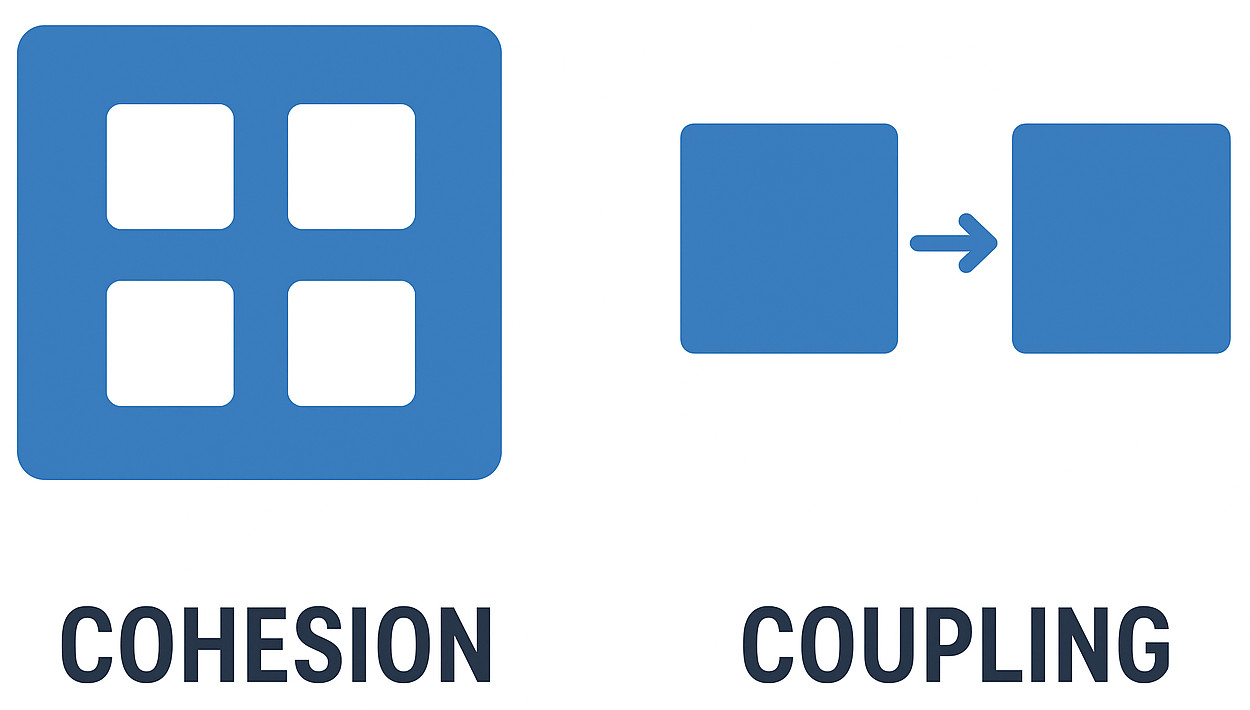
Modules, i.e, functions, classes, components, or services, are the building blocks of any software system and collaborate to conduct tasks. Depending on how these modules are set up and work together, maintaining your system will either be a pleasure or a nightmare.
- Cohesion: The degree to which a module’s internal components fit together.
- Coupling: The degree to which one module is reliant on another.
- High cohesion
- Low coupling
This combination generates codes that are clean, reliable, and scalable.
Let us assess each idea separately before diving further into the difference between cohesion and coupling.
What Is Cohesion in Software Engineering?
Students and developers studying system design often ask, “ What is cohesion in software engineering?” The degree of relatedness between a module’s responsibilities is called cohesion.
When a module has a single, unique goal, it is cohesive. A module displays high cohesion when its components cooperate to reach a common goal.
Why Cohesion Matters
- Improved Readability: It is easier to understand a module with a single responsibility.
- Better Maintainability: Modifications often remain inside the module.
- Simple Testing and Debugging: Testing is made simple by smaller, more targeted units.
- Reusability: Classes or functions that execute a single task can be applied in different contexts.
On the other hand, low cohesion leads to modules that resemble a “junk drawer”, full of irrelevant bits of reasoning. These modules are more difficult to test, more difficult to reason about, and more error-prone.
This leads us to the next vital subject: types of cohesion in software engineering.
Types of Cohesion in Software Engineering
Understanding the different forms of cohesion makes it easier to judge how well or poorly a module is structured. As we move from the worst kind (coincidental) to the best (functional), the quality gets better.
Coincidental Cohesion (Worst)
When components within a module are thrown together randomly, this happens. They don’t have a deep connection.
For example, a utility class that handles database cleanup, email notifications, parsing, and logging.
Logical Cohesion
Functions that are categorized logically but execute different operations.
For example, a module that includes all input-handling routines, regardless of whether they read from a file, keyboard, or network.
Temporal Cohesion
Elements are kept together because they are executed at the same time.
For example, initialization routines that execute at application startup.
Procedural Cohesion
Elements are grouped because they execute in a specific order.
For example, a function that verifies input, then cleans it, then writes to a log, and formats the input before passing it on.
Communicational Cohesion
Elements work on the same data set.
For example, a module that processes, filters, and summarizes a dataset.
Sequential Cohesion
Output from one part becomes the input to the next.
For example, a data-analysis module that reads raw data, sanitizes it, and then conducts statistical analysis.
Functional Cohesion (Best)
All components come together to accomplish one single task.
For example, consider a function called calculateInterest() or a class that concentrates only on authentication.
Technically, functional cohesion is the gold standard; it aligns perfectly with principles such as the SRP (Single Responsibility Principle) and makes the system much easier to verify and maintain.
What Is Coupling in Software Engineering?
- High coupling = modules heavily depend on each other
- Low coupling = modules are independent or interact
Why Coupling Matters
- Improved Maintainability: When you change one module, it won’t impact another.
- Flexibility: It is easier to upgrade or replace modules.
- Reusability: New systems can be linked to independent modules.
- Scalability: Services or components can scale without impacting one another.
Systems with high coupling are fragile, with minor changes having consequences throughout the codebase.
Types of Coupling in Software Engineering
Coupling has levels ranging from tightest to loosest, just as cohesion has levels from worst to best.
Content Coupling (Worst)
The internal operations of one module are changed or dependent upon those of another.
For example, writing directly to the memory of another module or using reflection to access the private data of another class.
Common Coupling
The global state or variables are shared across multiple modules. This leads to invisible dependencies and makes testing challenging.
External Coupling
Modules depend on external elements such as devices, protocols, and file formats.
For example, modules that read and write to the same hardware device.
Control Coupling
To control its behavior, one module sends control information (flags, signals) to another.
For instance, changing the execution flow by passing a Boolean “isAdmin.”
Stamp (Data-Structured) Coupling
Modules share composite data structures, but only portions are used.
For instance, passing a complete User object when only the username is needed.
Data Coupling (Best)
Only the required data is shared between modules, usually through clearly defined parameters.
For example, passing separate arguments to a function, like (name, age).
Because it encourages independence and clarity, data coupling is the perfect condition.
Difference Between Cohesion and Coupling
Understanding the differences in cohesion and coupling is central to designing robust systems.
| Aspect | Cohesion | Coupling |
|---|---|---|
| Orientation | Internal (within a module) | External (between modules) |
| Desired State | High | Low |
| Focus | How related module functions are | How dependent modules are |
| Result of Good Practice | Clean, well-structured modules | Flexible, maintainable architecture |
Cohesion vs Coupling in Practice
Low coupling is generally the result of high cohesion.
- A module usually needs fewer dependencies if it has a single, clearly defined purpose (high cohesion).
- A module’s tendency to depend on multiple external modules increases coupling if it conducts a lot of unrelated tasks (low cohesion).
Understanding this relationship allows engineers to intentionally build scalable and modular systems.
Cohesion and Coupling in Software Engineering with Example
Let us utilize code-based examples and a simple real-world analogy to illustrate these ideas.
Real-world Example:
High Cohesion, Low Coupling
- Grinder
- Water heater
- Brewer
One task is executed by each component (high cohesion). They communicate through clear interfaces (low coupling)
Low Cohesion, High Coupling
What if the grinder managed the UI, regulated the temperature, and stored water? Its responsibilities would rely on everything else (high coupling) and overlap (low cohesion).
class OrderService:
  def calculate_total(self, items):
    return sum(item.price for item in items)

class PaymentService:
  def process_payment(self, amount, payment_method):
    payment_method.pay(amount)
Each class is concentrating on one responsibility, and they interact through interfaces. This is good cohesion with low coupling.
class OrderManager:
  def handle_order(self, items, user, payment_method):
    # calculate total
    total = sum(item.price for item in items)

    # update inventory
    Database.update_stock(items)

    # send email
    EmailService.send_confirmation(user.email)

    # process payment
    payment_method.pay(total)
This class conducts too many unrelated tasks, like business logic, inventory, emailing, and payment, which leads to poor cohesion and high coupling.
Why High Cohesion and Low Coupling Matter in Modern Architectures
- Testability: Predictable, isolated behaviors are generated by highly cohesive modules. Test cases get simpler to understand and more effective.
- Maintainability: The ripple effect of changes is reduced by low coupling. One component can be modified without completely rewriting the system.
- Scalability: High cohesion and low coupling are critical for microservices, event-driven systems, and modular monoliths.
- Team Productivity: Without continuously interfering with one another, teams can work on different parts of the system.
Read: What is Software Architecture?
Cohesion vs Coupling in Design Patterns
- By classifying algorithms, the Strategy Pattern enhances cohesiveness.
- The Factory Pattern separates the creation of objects, reducing coupling.
- The coupling between subjects and observers is decreased by the Observer Pattern.
- By providing a simpler interface, the Façade Pattern reduces coupling.
The reason patterns work so well is that they improve coupling, cohesion, or both.
Cohesion vs Coupling in Real-World Architectures (Monoliths, Microservices, and Modular Monoliths)
The concepts of cohesion vs coupling impact entire architectural decisions as software systems develop, going far beyond classes and methods. Strong cohesion and low coupling have unique benefits for modern application structures like microservices, modular monoliths, and monoliths.
Traditional Monolithic Architecture
All features are merged into a single deployable unit in a monolithic application.
- Tight coupling occurs between modules.
- Responsibilities inside the system blur.
- Boundaries between components disappear.
When a monolith has poor cohesion, even small modifications demand complete redeployment, making the system fragile.
Read: What is Monolithic Software Architecture?
Modular Monoliths: Cohesion Done Right
A modular monolith divides the codebase into cohesive, well-defined modules with little coupling, but it still deploys as a single unit.
The benefits of microservices, clear domains, and maintainable boundaries are offered by this method without the operational complexities.
- High cohesiveness within each domain module.
- Loose coupling via particular interfaces or domain events.
- Modular monoliths are often used by teams as a precursor to microservices.
Microservices and Coupling Pitfalls
- Distributed coupling, where services rely too much on each other’s APIs.
- Temporal coupling, where services must be present at the same time.
- Data coupling occurs when multiple services share the same database schema.
These issues arise because domain confusion occurs from dividing services without maintaining cohesiveness.
Instead of concentrating on technical layers such as “all controllers” or “all repositories,” a microservice should be highly cohesive around a business functionality, such as billing, inventory, or notifications.
Event-Driven Systems and Loose Coupling
By allowing services to respond to events asynchronously rather than directly calling one another, event-driven architectures additionally improve coupling.
By doing this, communication-based coupling is reduced while maintaining the coherence of each service within its domain.
Choosing the Right Architectural Approach
- High cohesion ensures clarity of responsibility.
- Low coupling ensures flexibility and independence.
These principles continue to be universal drivers of good architectural health, regardless of whether one is designing a monolith or a microservices ecosystem.
Balancing Cohesion and Coupling: Trade-Offs
- While low coupling and high cohesion are perfect, real-world systems involve nuance.
- Increasing cohesiveness occasionally requires dividing modules, which may require increased communication (slightly increasing coupling).
- Complexity may increase if too much abstraction is used to reduce coupling.
- While microservices offer a high degree of independence, they also provide specific difficulties, such as distributed transactions.
- Knowing when to apply these principles and when to compromise is important to intentional design.
Conclusion
Developers can build long-lasting systems by clearly understanding cohesion vs coupling. You can design software that is dependable, scalable, and simple to maintain by understanding the difference between cohesion and coupling, identifying the different forms of coupling and cohesion, and understanding how they manifest in real projects.
- The modules have clarity and purpose when they are cohesive.
- Low coupling boosts the resilience and flexibility of your entire system.
Cohesion and coupling are the invisible forces that build excellent software. Keep them in mind when you are reviewing a peer’s code, building a new module, or explaining these concepts to a teammate.
 |