
Web Development Technologies: A Complete Guide
With the rapid shift towards digital platforms in the last two decades, having feature-rich web apps and websites is critical for driving digital growth. With this digital revolution, web development has advanced dramatically over the past three decades. What began with static HTML pages in the early 1990s has advanced into a complex ecosystem of languages, tools, styles, methodologies, and frameworks, collectively called web technologies. All these lead to dynamic, interactive, and scalable web applications.
| Key Takeaways: |
|---|
|
This article explores modern web development’s essential web technologies, frameworks, and tools.
What is Web Development?
The process of creating and maintaining websites for the internet is called web development.
Web development uses various technologies such as programming languages, software frameworks, and tools to design and develop websites accessible to users over the internet.
The outcome of a web development process is dynamic, responsive, and user-friendly websites that meet the objectives of businesses, organizations, and individuals.
Web development involves front-end development, which focuses on designing and developing the website’s user interface, and back-end development, which involves the server side of the website, including database management, server configuration, and web application programming.
Thus, web development is not merely programming but broadly refers to the tasks and processes involved in creating and maintaining a website, including everything from markup and coding to scripting, network configuration, and CMS development.
Types of Web Development
Web development is building websites and web applications that run on internet browsers. It has the following types:
Front-End Development (Client-Side)
Everything users see and interact with in a website is front-end. Front-end consists of user interface (UI), dashboards, menus, forms, and all other elements that users can see and interact with. It is the entry point for the website, and users can enter or submit information to the website using the front-end.
The front-end technologies used when developing a website can greatly impact the overall web development process. There is a wide range of web technologies available for front-end development with unique features, strengths, and weaknesses. Choosing the right technologies can make a huge difference in the efficiency, speed, and effectiveness of the web development process.
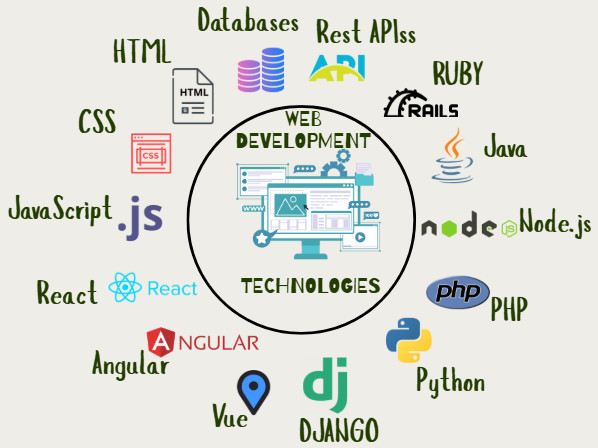
Some of the popular front-end web technologies are HTML, CSS, JavaScript, React, Angular, and Vue.js.
These technologies can be used together to provide a powerful foundation for any web development project.
Back-End Development (Server-Side)
The back-end of the website is the core of the website that contains the business logic, databases, and APIs powering the website. Whatever the smallest unit of data entered in the website through the front-end goes to the back-end for processing, and what the user sees in the browser is the outcome of the processing done by the back-end. Additionally, the back-end includes the server that processes all the website’s files, the databases that store the website’s data, and the application that runs the website.
Various technologies are used for back-end development that provide the necessary functionality and features to develop a powerful website that is scalable, efficient, and optimized for enhanced user experience.
Some of the prominent back-end technologies include Java, Python, PHP, Ruby, ASP.NET, Oracle, and MySQL. The decision to use a particular technology is guided by the project requirements and budget.
Full-Stack Development
This is a combination of front-end and back-end skills. This means full-stack developers work in the front-end as well as the back-end of a website. A full-stack development team can create a website, application, or software program from start to finish without having to transfer their work to some other team due to a lack of skills.
Full-stack development is the most sought-after role in the majority of organizations, and the developer’s all-around knowledge helps optimize website performance, catch issues before they occur, and assist team members in understanding web services.
Stages in the Web Development Process
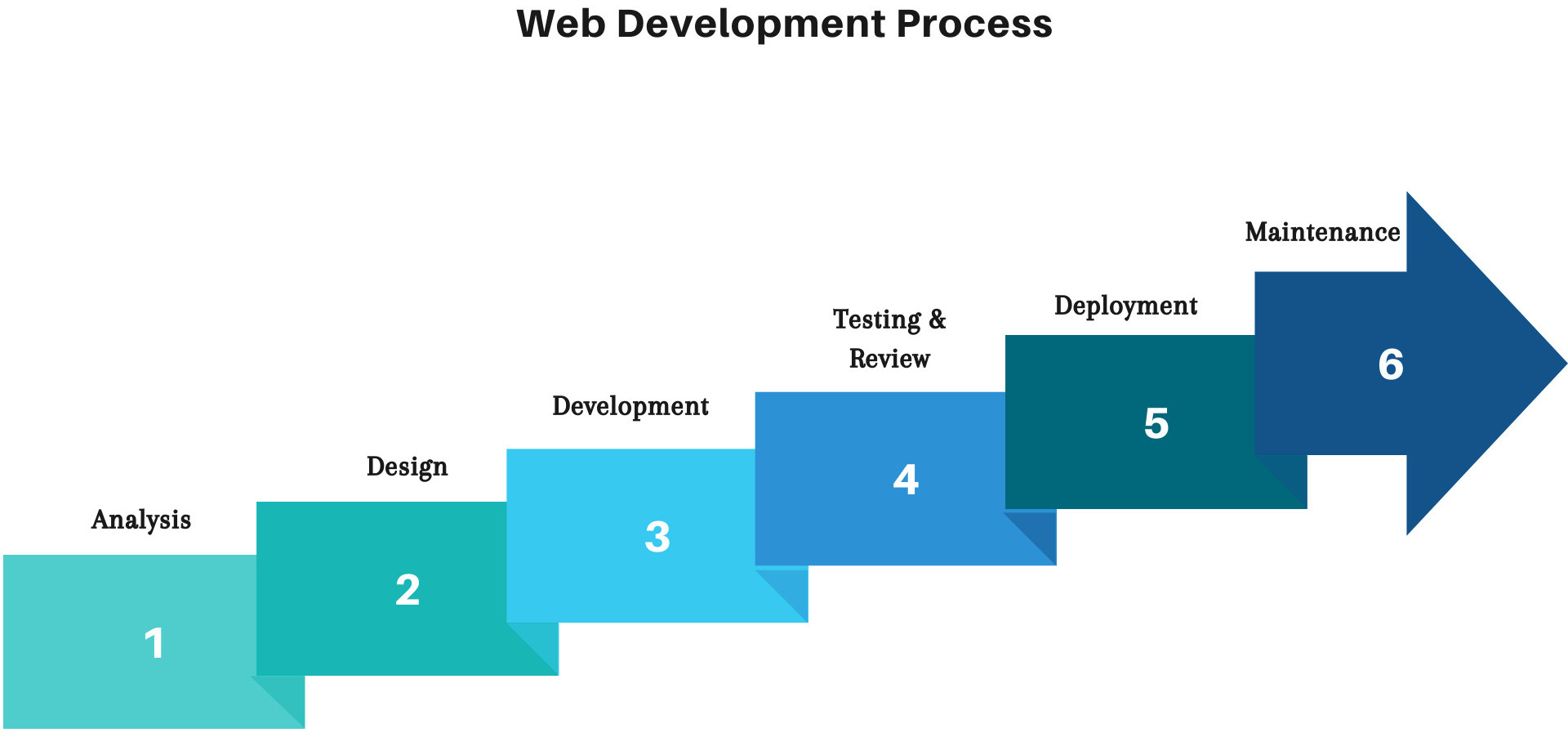
The web development process involves different parts and modules of development working together in sync towards a common goal. It is a streamlined workflow process with well-defined stages.
These stages are discussed here:
-
Analysis: This is the analysis and information gathering phase of the web development process. In this stage, the development team outlines business goals, audience, and budget, and chooses the right technology stack for the project based on the analysis.The analysis phase involves:
- Creating user personas
- Conducting user research
- Analyzing competitor websites
- Performing technical feasibility analysis
- Developing site maps and wireframes
Once the requirements and goals of the project are clearly understood, the team begins to devise a strategy to achieve them. -
Design: The design phase of the web development process is an important phase as it directly impacts the UI/UX of the website. The website design should be responsive, highly intuitive, and easy to navigate. In this phase, an optimized website design is created based on the client’s requirements.To provide a feature-rich audio-visual experience to the users, the development team adds:
- Website design
- Website content
- Visual components like navigation panels
- Multimedia components like images and videos
- Activity layouts
-
Development: In this stage, developers start coding and building the front-end, back-end, database, and integrating APIs if required.A variety of programming languages based on the functionalities required in the website are used for coding. The web developer takes all of the designs, wireframes, and other elements prepared in previous phases and converts them into a working website.The development phases involve:
- Writing code
- Setting up server-side functionality
- Deployment of site plugins
- Integration of features
- Security considerations
-
Testing & Review: Once the development is completed, the website or application must undergo rigorous testing to catch bugs, performance issues, and security vulnerabilities.This phase is the most critical phase of the web development process and yet underrated. Various testing methods and techniques are utilized in this phase to ensure the optimized performance of the website.The testing phase is divided into two main categories:
- Functional testing: Verifies the functionality of the entire website to ensure it performs intended tasks.
- Non-functional testing: Assesses the website’s performance, security, and usability.
The testing and review phase ensures that the website is bug-free and works as expected. -
Deployment: At this stage, the website is developed and tested and is ready to go live. This is achieved by deploying the website or putting the website on the internet. This phase involves:
- Transferring the code from a development or staging server to a production server.
- Configuring the live environment
- Compressing files
- Setting up caching
- Setting up load balancing
Website deployment can be a complex task, and hence, there should be a robust plan in place before deployment is started. All the necessary contingencies should be in place, and developers should be prepared to face different scenarios.Once the website is deployed successfully, it should be monitored and maintained to ensure it remains accessible and responsive. -
Maintenance: This last phase of the web development process is crucial as the website is monitored for any issues, and ongoing support is provided to ensure the smooth functioning of the deployed website.Website maintenance is integral to the web development process to ensure optimum performance and continuous upgrades based on evolving requirements.Website maintenance includes various tasks such as:
- Updating software
- Backing up data
- Monitoring web traffic
- Checking for security vulnerabilities
Effective maintenance ensures that the website remains relevant, updated, accessible, and optimal at all times.
Why is Web Development Needed?
- A well-designed website allows users to connect with potential customers, irrespective of their geographical location.
- A website boosts the brand credibility and makes the business look more trustworthy and professional.
- A responsive website that works across all devices provides a smooth user experience.
- A strong online presence is crucial for staying ahead of the competition and driving business growth.
- As most people today are connected in the virtual world, with half of the global population actively engaging in research, connection, education, and entertainment, it is important that businesses make their presence visible through websites.
Examples of Web Development
The following table shows some of the common examples of web development that are popular today:
| Example | Details |
|---|---|
| Google Docs | A free online word processor is part of the Google Docs editor suite and used for content creation. It allows users to monitor their content even in the browser. |
| Netflix | Netflix is a subscription-based OTT platform that streams various TV shows and movies. |
| A popular social networking site that has web and native app features. Its PWA is called Twitter Lite. | |
| This is an image-sharing platform that is used to find images and videos on pinboards. | |
| Medium | A top online content publishing tool for journalists, writers, and readers. It is highly responsive and can work even on an unstable network. |
Core Front-End Technologies
Front-end web development focuses on creating the visual and interactive elements of a website. It designs and builds the user-facing side of the website that is pulled up in the browser.
The most common front-end technologies used are markup and scripting languages for designing, styling, and making UI functional. The standard technologies used are:
HTML (HyperText Markup Language)
HTML is the backbone of web content and defines the structure of web pages using a set of elements and attributes.
- Semantic tags (
<header>,<article>,<footer>) - Forms for user input
- Multimedia support (audio, video)
HTML is used to give content a proper layout before customizing it.
CSS (Cascading Style Sheets)
CSS is the muscle of the website that has HTML as its backbone. CSS styles the visual appearance of a website.
- Flexbox and Grid for layouts
- Media queries for responsive design
- CSS variables for maintainability
Developers use CSS to customize colors, fonts, layouts, and other design elements. It can create responsive web pages that adapt to different screen sizes.
JavaScript
JavaScript is a dynamic programming language used in web development to add interactivity and dynamic behavior to web pages, such as dropdown menus, sliders, forms, and animations.
- DOM manipulation
- Event handling
- AJAX requests for asynchronous data loading
JavaScript is widely used for client-side scripting (the script runs on the client’s browser and not on the server that hosts the website). JavaScript enhances the user experience by making sites more dynamic and engaging.
Popular Front-End Frameworks and Libraries
Frameworks provide pre-built components and best practices, helping to speed up development. Here are some of the popular front-end frameworks and libraries in web development:
React
React.js is a popular web development framework with a one-way data binding feature. The framework is used for end-to-end application development and offers excellent server-side features and SEO support.
- It is developed by Facebook (Meta)
- React has a component-based architecture
- It uses virtual DOM for performance
Angular
- Angular is developed by Google
- It contains two-way data binding
- Angular has a robust ecosystem for large applications
Vue.js
- Vue is lightweight and flexible
- It offers reactive data binding
- Vue has a progressive adoption model
Express.js
Express.js is a model-view-controller (MVC) web framework created by T.J. Holowaychuk. It is highly stable and supports end-to-end app development.
Django
The Django framework is written in Python and is a web application development framework that follows MVC architecture. Django is a large enterprise-grade development framework that makes the web development process easier.
Laravel
Laravel is a free, open-source web application development framework that uses MVC architecture for developing state-of-the-art web pages. It offers seamless user authentication, faster caching, and automated testing.
Back-End Technologies
While front-end technologies help with creating the user-facing elements of a website, back-end technologies are used by developers who work behind the scenes to ensure everything runs smoothly.
Back-end web technologies include programming languages that manipulate servers, databases, and software that power websites and applications. This makes back-end development technologies harder to learn than front-end technologies.
Here are the primary technologies or server-side programming languages that are used in back-end development:
Python
- Python is known for its readability and simplicity.
- It offers various frameworks, such as Django and Flask, that simplify back-end development tasks.
- Python frameworks in web development support tasks like database management and handling HTTP requests.
- Its extensive libraries make it a popular choice for back-end web development.
Python is also used for automation, data analysis, and other applications in addition to web development.
PHP
PHP is a widely used server-side scripting language specifically designed for web development. It integrates with HTML and offers powerful features for handling databases, generating dynamic content, and interacting with web servers.
Laravel and Symfony are popular PHP frameworks used in web development. WordPress also heavily relies on PHP.
Ruby
Ruby is an object-oriented, dynamic programming language that emphasizes simplicity and readability. Ruby on Rails is the framework for Ruby, providing a structure for building robust and scalable web applications.
Ruby offers elegant syntax and an extensive ecosystem, making it a preferred choice for web development projects.
Java
Java is the most widely used programming language, famous for its platform independence and scalability. It is a versatile language commonly used for building enterprise-level web applications with high performance and security. Java offers popular back-end development frameworks like Spring and Hibernate that can easily build complex systems.
C#
C# ( C-sharp) is a modern, general-purpose programming language developed by Microsoft. It is primarily used for building Windows desktop applications and web services. However, with the rise of the .NET framework, C# has gained fame as a back-end language for developing secure and scalable web applications.
Node.js
Node.js is a JavaScript runtime environment built on Chrome’s V8 JavaScript engine. Developers can run JavaScript code on the server side, opening up opportunities for full-stack JavaScript development.
Node.js is a highly efficient, scalable, and ideal for building real-time applications and APIs.
Technologies like databases and APIs are used for back-end development, in addition to back-end (server-side) programming languages.
Databases
Back-end developers need a solid understanding of databases, server management, and web security, as well as proficiency in a programming language.
A database is the component where websites’ data, such as user data, product data, form data, etc., is stored and organized. It is a server-side component in the web development process and manages information like user details, content, and transactions. Depending on the type of database, data is organized in tables (relational databases like MySQL) or in flexible formats (NoSQL databases like MongoDB).
- Relational (SQL): MySQL, PostgreSQL
- Non-Relational (NoSQL): MongoDB, CouchDB
- In-Memory: Redis for caching
API Development
- REST (Representational State Transfer): Known for its simplicity and scalability
- GraphQL: Provide flexible queries for optimized data fetching
- gRPC: High-performance communication protocol
- JSON: JavaScript Object Notation, or JSON, is a format for structuring data.
- XML: Extensible Markup Language (XML) is a markup language that defines rules for encoding documents in human-readable and machine-readable formats.
Web Development Tools
Web development tools are software applications that developers use to build, test, and deploy web applications. Various IDEs, text editors, version control systems, and browsers are some examples of web development tools. These tools are used for web development and the web technologies discussed above. The following table provides a list of these web development tools:
| Tools | Examples |
|---|---|
| Code Editors/IDEs |
|
| Version Control Systems |
|
| Web Browsers |
|
| Terminals/Command Line |
|
| Web Servers |
|
| Content Management Systems (CMS) |
|
| Task runners and build tools |
|
| Website Testing Tools |
|
| DevOps and Deployment |
Modern web development integrates continuous integration and deployment (CI/CD) to streamline releases.
|
| Web Security |
Security is essential to protect data and maintain trust.
|
| Responsive and Mobile-First Design |
A mobile-first approach ensures the best experience on smartphones and tablets.
|
| Performance Optimization |
Performance impacts user conversions, SEO, and user satisfaction.
|
Many other web development tools are available besides those listed in the above table. The choice of the tool is based on the project requirements, complexity, and size. Choosing the right tool for the job and being familiar with its features and limitations is essential for the project’s success.
Trends in Web Development
- AI and Automation: AI-driven personalization, code generation tools, and chatbots are becoming mainstream.
- Serverless Architecture: AWS (AWS Lambda) and Microsoft (Azure Functions) introduced functions-as-a-service (FaaS), which reduces infrastructure overhead.
- WebAssembly (Wasm): This technology brings near-native performance to web apps, enabling languages like C++ and Rust in the browser.
- Jamstack: This new developer stack has decoupled front-end and back-end, making it faster and more secure.
Conclusion
Web development is critical for businesses intending to make their presence online. It is vital to have a comprehensive understanding of the web development process and the technology stack required to build robust and dynamic websites.
Web development technologies have matured into a diverse, dynamic ecosystem. Developers must be adaptable to keep up with rapidly changing tools and practices. Understanding the landscape of web technologies will help developers craft efficient, engaging, and secure online experiences.
Additional Resources
- Top 10 Backend Technologies Every Developer Should Know
- What is Software Architecture?
- What is Code Optimization?
- Differences Between Continuous Integration, Continuous Delivery, and Continuous Deployment
- Different Merge Strategies in Git
- Which Version Control System is the Best?
 |