
Top 10 Web Development Languages in 2026
Web development has evolved significantly since the early days of the internet in the 1990s. Gone are the days of those basic, static websites. They are now replaced by engaging dynamic websites that provide fulfilling user experiences. Web development keeps reshuffling its deck. New runtimes rise and fall, frameworks appear, and artificial intelligence (AI) is beginning to make its presence felt. Yet, a handful of web development languages continue to power the web applications.
| Key Takeaways: |
|---|
|
This guide on the top 10 web development languages provides details of the 10 best web development languages in 2026, including their features, use cases, benefits, and shortcomings, so that developers can choose the best among them based on their goals and constraints.
What is Web Development?
Web development is the process of developing and maintaining websites and web applications.
Web development includes a range of disciplines involved in designing, creating, and maintaining websites. Web development encompasses tools, frameworks, and programming languages for constructing responsive, interactive, and visually appealing web pages.
- Frontend Development: This category focuses on the user interface, or the part that the user interacts with. The user-facing side of a web application includes the visual design, layout, and user interface (UI) components. Languages like JavaScript and cascading style sheets (CSS) are commonly used to design the front end with markup languages like HTML.
- Backend Development: This type involves writing code that remains invisible but is essential for all applications and business logic. The backend of a web application handles database interactions, application or business logic, and security. Backend languages include Python, Java, PHP, Ruby, etc., to name a few.
- Full-stack development: It combines front-end and backend development and allows developers to build entire applications from scratch.
Why Web Development Languages Are Important?
- Dynamic Websites: Programming languages help developers to create dynamic websites that perform functions on the go.
- Powerhouse Functionality: Web development languages provide powerful features, such as logins, animations, encryption, etc., to develop complex web applications.
- User Engagement: These languages help to craft user-friendly interfaces and visually appealing designs, engaging users and providing a high-end user experience.
- Innovation Engine: As the web evolves, development languages help developers build innovative features and functionalities, driving the business and shaping the digital landscape.
Choosing a Web Development Language
- Project Requirements: Assess the requirements for specific features to be designed.
- Breadth of Ecosystem: Identify the frameworks, libraries, tooling, and cloud support required for the project, and then choose a programming language that fits perfectly in.
- Skills Availability: Assess the talent available to use a particular development language. In the process, check factors such as learning curve, community size, and hiring.
- Performance & Reliability: Check the programming language for performance and reliability, including latency, concurrency, and safety.
- Longevity: Assess if the programming languages chosen have backward compatibility, stewardship, and a clear evolution path.
- Use-case Fit: The language you choose should fit the use cases of the project being designed, with front-end and back-end support, real-time applications, and high throughput.
Top 10 Web Development Languages
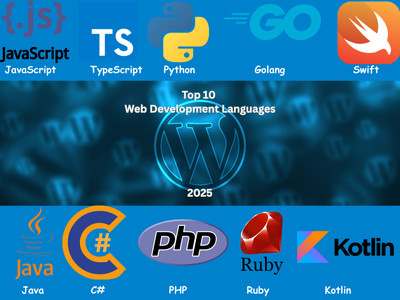
Hundreds of web development languages are available, and it is difficult for developers to determine the best programming language to learn and code in. The choice will ultimately depend on individual skill level, career goals, and the organization’s requirements. To help you get started, we have compiled the top 10 web development languages in 2026 with their overview, features, use cases, benefits, and limitations to guide your learning path:
1) JavaScript
Overview:
JavaScript is today’s most popular and in-demand language for developing dynamic web applications. It is nearly impossible to become a professional software developer without learning JavaScript.
The web’s most popular sites, from Facebook and Twitter to Gmail and YouTube, use JavaScript to create dynamic and interactive web pages.
- Versatility: JavaScript is a versatile language used for frontend and backend development.
- Interactivity: It adds dynamic elements to web pages, making them more engaging and responsive.
- A Large Support Community: The JavaScript community is large and growing. It contains extensive online resources, tutorials, frameworks, and other resources, making it easier to learn and troubleshoot.
- Client-side Interaction: Everything in the browser can be created using JavaScript; no translation required.
- Full-stack Unification: It can be used on client and server development, simplifying hiring and code sharing.
- Rich Ecosystem: JavaScript boasts a rich ecosystem of frameworks and technologies, including React, Vue, Svelte, Next.js/Nuxt/SvelteKit, Express/Fastify/Hono, and infinitely more.
- Fast Development Cycle: Its dynamic nature and flexible syntax enable rapid prototyping and iteration, resulting in faster development.
- Creating interactive web applications
- Building micro-frontends and serverless APIs
- Developing single-page applications (SPAs)
- Adding animations and user interfaces
- Prototyping at startup speed
- Different browsers may interpret JavaScript differently, leading to inconsistency and compatibility issues.
- JavaScript can be vulnerable to security threats like Cross-Site Scripting (XSS).
- JavaScript running in a single thread is a significant performance bottleneck for applications requiring heavy computation or I/O operations.
- JavaScript is a loosely typed language, and it can be difficult due to its dynamic nature.
2) TypeScript
Overview:
TypeScript is a superset of JavaScript that adds static typing and modern tooling niceties. It has grown in popularity over the past several years because it is simple to learn, is open-source, and builds on JavaScript.
Its versatility makes it one of the best programming languages for beginners. Several well-known organizations, including Google, Airbnb, and Slack, utilize TypeScript.
- JavaScript Compatibility: Code written in TypeScript is compatible with regular JavaScript, ensuring compatibility with existing web technologies.
- Static Typing Features: Features like code completion and refactoring make development smoother and enhance code quality.
- Interfaces: TypeScript provides interfaces that define an object’s structure but don’t provide an implementation.
- Error Detection: Static type checking helps catch type mismatches during compilation, avoiding issues with undefined variables or unexpected data structures.
- Enhanced Tooling: TypeScript provides great editor support, refactors, and DX, and works with practically every JS framework.
- Scalability for Large Teams: Its strict typing system enforces the discipline necessary for large teams working on shared codebases.
- Interoperability: It can be gradually adopted in existing JavaScript codebases.
- Improved Readability & Maintainability: Type definitions make code easier to read and understand.
- Developing Medium-to-large front-end and full-stack, enterprise-grade web applications
- Creating developer platforms/SDKs
- Maintaining complex codebases written in JavaScript
- Front-end development with frameworks like Angular and React
- Build steps add complexity to code; types can become ceremony if not curated.
- It ultimately compiles to JavaScript, so perf is the same as JS. There is no separate runtime.
3) Python
Overview:
Python is a general-purpose, readable, batteries-included language with deep roots in web, data, and AI. It is the most user-friendly language today. Its syntax is straightforward and intuitive, formatted similarly to English grammar rules, making it easy for English speakers.
Python is a popular choice for beginners seeking the best programming languages to learn for themselves.
- Readability: Python’s clean and concise syntax, similar to natural language, makes it easier to learn and maintain.
- Versatility: It is widely used for web development, data science, scripting, machine learning, and more.
- Extensive Libraries: Python has a vast collection of pre-written code (libraries). With Python, it’s easy to simplify complex tasks and streamline development.
- Rapid Backend Development: Python supports various frameworks, including Django, Flask, FastAPI, and Starlette, making APIs and back-office apps quick to ship.
- AI & Data Adjacent: It is a first-class ecosystem for ML/AI (PyTorch, TensorFlow) and data tooling. It comes in handy when your web app needs smart features.
- Huge Talent Pool: Python is easy to learn and widely taught.
- Python is extensively used in REST/GraphQL APIs
- Web development (SaaS backends)
- Data science and machine learning
- Scripting and automation
- Scientific computing
- Game development (with frameworks)
- Python is an interpreted language, making it slower than compiled languages that translate code to machine code before execution.
- Python’s dynamic typing and flexible data handling require significant memory, making it less suitable for memory-intensive tasks.
- The Global Interpreter Lock (GIL) prevents multiple threads from executing Python bytecode simultaneously, limiting its effectiveness for multi-threaded applications.
4) Go (Golang)
Overview:
Golang, or Go, is a compiled, garbage-collected language developed by Google. It is popular for its simplicity, performance, and concurrency.
Go contains much of the same functionality as C and C++ and is ideal for engineers who want to enter the field of systems programming. It’s the perfect language for building web servers, data pipelines, and machine-learning packages.
- Concurrency: Go has built-in support for concurrency, which simplifies handling multiple tasks simultaneously.
- Readability: It has clean and concise syntax, making Go code easy to understand and maintain.
- Garbage Collection: Automatic memory management of Golang reduces development complexity.
- Throughput & Concurrency: Fast and concurrent network services can be written using Goroutines/channels.
- Simplicity: Go’s minimal language surface area reduces bikeshedding and learning time.
- Deployment: Go supports single static binaries, quick builds, and a small memory footprint.
- Creating microservices, CLIs, proxies, and internal platforms.
- Building scalable web services and APIs
- Network programming and systems development
- Cloud-native application development
- Error handling in Go is explicit; generics exist but remain intentionally conservative.
- It is less ergonomic for complex business logic than Python/Ruby unless you apply patterns.
5) Swift
Overview:
Apple introduced the Swift programming language in 2014 to operate seamlessly across its platforms, including iOS, macOS, watchOS, and TVOS. It enhances user experience on Apple devices and offers a comprehensive toolkit and APIs.
- Modern Syntax: Swift has a clean and expressive syntax, making the code easy to read and write.
- Type Safety: It is strongly typed and catches errors at compile time, reducing the chances of runtime crashes.
- Optionals: Swift provides optionals to handle the absence of values. This improves code safety and prevents common runtime errors.
- Performance: This language is designed to be fast, with performance comparable to C++ for many tasks.
- Automatic Reference Counting (ARC): Swift uses ARC for efficient memory management, reducing memory leaks and optimizing performance.
- Ease of Use: Swift’s code is easy to write and maintain due to its modern syntax and features.
- Safety: Its strong typing, optionals, and error handling mechanisms enhance code safety and reduce the likelihood of bugs.
- Performance: Swift’s optimized performance for modern hardware makes it suitable for mobile and desktop applications.
- Active Development: Apple actively develops and supports it with regular updates and improvements.
- Swift Playgrounds: It provides an interactive environment, Playground, that makes learning and experimenting with Swift easy, making it ideal for both beginners and experienced developers.
- Developing applications for iOS, macOS, watchOS, and tvOS
- System programming, like device driver programming
- Server-Side web development with frameworks like Vapor and Kitura
- Writing scripts and automation tasks
- Game development
- Swift has a steep learning curve, especially for developers new to Apple’s ecosystem.
- Swift is primarily used for Apple platforms, limiting cross-platform development.
- It is a relatively young language, and may lead to changes requiring code updates.
- The tooling and ecosystem around Swift are not as mature as those for some older languages.
- There are challenges with binary compatibility between Swift versions, although this has improved with recent updates.
6) Java
Overview:
Java is a veteran, strongly typed JVM language powering enormous portions of the enterprise web. After many decades, it remains a dominant force in the programming world with its write-once, run-anywhere philosophy and mature ecosystem. It is a reliable choice for building large-scale applications like servers.
- Platform Independence: Java code is platform-independent and can run on various operating systems without modifications.
- Object-oriented Functionality: Java supports OOP principles such as code reusability and maintainability.
- Vast Libraries and Frameworks: It contains a rich set of libraries and frameworks for diverse development needs.
- Reliability & Scale: The JVM, JIT, and GC components are battle-tested at massive scale and are reliable.
- Framework Maturity: Java supports mature frameworks like Spring Boot, Quarkus, and Micronaut, which provide deep tooling for observability and security.
- Ecosystem Depth: Java provides libraries for everything, from payments and messaging to identity and compliance.
- Developing enterprise applications (web, desktop, and mobile)
- Building enterprise applications (web, desktop, mobile, with frameworks)
- Creating high-volume transaction systems like Big Data processing (Hadoop)
- Android application development
- Java programs run on the JVM, adding an extra layer between the code and the hardware, leading to slower execution speeds and increased memory usage.
- Java lacks support for low-level features like pointers, limiting its use in system programming and hardware manipulation.
- Java is a verbose language with lengthy and sometimes repetitive syntax, making code more complex and challenging to write.
- Cold starts in serverless require tuning, though frameworks like Quarkus help.
7) C#
Overview:
C# (pronounced C Sharp) is a modern, expressive language on .NET, that is cross-platform and high-performance. It is a general-purpose, object-oriented programming language built on the foundations of the C language. It uses a syntax similar to other C-derived languages, such as C++, so it’s easy to master on top of prior proficiency in another language in the C family.
- Object-oriented Functionality: C# promotes code organization and reusability through objects and classes.
- .NET Framework: C# integrates seamlessly with the .NET Framework, a vast library of tools and functionalities.
- Cross-platform Utility: With .NET Core, C# applications can run on Windows, macOS, and Linux.
- ASP.NET Core: It provides excellent performance, minimal APIs, and first-class Windows/Linux hosting with ASP.NET Core.
- Tooling: C# works in Visual Studio/Rider, providing strong debugging and profiling features.
- Full-stack Options: Frameworks like Blazor for web UIs, MAUI for cross-platform apps, and seamless Azure integrations provide full-stack options.
- Enterprise and ISV backends development (Windows desktop and web)
- Game development (Unity Framework)
- Mobile application development (Xamarin)
- System programming
- Automatic memory management in C# simplifies development, but the garbage collector can introduce performance pauses.
- Any changes to C# code necessitate recompilation, which can be a slower process.
- C# is inherently tied to the .NET ecosystem, limiting its flexibility in environments outside this framework.
8) PHP
Overview:
PHP is an open-source, server-side scripting language primarily used for developing complex and dynamic websites. It is an interpreted language that has been around for quite a few years, but still powers a surprising share of the web.
- Server-Side Scripting: PHP is ideal for developing dynamic web pages and applications as a server-side scripting language.
- HTML Integration: Its code can be embedded directly within HTML, seamlessly integrating server-side logic with web pages.
- Cross-Platform Compatibility: PHP runs on various operating systems, including Windows, macOS, Linux, and Unix.
- Extensive Standard Library: It supports various built-in functions offering database manipulation, file handling, and data encryption.
- Database Integration: PHP provides robust support for database integration, especially with MySQL, Oracle, and Microsoft SQL Server.
- Content-driven Sites: PHP dominates CMS and e-commerce and is responsible for many content-driven sites, including WordPress, Drupal, and Magento.
- Developer Velocity: Frameworks such as Laravel and Symfony for PHP make backends fast to build with batteries included.
- Hosting & Cost: PHP hosting is cheap and has straightforward deployment.
- Developing dynamic web pages and custom applications, including popular content management systems like WordPress and Drupal
- Building e-commerce platforms like Magento and OpenCart
- Server-side scripting to create interactive and dynamic websites
- Creating RESTful APIs and web services for application integration and communication
- PHP syntax has inconsistencies in function naming conventions, parameter order, and behavior across different functions, leading to confusion.
- Its weak typing can lead to unexpected type conversions and potential bugs if not handled carefully.
- The open-source nature of the language means that potential vulnerabilities in the core language or extensions are publicly visible.
- PHP’s error-handling mechanisms are less intuitive or comprehensive than desired.
9) Ruby
Overview:
Ruby is an expressive, developer-friendly language known for its clean syntax and developer productivity. It has evolved into a high-level, general-purpose language within and beyond web development. A robust framework, Ruby on Rails, makes it popular for building dynamic web applications.
- Clean Syntax: Ruby code is simple, easy to read, and understand, resembling natural language for a smoother learning curve.
- Focus on Developer Productivity: It has features and libraries that simplify the development process.
- Powerful Frameworks: Ruby integrates Rails, a robust web framework built on Ruby that jumpstarts development with pre-built functionalities.
- Productivity: Ruby’s elegant syntax, strong community conventions, and excellent testing culture enhance productivity.
- Cross-Platform Compatibility: It runs seamlessly on different operating systems, such as Windows, macOS, Linux, UNIX, and DOS.
- Active Community: Ruby has a vibrant and supportive community that contributes to its development and provides resources for learning and problem-solving.
- Dynamic Typing: The language’s dynamic nature provides flexibility in building features and allows runtime modifications.
- Speed to MVP: Rails still ships features at a blistering pace with scaffolding, generators, Active Record, and Hotwire/Turbo.
- Building web applications (backend) with frameworks like Rails
- Developing rapid prototypes and proof-of-concept applications
- Scripting and automation tasks
- Optimization for iteration speed, internal tools, and CRUD-heavy apps
- Lower raw performance than other languages like Go/Rust.
- Scaling often relies on caching, background jobs, and horizontal scaling.
- Smaller talent pool in some regions compared with JS/TS and Python.
10) Kotlin
Overview:
Kotlin is a modern and concise JVM language backed by JetBrains and Google. It is a preferred choice for Android app development and mainly focuses on developer experience and interoperability with Java.
- Concise Syntax: Kotlin has a clean, readable code structure that is easier to learn and maintain.
- Null Safety: Kotlin allows for the development of more robust applications, which help prevent crashes caused by null pointer exceptions.
- Java Compatibility: Kotlin code can seamlessly integrate with existing Java codebases in Android development.
- Expressive Backend Services: Kotlin frameworks such as Ktor, Spring Boot with Kotlin, and Arrow (FP) bring clarity and safety.
- Interop & Migration: It can be adopted incrementally inside Java stacks and possesses the same tooling/debugging advantages as Java.
- Multiplatform Story: Kotlin offers full-stack possibilities as it can target JVM, JS, and native.
- Full-stack JVM project development
- Building native Android applications
- Developing cross-platform mobile apps (with frameworks like React Native)
- Server-side development (limited use cases)
- In large projects or when incremental compilation is not fully optimized, Kotlin’s compilation times can be slower than Java’s.
- Kotlin’s ecosystem of libraries, frameworks, and community resources is still less extensive and mature than Java’s
- Including the Kotlin standard library and other runtime dependencies results in a larger application size.
- The hiring pool is smaller than that of Java; KMP for production web UIs is still maturing relative to JS frameworks.
Conclusion
There isn’t a single best language that can be chosen in 2026. Most successful teams select a primary language for speed and hiring, then pick a secondary language for specialized needs like real-time workloads, platform constraints, or performance hotspots.
If you choose TypeScript or Python with Go when needed, you will definitely cover 95% of all modern web scenarios.
 |