
Strings in Data Structures Explained with Examples
You have already worked with strings if you have ever texted someone, looked up a song’s lyrics, or yelled, “Hey Google, play Let It Go!”
You use a string, a collection of characters saved and modified by your device, every time you type something into a search bar, leave a comment, or even save your Wi-Fi password. Strings appear everywhere, whether it’s your name on Instagram, a subtitle on Netflix, or the “404 Not Found” error message that keeps coming up while you are late at night coding.
Strings are among the most flexible data structures in the field of data structures and algorithms (DSA); they are more than just text lines. They are simple to use and powerful enough to power everything from DNA sequencing tools to chatbots, which puts them at the perfect balance between complexity and simplicity.
Let us understand what strings actually are, how they are stored, why they are vital in DSA, and how knowing them can help you resolve problems more effectively.
| Key Takeaways: |
|---|
|
Introduction to Data Structures and Their Types
Understanding data structures and their types is vital before we can understand what a string in a data structure is.
A data structure is a methodical approach to data management, organization, and storage that aids effective access and modification. It defines the relationship between data and the operations that can be carried out on it.
Defining Data Structure & Its Types
- Primitive Data Structures: The majority of programming languages support the following basic data types: strings, Booleans, floats, and integers.
- Non-primitive Data Structures: They include arrays, linked lists, stacks, queues, trees, graphs, and hash tables, which are derived from primitive types.
Since textual data is one of the most common types of information in computing, the string data type has a special place among all primitive structures.
What is the String Data Type?
A string data type is a collection of characters that are saved as a single data value. These characters can be whitespace, letters, numbers, or symbols.
Strings are stored in contiguous memory locations in the majority of programming languages, making manipulation and traversal simple.
Examples of String Data Type
// C Language Example
char name[] = "Alice";

# Python Example
name = "Alice"

// Java Example
String name = "Alice";
Each of these specifies a variable that holds a string, which is a collection of characters.
Is a String a Data Structure?
Of course. Because it arranges data (characters) in a specific way and allows operations such as insertion, deletion, traversal, and search, a string is a data structure.
Since strings in languages like C are internally arrays of characters terminated by a special null character (\0), it is also frequently regarded as a specialized form of array.
How Strings Are Represented in Data Structures
An array of characters is used to represent the string data type. For example, “HELLO” is stored as follows in C:
| Index | 0 | 1 | 2 | 3 | 4 | 5 |
|---|---|---|---|---|---|---|
| Value | H | E | L | L | O | \0 |
The string ends with the \0 character.
Storing Strings in Data Structures
- C and C++: As mutable or immutable character arrays.
- Java, Python, JavaScript, and C#: These are immutable objects that are stored in memory as Unicode character sequences.
- Dynamic Structures: To get around immutability costs, structures like
StringBufferorStringBuilder(Java) are used for efficient modification.
Optimizing memory and runtime efficiency needs an understanding of how strings are stored in data structures.
Types of Strings in Data Structures
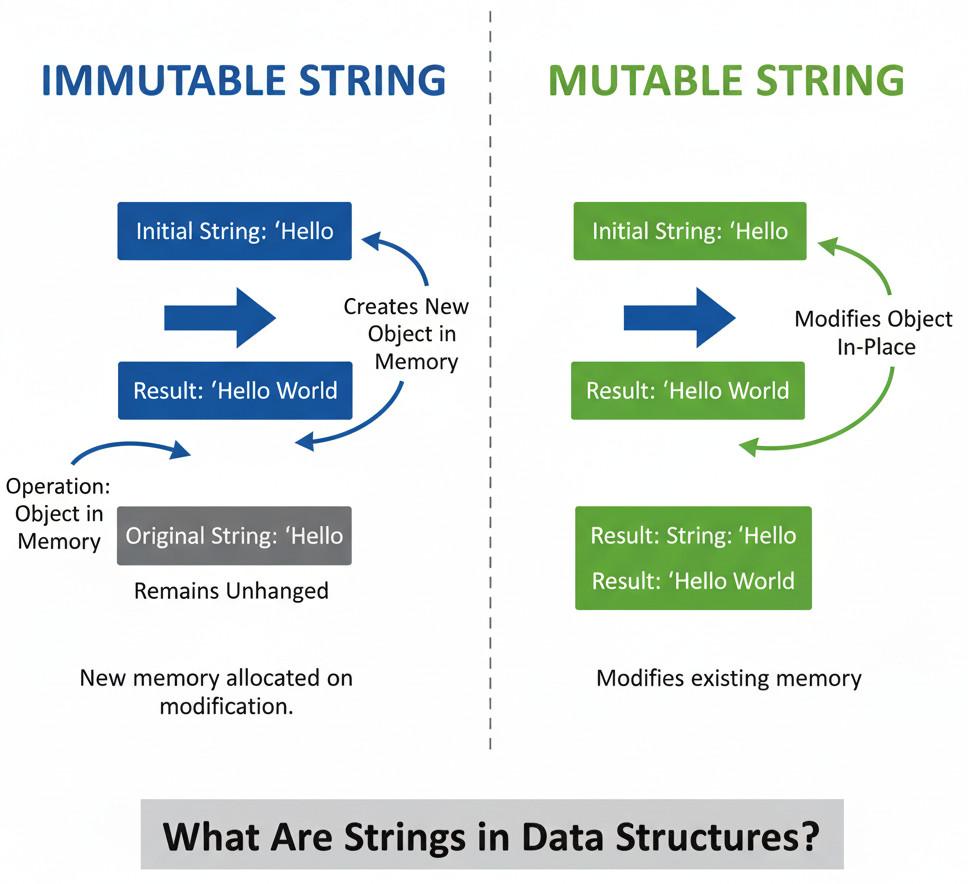
The types of string implementations depend on mutability & memory management strategies:
Immutable Strings
- The content cannot be changed once it has been created. Python’s str and Java’s String are two examples.
- Advantages: It includes hash stability and thread safety.
- Disadvantages: Ineffective for frequent changes.
Mutable Strings
- Allows characters to be modified without making new objects. Examples include
StringBuilderin Java,std::stringin C++. - Advantages: Faster adjustments.
- Disadvantages: Needs manual memory management in low-level languages.
Fixed Length Strings
- Have a predefined maximum size. Efficient for consistent storage, but memory waste if not utilized to its full potential.
Variable-Length Strings
- Adapt dynamically to the size of the content. Common in database systems and high-level languages.
How Strings Work in Memory
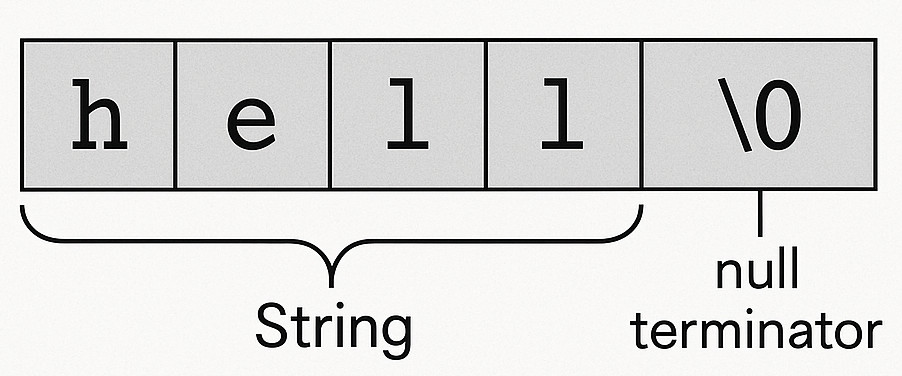
Typically, the first word that comes to mind when we think of a string is “Hello”. Under the surface, however, your computer interprets that as a series of numeric codes, with each letter mapping to a character encoding (such as Unicode or ASCII).
The Anatomy of a String
Take the word "HELLO":
| Character | ASCII Value |
|---|---|
| H | 72 |
| E | 69 |
| L | 76 |
| L | 76 |
| O | 79 |
These are stored by your systems as contiguous memory locations with numeric representations, followed by a unique end-of-string marker (\0 in C).
Mutable vs. Immutable: Why It Matters
You can alter a string directly in languages like C++(std::string s= “data”; s[0] = ‘D’;). However, strings in Python and Java are immutable, which means that changing a single letter actually creates a new string in memory.
Performance and memory management are affected by this small detail, especially in loops or concatenation-heavy tasks.
Pro-tip: For higher efficiency, use mutable alternatives like StringBuilder(Java) or "".join(list_of_strings) in Python when building large strings repeatedly (for example, when creating HTML or logs).
String Operations in Data Structure

The string operations in data structures are among the most critical features of strings. These operations define how we work with and alter textual data.
Traversing a String
- Loops or iterators are used to sequentially access each character.
- Time Complexity: O(n)
Length of a String
- Using built-in functions, such as Python’s
len(), or counting characters until the end. - Time Complexity: O(1) if the length is stored, O(n) if counted manually.
Concatenation
- Joining two strings together:
"Hello" + "World" → "HelloWorld". - Time Complexity: O(n + m)
Substring Extraction
- Retrieving a portion of a string.
- Example:
s[1:4]in Python gives characters from index 1 to 3.
Insertion and Deletion
- Inserting or eliminating characters within a string.
- Immutable strings require creating a new string each time, increasing time and space complexity.
Search and Match
- Finding a substring or pattern inside another string. Common algorithms include:
- Naive Pattern Matching – O(nxm)
- KMP Algorithm – O(n + m)
- Rabin-Karp Algorithm – O(n + m) average
Comparison
- Confirming whether two strings are identical or differ lexicographically.
Reversal
- Reversing the order of characters. Often done via the two-pointer technique or built-in methods.
Examples of String Operations in Practice
s = "DataStructure"
print(s.lower())# Output: datastructure
print(s[4:])# Output: Structure
print(len(s))# Output: 13
print(s[::-1])# Output: erutcurtatad
These simple operations build the basis for advanced string algorithms utilized in text processing and data analysis.
Complexity Analysis of String Operations
Understanding the computational cost of string manipulation aids in boosting performance.
| Operation | Average Time Complexity | Description |
|---|---|---|
| Access / Indexing | O(1) | Direct access by index |
| Traversal | O(n) | Visit each character |
| Concatenation | O(n + m) | Combine two strings |
| Search | O(n·m) | Naive pattern search |
| KMP Search | O(n + m) | Efficient pattern search |
| Insert/Delete | O(n) | Requires shifting elements |
| Comparison | O(min(n, m)) | Lexicographical comparison |
Space complexity for most string operations is O(n).
Advantages of String as a Data Structure
- Simplicity: It is simple to declare and control.
- Universality: Text handling is needed for practically all applications.
- Rich Built-in Functions: String libraries are enhanced in modern languages.
- Small Character Set Optimization: Because of the smaller alphabet size, algorithms such as sorting and counting frequency operate faster.
- Ease of Storage and Retrieval: Strings are efficiently stored in files, arrays, and databases.
- Pattern Matching and Search Capabilities: Essential to natural language processing, compilers, and search engine algorithms.
Disadvantages of Strings
- Immutability Overhead: Changing a string in languages like Python and Java leads to the creation of a new object.
- Memory Usage: Long strings have the potential to consume a lot of memory.
- Performance bottlenecks: Programs may lag due to frequent copies or concatenations.
- Buffer Overflows: Inaccurate handling of string lengths can lead to vulnerabilities in languages such as C.
Applications of Strings in Data Structures
- Text processing: Includes spell checking, tokenization, and word counting.
- Pattern matching: Substring search in search engines.
- Data validation: Verification of an email address, password, or URL.
- Compression algorithms: LZW compression and Huffman coding.
- Cryptography: String manipulation is vital to both encryption and decryption.
- Natural Language Processing (NLP): Sentiment analysis, stemming, and tokenization.
- Data transmission: Strings can encode data in HTML, XML, or JSON formats.
- Compiler design: Strings are necessary for the lexical analysis of source code.
How Strings Differ from Other Data Structures
- They are indexed and linear, just like arrays.
- Strings are primarily non-hierarchical, compared to stacks or queues.
- Strings often serve as the building blocks for more complex, intricate data structures like tries and suffix trees, which help in quick prefix searches and pattern matching.
Internal Representation and Memory Management
- ASCII Representation: A single byte (0-255) is used for each character.
- Unicode Representation: Uses UTF-8, UTF-16, or UTF-32 encodings to support multiple languages.
- Dynamic Allocation: Certain languages automatically adapt strings to make room for new information.
- Interleaved Storage: By interleaving segments rather than copying every character, advanced memory models maximize string concatenation.
Performance and memory efficiency during string operations are impacted by these variances.
String Algorithms in Data Structures
- Pattern Matching Algorithms: Boyer-Moore, Rabin-Karp, and KMP.
- Palindrome Checking: This two-pointer technique determines whether a string reads the same way in reverse.
- Anagram Detection: Using frequency arrays or hash maps.
- Longest Common Subsequence / Substring: Algorithms based on dynamic programming.
- String Compression: Dictionary-based techniques or run-length encoding.
- Trial-based Searching: Efficiently storing several strings for lookups based on prefixes.
These methods work as the foundation for modern search engines, text editors, and compilers.
Storing Strings in Different Data Structures
- Arrays: Used for static storage of small things.
- Linked Lists: For programs that need to add or remove data regularly.
- Tries / Prefix Trees: For autocomplete functions and dictionary implementations.
- Hash Tables: Strings can be stored as keys in databases or lookup tables.
- Graphs: Helpful in natural language processing, they show the relationship between words or substrings.
This interplay between strings and other structures demonstrates their foundational importance.
Best Practices for Using Strings in Programming
- When thread safety or security is an issue, use immutable strings.
- For efficiency, use mutable alternatives.
- For frequent changes, use StringBuilders or a comparable program.
- Use effective join operations instead of repetitive concatenations in loops.
- Preallocate memory to prevent reallocation when its size is known.
- Be aware of encoding, and always use Unicode correctly.
- Avoid data corruption and injection problems by ensuring to trim and clean input.
Real-World Examples of String Data Structures
| Application | Example | Underlying String Use |
|---|---|---|
| Web URLs | https://example.com | Encoded as a string for parsing |
| Email Validation | user@example.com | Pattern matching |
| File Paths | C:\Users\Alice\file.txt | Stored and processed as strings |
| Chat Applications | Messages stored as strings | Efficient retrieval and search |
| DNA Sequencing | “ATGCCGTA” | Analyzed as a string of bases |
These string data examples demonstrate how strings fuel both simple and complex systems.
The Role of Strings in Data Structure and Algorithm Learning
Strings work as a link between theory and real-world applications in the context of DSA.
- Understanding memory layouts.
- Put efficient algorithms into practice.
- Get ready for technical interviews.
- Create text-based systems, like chatbots, search engines, and compilers.
Why Strings Are the Bridge Between Data and Meaning
Strings carry context, unlike Booleans or integers. While “42” is just a number, “42 Wallaby Way, Sydney” has structure, meaning, and purpose.
Strings are unique among data structures because they express information rather than just serving as containers for it.
Raw data is converted into something readable, searchable, and meaningful by strings. One character at a time, they allow machines to understand humans.
Conclusion
In computing, strings are more than just text; they are powerful data structures that represent structure, meaning, and order.
The string data types are basic to computer science and programming, used for everything from basic variable storage to innovative algorithms like KMP and Trie-based searches.
Writing efficient, safe, and scalable code is made possible for developers by having a solid understanding of string operations in data structures, string types, and how strings are represented and stored.
 |