
What is Composable Architecture in Software Development?
Today’s businesses, especially e-commerce, are focused on innovation, flexibility, speed, and scalability. These needs make companies use modern microservices-based headless technologies to power their e-commerce experiences. These platforms mainly focus on composable architecture and offer business leaders the ability to take a more modular and best-of-breed approach.
| Key Takeaways: |
|---|
|
This article deeply explores composable architecture and explains its principles, benefits, challenges, and real-world applications.
Understanding Composable Architecture
Composable architecture in software development is a design philosophy and software development practice to build modular, loosely coupled, and reusable software components.
Each component performs a specific function and interacts with other components through clear interfaces or APIs.
Contrary to monolithic architectures, where functionality is tightly interwoven, composable architecture uses plug-and-play assembly.
Like LEGO bricks, developers can pick and choose components and assemble or reassemble them into a tailored application to adapt to changing needs.
Composable architecture offers flexibility, scalability, and faster development cycles that are not present in monolithic systems.
Key Characteristics
- Modularity: Applications consist of smaller, self-contained units (often microservices) that handle specific responsibilities.
- Reusability: Components are designed to be reused and can be utilized in multiple contexts, minimizing redundancy and development.
- Interoperability: Composable architecture uses standardized interfaces that allow components to integrate seamlessly.
- Scalability: Individual components can scale independently, optimizing resources.
- Flexibility: It enables businesses to rapidly adapt to changing business requirements by easily adding, removing, or replacing components.
- API-Driven: Components promote loose coupling and interoperability by interacting through well-defined APIs.
Composable architecture is in sharp contrast to traditional or monolithic architectures, in which the entire system is represented by one large, all-encompassing monolith. Changes made to one part of the application cascade through the whole system. Monolithic systems are so inflexible that even a minute change can affect the entire system.
Composable application architectures, however, foster a “loose coupling” of smaller, agile components. This ensures that changes in one component have minimal, if any, impact on others, making composable technologies more flexible and easier to maintain.
For example, consider an e-commerce system. This system has many components, such as a catalog, order management, payment gateway, customer support, and so on. Using a composable architecture, each component is a separate entity that is loosely coupled.
A commerce system using a composable architecture (with few connections) is represented as follows:
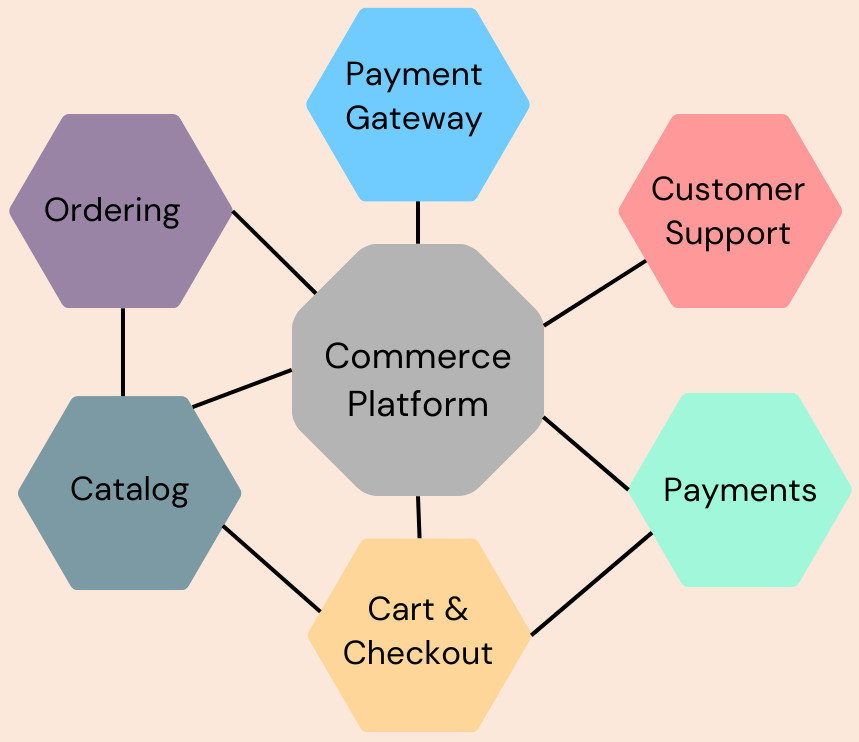
All these components are interconnected by APIs and perform specific functions. Changes made to one component do not necessarily affect the other components; even if they do, they have a minimal effect.
Read: What is Software Architecture?
Evolution of Software Architecture From Monoliths to Composability
The evolution of composable architecture can be traced back to reviewing its predecessors:
- Monolithic Architecture: These are single, indivisible units, and any change, no matter how minute, requires rebuilding and redeploying the entire system. Read: What is Monolithic Software Architecture?
- Service-Oriented Architecture (SOA): SOA introduced modularity through services. However, their integration was heavy, with enterprise buses adding more complexity to systems.
- Microservices Architecture: Applications are decomposed into lightweight, independent services. These services provide granularity to the system but can sometimes be complex in governance and orchestration.
- Composable Architecture: This builds on microservices but emphasizes business-level composability. The system is broken down into technical components that align with business capabilities and enable rapid configuration.
Building Blocks of Composable Architecture
Composable architecture is built on the following fundamental components based on the MACH approach. MACH stands for Microservices, API-first (application programming interfaces), Cloud Native, and Headless.
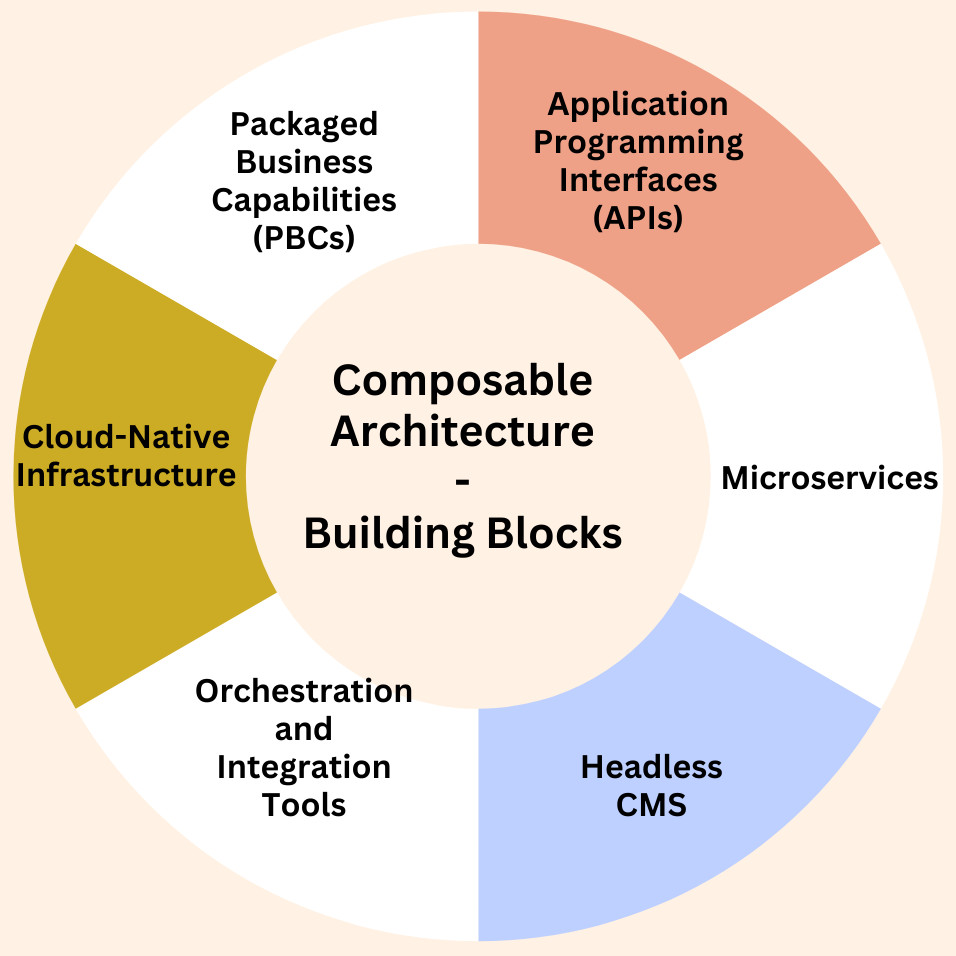
Packaged Business Capabilities (PBCs)
PBCs are self-contained units that represent business functionality. In the e-commerce system, various units, such as customer management or order fulfillment, are classified as PBCs. These units are pre-built, reusable components that perform specific business functions. They can also be sourced from third-party vendors or developed in-house.
A PBC might include multiple microservices, APIs, and user interfaces bundled together to provide a comprehensive solution for a particular business requirement.
Application Programming Interfaces (APIs)
APIs are the glue connecting various components in a composable system. They act as the communication channels between different components or services, enabling data exchange and interoperability. APIs define data structures, methods, and other interfaces that components can use to interact and ensure a smooth data flow.
Microservices
Microservices are small, self-contained services that encapsulate specific business functionalities. Each microservice is independently developed, deployed, and scaled. They communicate with each other through APIs, promote loose coupling, and reduce dependencies.
For example, in an e-commerce system, payment processing, user authentication, or inventory management are independent microservices.
Headless Content Management System (CMS)
A headless CMS decouples the content management functionality from the presentation layer (front end). This allows for greater flexibility in delivering content to various channels and devices, such as websites, mobile apps, and more. The backend content repository is decoupled from the front end in a headless CMS. This means content can be created, managed, and stored independently of how it’s displayed to the user.
Orchestration and Integration Tools
Middleware platforms, API gateways, and integration platforms like MuleSoft, SnapLogic, or Kafka handle communication, routing, and security in composable systems. They facilitate the integration of various components and systems and ensure efficient data flows and connected workflows.
Cloud-Native Infrastructure
Cloud technologies such as infrastructure (IaaS), platforms (PaaS), and software (SaaS) provide the scalable, on-demand computing resources for composable architectures. They can be quickly provisioned and scaled to meet the needs of individual components.
Composable Architecture Implementation
The following are the steps to follow for implementing a composable architecture:
1. Assess Current Architecture and Needs
Conduct a thorough assessment of the current system and analyze bottlenecks, inefficiencies, and areas that need flexibility. Special attention should be given to parts of the application that are difficult to scale, update, or integrate with other systems.
2. Identify Key Components to Modularize
Certain business functions in the system may be easily separated into independent services, while others may be difficult. Break down the application into smaller, manageable components, focusing on high-impact areas. Pay attention to areas that will most benefit from composable architecture.
3. Choose Appropriate Technologies
Technologies are crucial in composability and should be chosen carefully. TO begin with, choose a headless CMS to manage content independently from its presentation. Opt for microservices frameworks that support small, autonomous service development. Ensure scalability by choosing appropriate cloud platforms. Finally, to enable seamless integration between different services and platforms, and to ensure smooth data flow and communication, implement an integration platform as a service (iPaaS).
4. Develop an API Strategy
Components in a composable architecture communicate via APIs; therefore, consistent and well-documented APIs should be designed for all components. An overarching API strategy will keep documentation accurate and reliable so that all APIs can be easily implemented to connect new components.
5. Implement Gradually
Start with a pilot project to test the approach and build experience. For this, start with a small, manageable components that allow testing the composable architecture and identifying any issues or challenges. Refine the processes and strategies based on this project before slowly scaling up.
6. Continuously Evaluate and Optimize
Assess the performance of the composable architecture regularly and identify areas for improvement. Use metrics and feedback about optimizations and adjustments to ensure the system remains efficient and effective.
Best Practices for Implementing Composable Architecture
- Start Small: Start with a single business domain and then expand slowly.
- Define Standards: Set early API design guidelines, security protocols, and governance policies.
- Prioritize Business Capabilities: Modularize around business outcomes rather than technical layers.
- Invest in Observability: Use observability options such as logging, tracing, and monitoring to gain visibility into component interactions.
- Promote Cultural Alignment: Encourage cross-functional collaboration between business and technical teams.
Tools and Technologies Supporting Composability
The following table lists various tools and technologies that support composability:
| Tools/Technologies | Examples |
|---|---|
| API Gateways | Kong, Apigee, AWS API Gateway |
| Event Streaming | Apache Kafka, RabbitMQ |
| Containerization | Docker, Kubernetes |
| Integration Platforms | MuleSoft, Boomi |
| Headless CMS & Commerce | Contentful, Strapi, commercetools, Shopify Plus |
| Micro Frontend Frameworks | Single-SPA, Module Federation (Webpack) |
Benefits of Composable Architecture
- Agility: New features can be integrated quickly without rebuilding entire systems. This ability to quickly adapt to new market demands or business needs helps organizations to stay in the competition.
- Reusability: Pre-built components used in a composable architecture reduce redundant development efforts. For example, a payment processing module can be reused across multiple applications.
- Scalability and Resilience: Each module of the composable system is independent, allowing failures to be isolated. Teams need not overprovision entire systems when scaling up bottleneck components.
- Faster Innovation: Independent components allow rapid innovation and faster development with new features and functionalities. Organizations can test, learn, adapt, and launch rapidly.
- Alignment with Cloud and SaaS: Composable architecture fits well with SaaS ecosystems. Businesses can integrate third-party services instead of building everything in-house.
- Reduced Costs: Development in a composable system is streamlined, and components are reused, which saves on development, maintenance, and operational costs. As components are scaled independently, resources are allocated where they are needed, thus preventing overprovisioning and saving costs.
- Future-Proofing: Composable architecture is modular and allows for seamless replacement of components with better alternatives that may develop in the future. Its easy integration of new technologies and features ensures the system remains relevant and efficient.
- Reduced Vendor Lock-in: Since the system uses independent components, organizations are less reliant on specific vendors, thus reducing vendor lock-in.
- Enhanced Collaboration: Composable architecture eliminates the need to tightly couple the components tightly, encouraging collaborative problem-solving.
- Customization: Composable architectures create tailored solutions by assembling and reconfiguring components to meet personalized business needs. This ease of customization enables businesses to achieve a formidable competitive advantage.
Challenges of Composable Architecture
- Complex Orchestration: Managing dependencies, communication, and orchestration becomes complex as the number of components grows.
- Governance and Security: Each component must adhere to authentication, data-protection standards, and compliance. Standardizing policies is challenging, with each component having unique configurations and resource utilization.
- Performance Overhead: Too many API calls and excessive inter-service communication may introduce performance overhead.
- Cultural Shift: Migrating the traditional system to a composable system may result in a cultural shift for teams accustomed to monolithic or tightly coupled systems.
- Tooling and Monitoring: Tracking and monitoring may be challenging as they should be carried out across distributed systems.
- Increased Attack Surface: Many microservices and exposed APIs lead to an increased attack surface.
- Integration Challenges: Integration and seamless communication across the infrastructure become challenging as the number of microservices grows.
Differences Between Monolithic and Composable Architecture
Here is a comparison table that summarizes the key differences between traditional (monolithic) and composable architectures:
| Aspect | Monolithic Architecture | Composable Architecture |
|---|---|---|
| Overall Structure | Single, tightly coupled system | Loosely coupled, modular microservices |
| Codebase | Common codebase for the entire system | Independent codebase for each microservice |
| Agility | Minimal | Increased agility with easy, independent updates |
| Resource Utilization | Higher | Optimal |
| Communication | Intra-process communication between modules | Inter-process communication via API management |
| Scalability | Resource-intensive scaling | Independent scaling of each component |
| Maintenance | An update in one part may affect the entire system | Changes in one component do not affect others |
| Single Point of Failure | Exists | Does not exist |
Real-World Applications of Composable Architecture
Composable business solutions have wide-ranging applications. Here are some use cases of composable architecture:
1. E-Commerce Platforms
Retailers can choose best-of-breed components such as product catalogs, shopping carts, payment gateways, and recommendation systems using a composable architecture. Retailers can create customized online stores using these different components.
2. Banking and Financial Services
Banks and financial institutions can create modular services for KYC, loan approval, fraud detection, and customer onboarding, reassembling them for new products. They can also seamlessly add new systems and payment gateways to their ecosystem.
3. Healthcare Systems
Composable architecture can be used in healthcare systems to handle patient records, appointment scheduling, telemedicine, and billing. It can also help to enable interoperability between disparate systems like electronic health records (EHRs), imaging systems, and patient management platforms.
4. Telecommunications
Telecom providers can use composite systems for billing, usage tracking, and plan customization, allowing rapid rollout of new subscription models.
5. Government and Public Services
Composable platforms can integrate identity verification, benefits distribution, and citizen services while adapting to evolving regulations.
Future of Composable Architecture
- AI-Driven Orchestration: Automation of component assembly based on business goals.
- Low-Code/No-Code Platforms: Facilitating application composition by non-technical teams.
- Composable Security: Embedding modular, reusable security services in systems.
- Industry Standards: Broader adoption of open standards for interoperability.
Conclusion
Composable architecture in software development marks the shift from rigid, one-size-fits-all monolithic architectures to modular, adaptable ecosystems. By using reusable interoperable components to assemble systems, organizations can achieve unprecedented scalability, agility, and innovation.
Though challenges of orchestration complexity and governance exist in composable architecture, the benefits far outweigh these hurdles. As digital ecosystems evolve, composable architecture is set to become a dominant paradigm, enabling organizations to survive change and thrive because of it.
In essence, composable architecture is more than a technical design choice. It is a business enabler that turns software into a dynamic asset aligned with strategic requirements.
 |