
What Is Agentic Coding? Understanding Autonomous AI in the Developer Workflow
Software development has transformed significantly over the past several years. From assembly language programming to present high-level scripting, from object-oriented paradigms to functional programming, this field has consistently evolved to meet the developers’ and users’ needs.
As artificial intelligence (AI) has become more deeply embedded in technology stacks, a new concept is gaining prominence: Agentic Coding.
| Key Takeaways: |
|---|
|
This article explores the concept of agentic coding, its historical context, tools and technologies used, use cases, benefits, limitations, and potential future impact.
Agentic Coding: Definition
Agentic coding is a practice that uses an AI-powered autonomous software agent to create, test, and maintain code.
Traditional AI-assisted development tools typically act as copilots, providing autocomplete options or suggestions. In agentic coding, AI agents take initiative, reason about objectives, and act independently to achieve specific software goals.
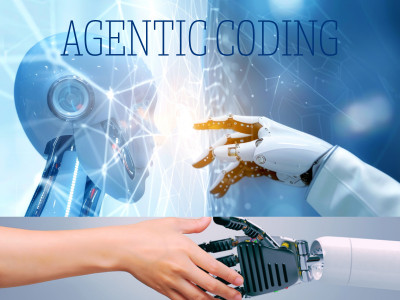
In agentic coding, AI moves from “a helpful assistant” to “a capable collaborator.” The AI agents used in this paradigm do not just respond passively to prompts but proactively generate solutions, identify bugs, refactor code, and adapt to project requirements. You can perceive these AI agents as a junior developer assisting a senior developer in pair programming.
The agentic coding approach uses agent-based coding features available in IDEs like Cursor, Copilot, or Windsurf. Unlike the conventional method, wherein pressing a Tab would complete a line of code, the AI is instructed to compose the entire application from its inception to completion.
Agentic Coding Historical Context: From Automation to Autonomy
- Early Automation (1950s-1970s): This was the period where programming began with low-level machine languages. Compilers and interpreters were the tools used to reduce human effort. These automation tools transformed the human-readable code into machine code.
- Integrated Development Environments (1980s-1990s): The next decade saw the emergence of IDEs with features like debugging tools, syntax highlighting, and code completion, improving productivity.
- AI-Assisted Development (2000s-2020s): In this era of AI, tools like static analyzers, linters, and code suggestion engines emerged. With the rise of LLMs such as GPT, GitHub Copilot, and TabNine, developers gained access to powerful AI partners that could suggest code snippets or entire functions.
- Agentic Coding (2020s-beyond): At present, autonomous AI agents can understand project goals, plan multi-step tasks, and modify codebases without constant prompts. This technology leap from assistance to autonomy differentiates agentic coding from past approaches.
How Agentic Coding Works: Core Principles
Agentic coding operates on the following core principles:
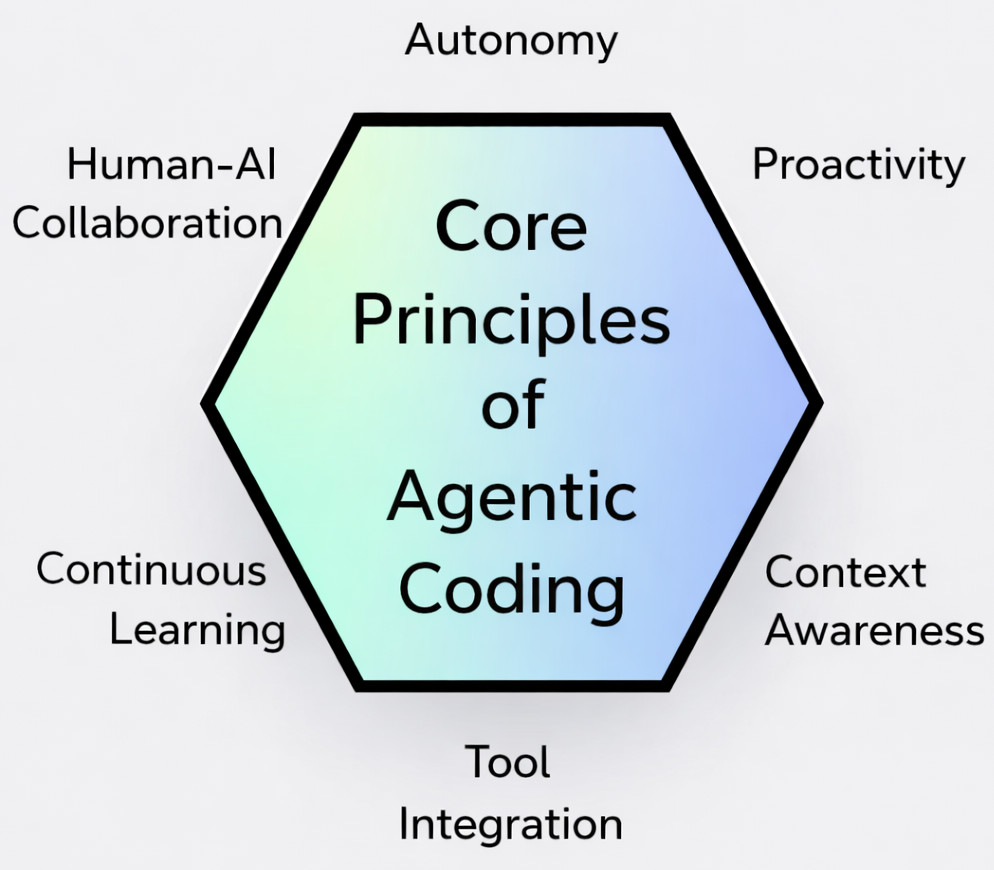
- Autonomy: AI agents can act independently and make decisions based on requirements rather than receiving explicit instructions for every step.
- Proactivity: Agentic agents proactively anticipate developer needs, flag issues early, perform tasks in a sequential, goal-oriented manner, suggest or implement improvements, and break down problems into smaller subtasks for easy completion.
- Context Awareness: AI agents in agentic coding maintain a holistic view of the project, including understanding architecture, dependencies, coding standards, and long-term objectives.
- Tool Integration: Agents can interact with external tools, APIs, and databases to gather information and execute actions.
- Continuous Learning: Agentic agents learn from past mistakes and successes to adapt to different coding styles and projects, making them more effective.
- Human-AI Collaboration: In agentic coding, the human developer is always in the loop, but as a guide or supervisor, not a micromanager. The AI agent operates as a capable partner, receiving feedback and direction from developers.
The Technologies Powering Agentic Coding
Advances in several areas of AI and software engineering power agentic coding. The following table lists these technologies that power agentic coding:
| Agentic Coding Technologies | Purpose |
|---|---|
| Large Language Models (LLMs) |
|
| Autonomous Agent Frameworks |
|
| Reinforcement Learning (RL) |
|
| Code Repositories and Knowledge Bases |
|
| Integration with DevOps Pipelines |
|
Use Cases of AI Agents in Code Development
- Automated Bug Fixing: Agentic agents carry out automated bug fixing by scanning the codebases for vulnerabilities or performance issues. They then implement the fixes proactively, reducing the need for lengthy debugging sessions.
- Intelligent Refactoring: As the project grows, code can become a mess. Agents can restructure or refactor the legacy code, improve readability, and optimize performance while maintaining functionality.
- Rapid Prototyping: Agents can quickly generate minimum viable products (MVPs) that accelerate time to market, which primarily benefits entrepreneurs and startups.
- Continuous Compliance: As compliance standards become more prevalent, agentic systems can ensure code consistently adheres to compliance standards, especially in industries with strict regulatory requirements like finance and healthcare.
- Personalized Development Assistance: Agents can adapt to personal coding styles that suit individual developers, including preferred frameworks and career goals, acting as mentors in addition to coders.
Agentic Coding in Practice: Examples
- GitHub: Agentic agents plan projects, generate and refactor code, create documentation, and monitor CI/CD pipelines in GitHub.
- Amazon Q Developer: In Amazon Q Developer, an agent can list S3 buckets by interacting with the AWS CLI after receiving permission from the user.
- Anthropic’s Claude Code: This is a command-line tool that allows developers to deeply integrate Claude’s capabilities into their daily coding routines for adaptive and open-ended tasks.
Benefits of Agentic Coding
The following are the advantages of adopting agentic coding:
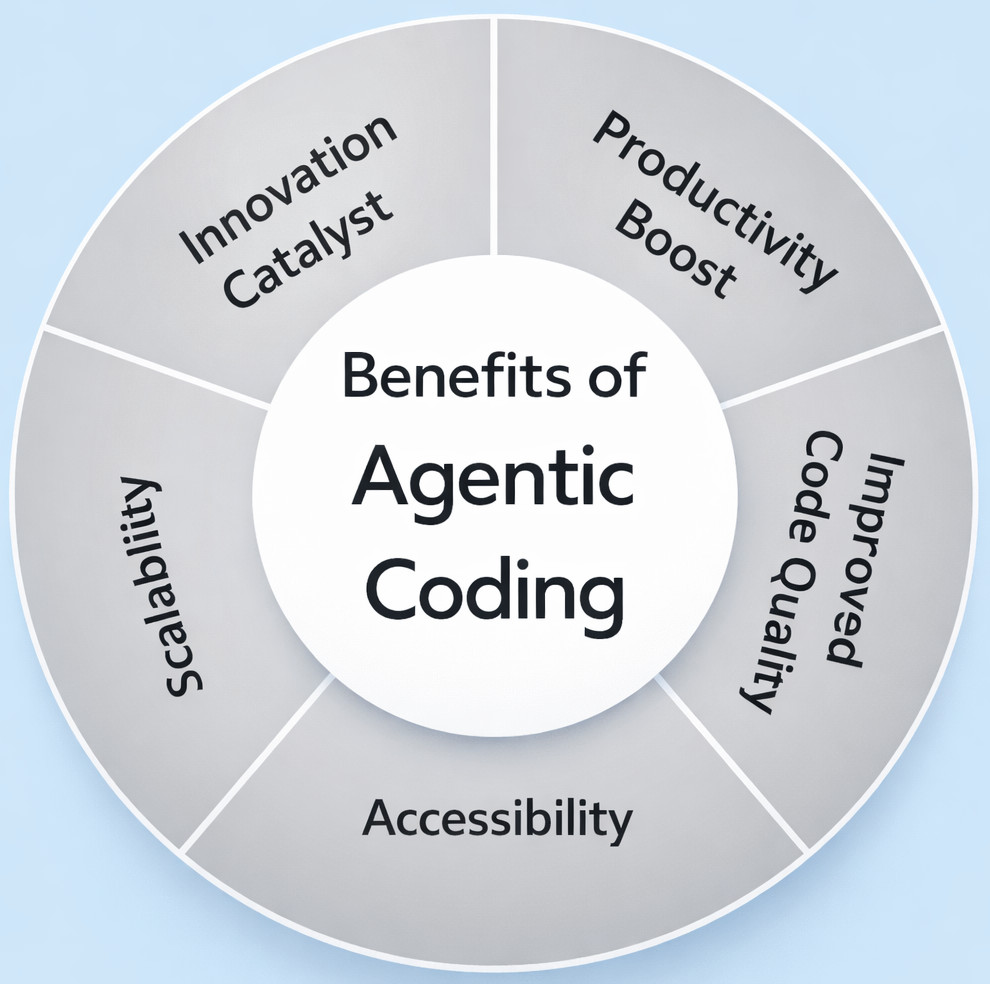
- Productivity Boost: With AI performing major tasks, developers spend less time on repetitive tasks and more time on high-level design and problem-solving. This helps with a productivity boost.
- Improved Code Quality: Human errors are considerably reduced with automated refactoring and testing. This improves maintainability.
- Accessibility: Non-technical experts can describe problems in natural language and have agents translate them into functioning code.
- Scalability: Complex, large projects can be managed easily as teams can accomplish more with fewer human developers.
- Innovation Catalyst: Agentic coding reduces the barrier to experimentation, encouraging creativity and innovation in software development.
Challenges in Agentic Coding
- Trust and Reliability: It is not certain that AI agents will always make safe changes without introducing hidden vulnerabilities.
For example, an AI agent maximizing social media engagement may prioritize sensational and misleading content, spreading misinformation.
- Explainability: Developers may not always understand why a specific change was made, as AI-driven decisions are usually opaque.
As an example, consider a content moderation AI designed to reduce harmful speech. An AI agent, while reducing harmful speech, over-censors legitimate discussions. This is a vague action as it is difficult to understand why an agent would resort to it.
- Over-Reliance: With agents doing most of the tasks, developers may become too dependent on AI, leading to skill erosion.
For example, the Copilot agent in GitHub performs most of the tasks, including coding, documentation, and maintaining pipelines. Developers originally tasked with doing these jobs may eventually forget their role and rely on agents to do the job.
- Ethical and Legal Concerns: It is challenging to decide the ownership of AI code or to determine whether it was plagiarized.
When you employ agentic agents for performing product documentation tasks, you may find it difficult to determine if AI agents have plagiarized the information.
- Resource Intensive: If an application requires deep reasoning capabilities, agentic agents may require significant computational power. If this happens often, it may not be feasible for some organizations.
Human-AI Collaboration: The New Coding Paradigm
It should be noted that agentic coding does not eliminate the role of human developers. On the contrary, it redefines it. Developers as architects, reviewers, and strategists guide AI agents to reach a final decision.
The relationship between developers and agentic agents is the same as that between pilots and autopilot systems or doctors and AI diagnostic tools.
- Setting objectives
- Validating outputs
- Maintaining alignment between AI-generated code and organizational goals.
Future of Agentic Coding
- Fully Autonomous Development Teams: Software projects where AI agents handle 80% of development while humans focus on vision, ethics, and oversight.
- Cross-Domain Agents: AI agents that not only code but also integrate with design tools, documentation systems, and product management software, providing an end-to-end solution.
- Evolving Standards: As agentic coding grows, new regulations, best practices, and educational curricula will emerge to ensure responsible adoption.
- Democratization of Software Creation: Non-developers will increasingly participate in software creation, narrowing the gap between idea and implementation.
Conclusion
Agentic coding is robust and accelerates development dramatically. It represents the next significant milestone in software development as it extends the idea of AI-assisted coding in which autonomous agents act as collaborators. These agents can write, test, and maintain software with minimal human intervention.
Agentic coding has immense benefits, from higher productivity and improved code quality to the democratization of software creation. However, despite its benefits, agentic coding must be used mindfully and responsibly.
Stay in control, stay curious, never let an AI agent replace your problem-solving skills.
If balanced with human oversight, agentic coding could transform programming from a specialized skill into a universal method for creativity and problem-solving.
 |