
Agentic Coding vs. Vibe Coding: Comparing AI-Coding Paradigms for Developers
“Dig into every industry, and you’ll find AI changing the nature of work.” – Daniela Rus
Software development is no stranger to AI. Apart from producing AI for the world, this field also benefits from the immense potential of this technology. With AI evolving by leaps and bounds, we can see a fundamental shift in the way software code is written. Two opposing yet complementary AI coding paradigms are already emerging as leaders in this revolution: Vibe Coding and Agentic Coding. While these buzzwords are doing the rounds in the industry, the million-dollar question that arises is, “Which approach will rule enterprise development in the coming years?”
Let’s explore these revolutionary coding approaches and examine how they differ from one another.
| Key Takeaways: |
|---|
|
According to Stack Overflow’s 2025 Developer Survey, in 2025, 84% of developers use or plan to use AI tools, signaling that AI-assisted development isn’t just a trend but is becoming a new standard.
As we explore the key differences between agentic and vibe coding in this article, you will discover how these two methodologies revolutionize how software is built, deployed, and maintained at scale.
What is Agentic Coding?
Agentic coding is an AI system that consists of AI agents that can plan, execute, and iterate on complex coding tasks with minimal human intervention.
It is primarily a goal-directed, intentional style of programming highlighting the coder’s capacity to act with purpose and control.
- Sets clear objectives before coding.
- Breaks problems into structured steps.
- Uses tools, AI, or agents as collaborators, but remains firmly in charge of the trajectory.
- Maintains a balance between automation and human oversight.
- The test-driven development (TDD) approach, in which tests guide code structure.
- Design patterns and architecture-first thinking that ensure scalability and maintainability.
- AI pair-programming with guardrails where the human defines goals and constraints, and AI executes within boundaries.
In agentic coding, the coder owns outcomes, ensuring software is robust, secure, and aligned with business or user goals.
- Understand project contexts
- Make architectural decisions
- Refactor existing codebases
- Analyze requirements
- Break down the complex into manageable tasks.
- Execute multi-step development tasks autonomously.
Read more about agentic coding in the article, What is Agentic Coding?
What is Vibe Coding?
Vibe coding is a process in which AI agents transform thinking into executable code. Users express their thoughts and intentions using plain speech (Natural language programming), and the intelligent AI agent translates these ideas into working software.
This is like conversing with your computer, where you narrate what you want. The computer (AI agents) then transforms your intentions into software. This way, developers can focus on business logic, user experience, and creative problem-solving instead of struggling with complex syntax or spending hours debugging and fixing errors.
Vibe coding emphasizes a flow-state, exploratory approach, unlike agentic coding. Developers rely on the project’s “vibes” instead of meticulously planning every step.
- Developers may experiment rapidly without overthinking.
- Coding becomes an act of creative play.
- Several agents and assistants, such as AI co-pilots, autocomplete, and generative suggestions, serve as sparks of inspiration.
- The results are not entirely predetermined, but are discovered along the way.
What makes vibe coding so appealing is that developers communicate logic, ideas, and functionalities through natural conversation rather than manually writing extensive code.
This fosters an inclusive community environment that allows domain experts who understand business requirements to participate directly in the coding process.
Agentic vs. Vibe Coding
The core difference between agentic and vibe coding lies in the level of AI autonomy and human control: with agentic coding, there is a greater autonomy for complex projects, whereas vibe coding emphasizes human direction for rapid, ideation-focused development.
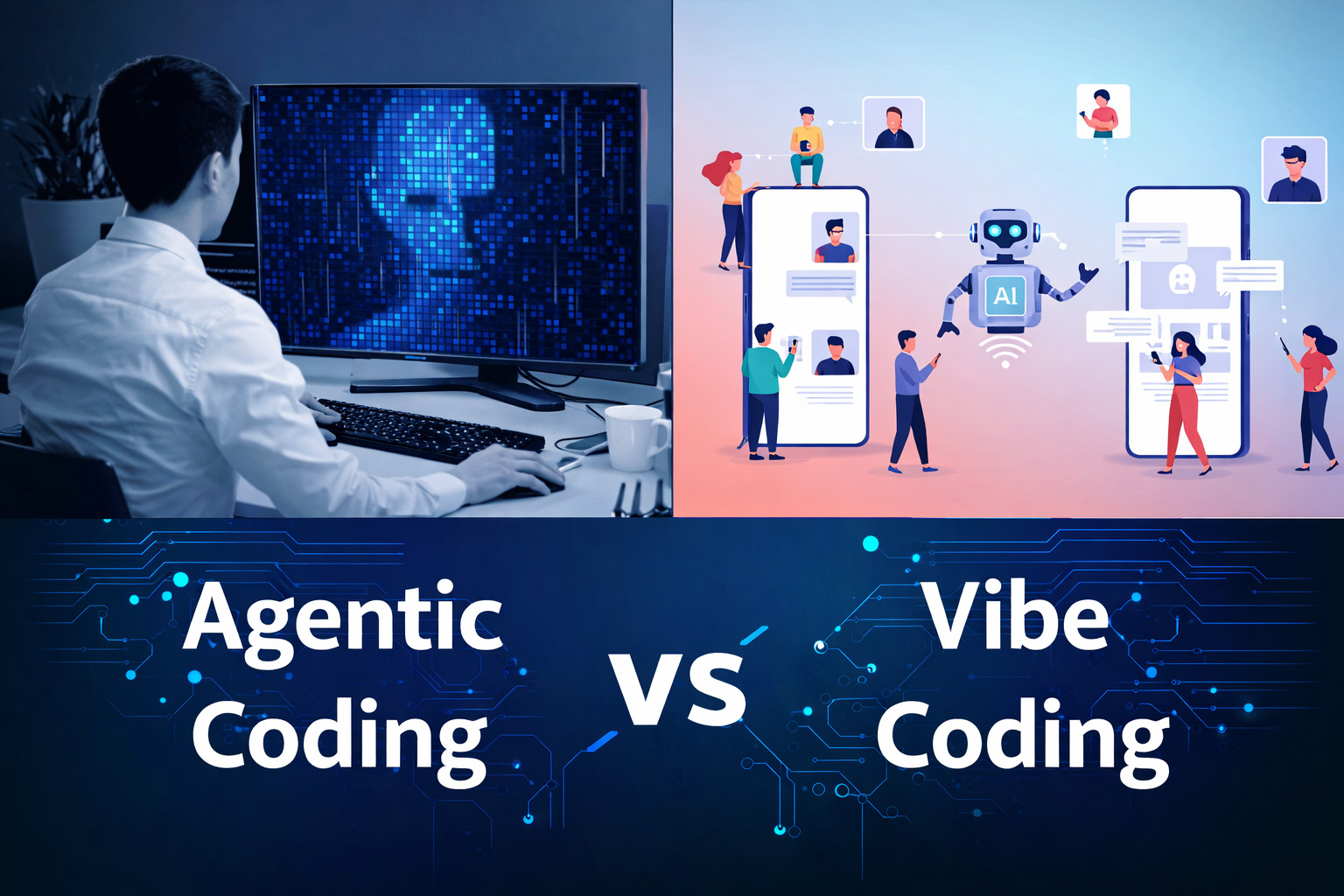
The following table summarizes the key differences between agentic and vibe coding:
| Aspect | Agentic Coding | Vibe Coding |
|---|---|---|
| Mindset | Goal-driven, intentional, accountable | Intuitive, playful, exploratory |
| Autonomy | Fully autonomous dev agent | Conversational co-pilot |
| Process | Structured steps, planning before coding | Flow state, improvisation, discovering as you go |
| Human role | High-level supervisor | Continuous steering |
| Initial Setup Time | Slow | Fast |
| Strengths | Large refactors, CI/CD maintenance | Rapid prototypes, green-field apps |
| Technologies used | Strict use of tests, frameworks, and architecture | AI co-pilots, autocompletion, creative prompts |
| Best Suited For | Mission-critical systems, long-term projects | Prototypes, hackathons, creative experiments |
| Scalability | Highly scalable | Limited scalability |
| Drawbacks | Can become rigid, slow, and resistant to change | Lacking discipline, produce messy code |
| Risk | Higher, silent failures are possible | Lower, every change is reviewed live |
| Rewards | Reliability, scalability, alignment with goals | Innovation, speed, unexpected breakthroughs |
| Tool examples | Devin 2.0, Copilot Agent | ChatGPT, Cursor, Ghostwriter |
Case Studies
Here are a few case studies to better understand agentic and vibe coding paradigms.
Case Study 1: FinTech App Development
Think of a startup developing a payment platform that needs to adhere to financial regulations. Here, agentic coding prevails – all features must be locked down and tested with an audit trail.
That said, vibe coding might be more useful in exploratory phase(s) of UI design, exploring different interaction models with some degree before settling into compliance-driven rigor.
Case Study 2: Game Development
Game developers typically start in vibe mode, where we just rapidly prototype mechanics, aesthetics, and narratives. When a game idea sticks, agentic coding now stabilizes the device, scales online play on its behalf, and adds systems for payment.
Case Study 3: AI Startups
AI product companies, especially startups, frequently embody the hybrid model: vibe coding during R&D phases to test what’s possible with new models, then switching to agentic coding to operationalize products for enterprise clients.
Balance Between the Two
- Start with Vibes, End with Agency: Vibe coding can be used to brainstorm, explore, and prototype. When refining, testing, and scaling, switch to agentic coding.
- Cycle Iteratively: Alternate between the two, for example, vibe coding for innovation sprints, and agentic coding for stabilization sprints.
- Team Composition: Let some team members lean into vibe coding as explorers while others specialize in agentic coding as builders. The team will then have a balance of creativity and reliability.
The Future of Agentic and Vibe Coding
- Agentic mode: AI facilitates test coverage, linting, and architectural guidelines.
- Vibe mode: AI acts as a jam partner, generating wild ideas, remixing code snippets, and suggesting unorthodox solutions.
In the future, developers will treat coding more like orchestration, moving between disciplined agentic coding and free-flowing vibes coding as naturally as musicians shift between improvising solos and reading sheet music.
Conclusion
The contrast between agentic and vibe coding is not about choosing one style over the other but appreciating programming’s dual nature as engineering and art.
Agentic coding provides accountability, structure, and reliability. Vibe coding ensures creativity, innovation, and rapid iteration. Together, they help human cognition with structured reasoning intertwined with spontaneous creativity.
In this era of AI, developers who can master both paradigms and easily switch between them will shape the future of software. By balancing both methodologies, they will write code and compose experiences, orchestrating machines with agency while vibing with the unknown.
 |