
Cyber-Physical Systems (CPS) Explained
The modern technology landscape is rapidly changing, and various systems that are part of this landscape are converging. One such system is the Cyber-Physical Systems (CPS) that has emerged as the result of the convergence of computing, networking, and physical processes.
| Key Takeaways: |
|---|
|
In this article, we will discuss the following:
|
This article delves into the concept of CPS, explaining its components, architecture, key features, applications, challenges, and future potential.
What Are Cyber-Physical Systems?
Cyber-Physical Systems (CPS) are defined as integrations of computation and networking components with physical processes. Physical processes are monitored and controlled by the embedded computers and networks with feedback loops in which physical processes affect the computations and vice versa.
CPS has tighter integration with the physical world and has uses in advanced computing and networking to interact with the physical world in real time. They are distinct from traditional embedded systems. In simpler terms, CPS technology connects the physical and virtual worlds, consisting of computational and physical capability that engages with humans as before.
CPS is a new generation of digital systems and is designed to act like a network of multiple variables with physical input and output instead of standalone technology. The CPS concept is closely related to sensor networks, like robotics, that use computational intelligence.
Components of CPS
- Physical Components: Sensors, actuators, and mechanical parts form the physical components.
- Cyber Components: Embedded processors, software algorithms, and network protocols are the cyber or logical components of CPS.
- Communication Infrastructure: Allows seamless interaction between cyber and physical components.
CPS has applications in various domains, including autonomous vehicles, smart grids, healthcare systems, and industrial automation. It enhances the efficiency, safety, and decision-making prowess through automation and interconnectivity.
Key Features of CPS
CPSs have distinct features that set them apart from computer systems and embedded devices. Here are some of the key features of CPS:
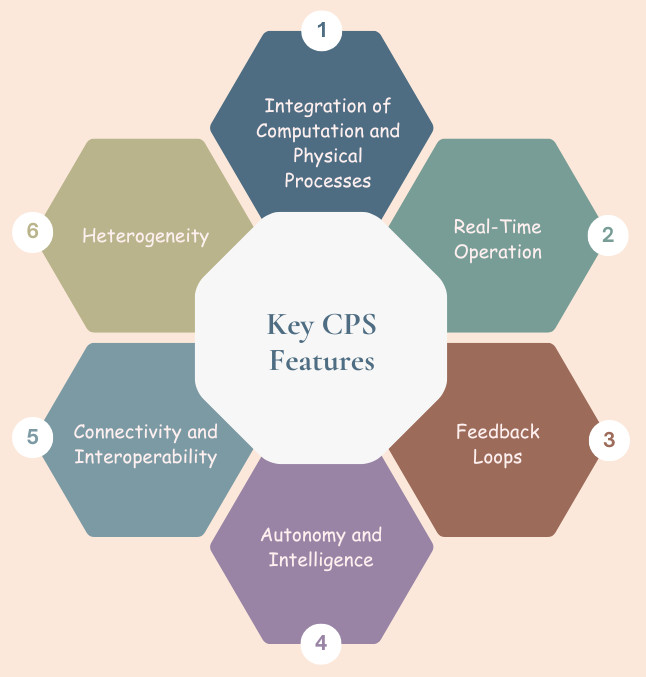
- Integration of Computation and Physical Processes: CPS integrates software and hardware components to monitor and control physical entities. They are not merely software running on hardware, but in CPS, the cyber and physical components are tightly intertwined. This helps with real-time interaction and feedback between digital and physical worlds.
- Real-Time Operation: CPS operates in real time and promptly responds to changes in the physical environment. Applications like autonomous vehicles that require immediate action use CPS.
- Feedback Loops: Continuous feedback is required between sensors, controllers, and actuators to ensure responsive and adaptive behavior.
- Autonomy and Intelligence: CPS adapts to changing conditions and operates autonomously. It can make decisions based on real data, learn from its expectations, and also use machine learning (ML) and artificial intelligence (AI).
- Connectivity and Interoperability: CPS are connected to networks (wired or wireless) and perform functions like exchanging data, coordinating actions, and learn from each other. This interconnectivity boosts scalability and adaptability.
- Heterogeneity: Various components of CPS, such as sensors, actuators, processors, and communication devices, make it a heterogeneous system that requires sophisticated integration and coordination mechanisms for seamless operation.
Architecture of Cyber-Physical Systems (CPS)
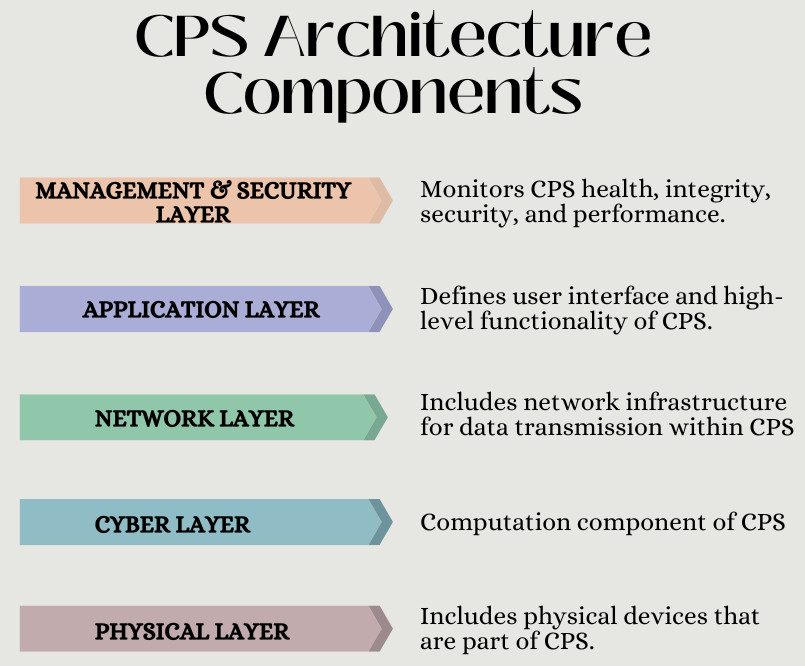
CPS architecture integrates hardware and software components, facilitating the dynamic interaction between physical processes and computational elements. The architecture forms the foundation for the intelligent and responsive behavior of CPS.
A general CPS architecture includes the following layers:
1. Physical Layer
This is the uppermost layer of CPS and includes all physical devices, such as mechanical and electronic hardware. Sensors that collect data (e.g., temperature, pressure, motion), actuators that control the physical process based on commands, and machines are some of the devices that form the physical layer of CPS.
These layers are for the real-world system or environment that CPS interacts with.
2. Cyber Layer
This layer forms the computation part of CPS. It includes software systems, data processing components, AI/ML algorithms, and embedded controllers. Cyber layer components analyze sensor data to make informed decisions.
3. Network Layer
Data transmission between the physical and cyber layer components is carried out by the network layer. This layer includes wired or wireless infrastructure that transmits data between the layers in addition to communication protocols, security mechanisms, and network infrastructure (e.g., 5G, Wi-Fi, Ethernet).
4. Application Layer
This is the layer that defines the user interface (UI) and high-level functionality of CPS. CPS tasks such as vehicle navigation, industrial process control, and medical diagnostics are tailored in the application layer.
5. Management and Security Layer
This is an important layer that monitors the health, performance, and integrity of CPS. It also handles configuration, maintenance, authentication, access control, and data privacy of the system.
Application of Cyber-Physical Systems (CPS) Across Industries
CPS is not just a theoretical concept; these systems are transforming industries and shaping how technology will look in the future. Here are some real-world applications of CPS:
Manufacturing
Using CPS, machines communicate, diagnose issues, and adapt to changes autonomously. These “smart factories” enabled by CPS boost productivity, improve quality control, reduce downtime, and facilitate mass customization. Robots with sensors and actuators work in smart factories, and ML algorithms analyze production data to predict maintenance needs and prevent failures.
Healthcare
CPS supports real-time patient monitoring, smart implants, and remote surgeries that adjust therapy based on body feedback. The healthcare industry has undergone a significant transformation with CPS that makes use of connected medical devices and wearables to monitor patients’ health data. Implantable devices like pacemakers and insulin pumps have sensors that monitor physiological parameters and deliver personalized therapy.
Transportation
Autonomous driving is a breakthrough in transportation using CPS. In addition to this, vehicle-to-vehicle (V2V) and vehicle-to-infrastructure (V2I) communications help improve road safety and reduce congestion. Autonomous vehicles use sensors and advanced algorithms to understand their surroundings, navigate through traffic, and make swift decisions.
Agriculture
Agricultural yield is boosted by using smart farming technologies, using CPS to monitor crop health, soil moisture, and automate irrigation. This also reduces resource waste.
Energy Systems
CPS monitors consumption patterns, optimizes grid load, and integrates decentralized energy sources like solar and wind. Smart grids in the energy sector use CPS by integrating sensors, smart meters, and communication networks to control and monitor the flow of energy and to integrate renewable energy sources.
Aeronautics
CPS can be used in the aeronautics field to improve aircraft control and safety. Performance and efficiency of aircraft can also be improved using CPS.
Benefits of Cyber-Physical Systems
- Increased Efficiency: CPS performs real-time monitoring and control. This helps systems with better resource utilization, reduced waste, and optimized processes.
- Improved Safety: With real-time interaction between physical and virtual worlds, dangerous conditions can be detected by CPS early on and preventive action taken.
- Scalability and Flexibility: CPS expands systems or reconfigures them for different tasks or environments.
- Higher Reliability: System uptime is improved, and failures are reduced with predictive maintenance and self-healing abilities.
- Better User Experience: CPS enhances comfort and performance by adapting to user behavior and preferences dynamically.
Challenges and Risks in CPS
Significant harm is caused if the CPS is compromised, especially in healthcare or transportation sectors, due to the sensitivity of operations.
- Security Vulnerabilities: CPS relies on precise sensor data for real-time decision making. Since the network component is interconnected with CPS, it becomes a potential target for cyberattacks. Compromised or manipulated data can lead to irreversible errors and unreliable operations, like a hacked autonomous vehicle can cause real-world harm.
- Complexity and Integration: There is a tight integration between physical and software components in CPS that is highly complex and requires multidisciplinary expertise. Owing to their complexity, they are more vulnerable to attacks, specifically the communication network and individual components.
- Real-Time Constraints: Most of the time, CPS must perform under strict time constraints, such as in autonomous vehicles. Delays in sensing or controlling can lead to system failures or safety concerns.
- Interoperability Issues: Mixing standards or older systems with new CPS can create security gaps and compatibility issues. This also makes integration difficult, and interoperability suffers.
- Safety & Privacy Concerns: The data that CPS collects is mostly sensitive (e.g., health information, location data) and requires robust privacy measures.
- Legacy Systems: Many organizations still use legacy systems that were not designed with cybersecurity in mind. CPS on such outdated systems is an easy target for attackers.
- Regulatory Compliance: Not complying with cybersecurity standards and regulations may cause security issues. It is vital to protect CPS against evolving threats and ensure resilience by adhering to standards and regulations.
These challenges discussed urge the need for effective cybersecurity measures to protect CPS from potential threats and maintain reliability and operational safety.
Cybersecurity Measures in CPS
- Authentication and Access Control: Devices and networks used in CPS should be prevented from unauthorized access. One key strategy is segmentation, which divides the system into smaller, isolated zones to limit cyberattacks. Techniques like firewalls, VLANs, and ACLs are used for this purpose.
To prevent unauthorized access, strict access control policies, such as strong authentication and role-based access, are also necessary.
- Encryption: Securing communication between components is a security measure that should be implemented across the system. Various encryption methods can encrypt the data that travels between system components.
- Anomaly/Incident Detection: Continuous monitoring should be employed to detect and respond to security incidents in real-time. Organizations can identify suspicious activities by analyzing security logs, network traffic, and other data.
- Secure Software Development: It is advisable to follow security best practices from the start to thwart security risks. For example, writing code with security best practices instead of following them during deployment will significantly prevent security threats.
- Resilience and Redundancy: Systems should be designed to continue to function normally during attacks or failures.
In addition to these security measures, emerging standards and frameworks, such as the NIST CPS Framework, guide organizations in effectively securing their systems.
Future of Cyber-Physical Systems
- Edge Computing: Shifting computation closer to the data source location for faster response times.
- 5G and Beyond: Enabling ultra-low latency communication, such as 5G networks for critical CPS applications.
- Digital Twins: Creating real-time virtual models of physical systems for simulating, monitoring, and controlling operations.
- Quantum Computing: Offering breakthroughs in optimization and control problems through quantum computing.
- Standardization: Unifying protocols and interfaces to improve interoperability and reduce development complexity.
The convergence of CPS with technologies such as the Internet of Things (IoT), Blockchain, and augmented reality will lead to new applications and business models.
Conclusion
Cyber-physical systems (CPS) are transforming the way we interact with and control the physical world. By tightly integrating computational nodes with physical processes, CPS enables safer, smarter, and more efficient systems across important industries.
However, there are potential threats and security risks associated with CPS. CPS must prioritize security, privacy, and ethical considerations to ensure that society as a whole benefits. As technology continues to evolve, the importance of CPS will only grow, reshaping everything from how we live and work to how we heal, create, and travel.
 |