
Different Types of Programming Languages
Software development is one of the most sought-after fields today in the world, and an essential skill that every software professional is expected to possess is programming. Programming language is the foundation of modern software development. They serve as the medium of communication between humans and computers.
| Key Takeaways: |
|---|
|
This article explores the various types of programming languages, their classifications, and their real-world significance.
What is a Programming Language?
A programming language is a system of grammatical rules (both syntactic and semantic) and notations that instruct a computer or a device on how to execute specific tasks.
A programming language is made of keywords, symbols, punctuation, and operators that dictate how a program is written and structured. Machine-level language was the first language used to communicate with the computer. However, over time, programming languages have incorporated more natural language and human-readable elements, creating a more intuitive development process.
Key Features of Programming Languages
Although different programming languages are identified by their unique features and utilities, there are a few key features that almost all programming languages share.
- Simplicity: A programming language must offer clear and simple concepts that are easy to understand, apply, and learn.
- Capability: The language must have a robust set of features to perform a wide range of tasks. It must have the necessary means and methods to achieve optimal results in a specific area where it is used.
- Abstraction: A programming language should be able to hide specific low-level details and, at the same time, define and use complicated structures or operations.
- Efficiency: An efficient language helps prevent excessive memory and time consumption.
- Structuring: Programmers can write their code more efficiently and with fewer errors if the programming language is well-structured.
- Compactness: Operations should be concise, without requiring excessive detail.
- Principle of Locality: This phenomenon, also known as the locality of reference, describes a computer program’s preference for continually accessing the same areas of memory over a short span of time. Programming languages utilize the principle of locality, employing loops and subroutines to optimize the overall performance of an application.
Differences between Natural Language and Programming Language
Natural languages are those spoken by people, while programming languages are designed for machines. Both types of languages were created to communicate ideas, expressions, and instructions.
Here are some of the key differences between natural and programming languages:
| Natural Languages | Programming Languages |
|---|---|
| Designed for human-to-human communication, conveying thoughts, emotions, and complex ideas in a flexible and nuanced manner. | Designed for human-to-computer communication, providing precise instructions to control a machine’s behavior and create software. |
| Examples include English, Spanish, and Mandarin. | Examples include Python, Java, and C++. |
| Inherently ambiguous, context-dependent, and a vast vocabulary with many synonyms and homonyms. | Characterized by strict syntax and semantics, requiring precise adherence to rules to ensure unambiguous interpretation by a computer. They are designed for logical instruction and lack the capacity for emotional or metaphorical expression. |
| Their grammar is flexible and can evolve. They allow for creativity, metaphor, and emotional expression. | Their structure is defined and changes through deliberate updates by development teams. |
| Requiring interpretation based on context, cultural understanding, and shared human experiences to grasp the meaning fully. | They are processed by compilers or interpreters that translate the code into machine-executable instructions, demanding absolute clarity and no ambiguity for successful execution. |
| Natural languages are open and allow combinations without the risk of making mistakes. | Programming languages are closed and fixed to avoid confusion and mistakes. |
Different Types of Programming Language Classifications
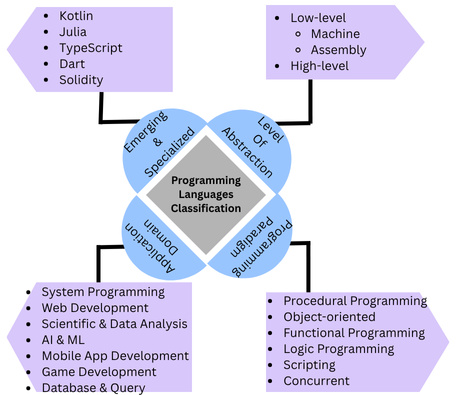
There are hundreds of programming languages currently available on the market, making it difficult to track them all. Hence, these programming languages must be classified to facilitate easy identification. While there are dozens of ways to classify programming languages, three main categories are commonly used: level of abstraction, programming paradigms, and application domain. The fourth classification provides emerging languages. The detailed classification is shown here:
Level of Abstraction
Depending on their closeness to machine code, programming languages are divided into low-level and high-level languages.
-
Low-Level Languages
These languages interact closely with computer hardware, providing minimal abstraction from the machine’s instruction set. Developers can manage memory and processor instructions directly using low-level languages. Low-level languages are further divided into machine language and assembly languages.-
Machine LanguageMachine language is the lowest level of programming. It consists entirely of binary code (0s and 1s), and a machine language program is directly executed by the central processing unit (CPU).Machine language is extremely fast, and no translation is required for the code. However, it is difficult to write, read, and debug. It is highly machine-dependent. Hence, every different type of machine will have different machine code instructions, making the language inflexible for coding.
-
Assembly LanguageThis type of language uses mnemonics (codes) and symbolic names instead of binary codes. Each assembly language instruction corresponds to one machine language instruction.For example, Move A, B (moving data from B to A) will perform the data movement operation.An assembler is required to convert assembly code to machine code. Assembly language is easier to use than machine language and allows for direct hardware control. A developer can access hardware resources, such as registers, using assembly language.However, the assembly language remains complex and is not portable across different processors.
-
-
High-Level Languages
High-level languages provide greater abstraction from hardware and low-level machine code, using natural language elements and mathematical notations. These languages require compilers or interpreters to translate the program into machine code.C, Python, Java, C++, and JavaScript are examples of high-level programming languages.High-level languages are easier to read, write, and debug. They are also easy to maintain and highly portable. However, they are slower than low-level languages and are less efficient.
Classification by Programming Paradigm
A paradigm is a style or way of programming. Different languages support different paradigms, and some are multi-paradigm. Depending on the programming paradigms used, programming languages are classified as:
-
Procedural Programming Languages
Procedural languages are designed around the concept of procedures or functions, which are blocks of code that perform specific tasks. Programs in procedural language are executed step by step, following a defined sequence. C, Pascal, Basic, and FORTRAN are some examples of procedural languages.Procedural language focuses on how tasks are performed and mainly adopts a top-down programming approach. Procedural languages have a simple structure, utilizing reusable functions and procedures. These languages are suitable for mathematical and algorithmic problems. They are commonly used in medium-sized applications and embedded systems where logic and control flow are straightforward.Procedural languages, however, are challenging to scale for large applications, and data is not well-encapsulated, as these languages focus more on functions and procedures. -
Object-Oriented Programming (OOP) Languages
OOP languages focus more on data. It organizes data and the code operating on that data into entities called objects. This mirrors real-world entities, promoting code reusability and modularity. C++, Java, C#, Ruby, and Python are the popular OOP languages.OOP languages are based on four core principles of encapsulation, inheritance, polymorphism, and abstraction, which promote reusability and modularity. These are easier to maintain and debug. OOP languages are frequently used in software, web, and game development, and also in simulation modeling and AI applications.A significant drawback of OOP languages is that they are slower, mainly because of abstraction. They are also complex, especially for small programs. -
Functional Programming Languages
Functional programming treats computation as the evaluation of mathematical functions. It avoids changing state and mutable data. Examples of functional programming languages are Haskell, Scala, Lisp, Erlang, and F#.Functional programming languages have predictable, maintainable code that is easy to understand by using pure functions and immutable data. These languages are often used in applications that handle vast amounts of data or run multiple tasks simultaneously, like in data science, financial modeling, and real-time distributed systems.Functional programming languages treat functions as first-class citizens and focus on what to solve rather than how to solve. It is easier to debug due to the lack of side effects, and it is an excellent language for parallel processing.However, these languages usually have a steep learning curve and are less intuitive for imperative programmers. -
Logic Programming Languages
Logic programming languages are based on formal logic. Programs are written as a set of facts and rules about problems within a system of formal logic. Prolog is a typical example of a logic programming language.Using a system of facts and rules enables computers to solve computations independently without requiring step-by-step instructions.The rules and relationships are typically defined in the form of clauses. Inferences are then drawn based on these rules. Logic programming languages are utilized in fields such as AI and computational linguistics for tasks that involve pattern matching and knowledge representation.Logic programming languages mostly have a declarative style that simplifies reasoning. However, they are inefficient for general-purpose computation and are hard to optimize. -
Scripting Languages
Scripting languages are primarily used to automate repetitive tasks, manipulate data, or control other programs in larger applications. These languages are typically interpreted rather than compiled. Python, JavaScript, Perl, PHP, and Bash are the scripting languages that are extensively used today.Scripting languages have a simplified syntax, are easy to learn, and are ideal for writing quick, small scripts for specific tasks. They are used in web development, data processing, system administration, and software automation. They are great for quick prototyping, but are slower than most compiled languages. They are not ideal for large, complex systems. -
Concurrent and Parallel Programming Languages
Concurrent and parallel programming languages are designed to handle multiple tasks simultaneously, critical for modern multicore processors. Go, Erlang, Ada, and Rust are programming languages that exhibit concurrent and parallel programming capabilities.These languages feature constructs such as threads, synchronization, and message passing, which facilitate concurrent and parallel programming. Concurrent and parallel programming languages offer high performance on multicore systems and are ideal for server and distributed computing applications. They are complex to debug and run the risk of race conditions.
Classification by Application Domain
Programming languages can also be classified based on their specific use cases or the domain they serve. Depending on the application domain, programming languages are divided into the following categories:
-
System Programming Languages
These languages are used to develop operating systems, device drivers, and embedded systems as they interact closely with hardware. C, C++, Rust, and Assembly are examples of system programming languages, with C and C++ being the most extensively used.System programming languages are high-performing with optimal memory management and low-level hardware access. These languages often require a deep understanding of hardware architecture, memory management, and system-level details. They are more complex to learn and use compared to high-level languages. -
Web Development Languages
These are the programming languages that are used to build web applications and websites. Web development involves frontend and backend development, and there are programming languages that are accordingly classified as frontend and backend programming languages.- Frontend (Client-Side)
Front-end languages, also known as client-side programming languages, are responsible for controlling user interfaces and browser interactions in web applications.HTML, CSS, JavaScript, and TypeScript are popular programming languages used in frontend web development.
- Backend (Server-Side)
These are also known as server-side languages and manage the database, business logic, and server communication in web applications.Common server-side programming languages include PHP, Python (with frameworks such as Django and Flask), Java (utilized with Spring), Ruby (utilized with Rails), and JavaScript (utilized with Node.js).
- Frontend (Client-Side)
-
Scientific and Data Analysis Languages
Scientific and data analysis programming languages focus on numerical accuracy, performance, and data visualization. Python (NumPy, Pandas libraries), R, MATLAB, and Julia are some of the programming languages commonly used in scientific and data analysis.These languages commonly have rich libraries and interactive environments. They are used in data science, machine learning, and statistical modeling. A significant drawback of these languages is that they are slower when it comes to low-level computation. -
Artificial Intelligence and Machine Learning Languages
AI-focused languages focus on symbolic reasoning, pattern recognition, and data analysis.Python, Lisp, Prolog, and Julia are examples of programming languages used in AI and ML. Python dominates due to libraries like TensorFlow, PyTorch, and Scikit-learn. Prolog and Lisp languages are considered foundational in the field of AI research. -
Mobile App Development Languages
Mobile app development languages are used to develop mobile apps and are classified based on whether they are used for Android, iOS, or cross-platform development. They are classified as follows:- Android Development
The programming languages that are used for developing mobile apps on the Android operating system are Java and Kotlin.
- iOS Development
Swift and Objective-C are the programming languages that are used for developing apps on the iOS platform.
- Cross-Platform
Cross-platform (across multiple devices) development is done using languages/frameworks like Flutter (Dart), React Native (JavaScript), and Xamarin (C#).
- Android Development
-
Game Development Languages
Game development systems require high performance, graphics control, and physics simulation. Most game development systems utilize C++. However, other languages, such as C#, Java, Python, and Lua, are also used for this purpose.Additionally, engines such as Unity (C#) and Unreal Engine (C++) are also utilized. -
Database and Query Languages
These are the languages used to retrieve data from databases and perform modifications to the data. The most popular database and query languages are:- SQL (Structured Query Language): This is a standard language for relational databases.
- NoSQL languages: These languages are used in non-relational databases, such as MongoDB.
- GraphQL is used for efficiently querying APIs.
Emerging and Specialized Languages
Having discussed the major classifications of programming languages, several new programming languages have emerged in recent years and are gaining ground slowly. Some of these languages are listed here:
Kotlin
Kotlin is the official language for Android development and is interoperable with Java. It is concise, null-safety, and modern.
Julia
Julia is a programming language focused on numerical computing and machine learning. It combines the speed of the C language with the simplicity of Python.
TypeScript
TypeScript is a superset of the JavaScript language that adds static typing. It is used in large-scale web applications and is a popular language for web development.
Dart & Solidity
These are the newest programming languages. Google’s Flutter framework uses Dart for cross-platform apps. Solidity is a programming language specifically designed for blockchain and innovative contract development on the Ethereum platform.
Popular Programming Languages and Their Features
In this section, we list the features of popular programming languages:
| Programming Language | Features |
|---|---|
| C Language |
|
| C++ |
|
| Java |
|
| Python |
|
| JavaScript |
|
| PHP |
|
| Swift |
|
| Go (Golang) |
|
| Rust |
|
| R |
|
Choosing the Right Programming Language
Selecting an appropriate programming language depends on several factors, as follows:
- Project Type: Whether the project to be developed is based on Web, mobile, system, or AI.
- Performance Requirements: Should the development focus on speed and efficiency?
- Scalability: Is there a requirement for support for large systems?
- Ecosystem: Identify the ecosystem for the programming language, including libraries, frameworks, and community support.
- Learning Curve: Evaluate the developer experience and team skillset, as well as whether the chosen language has a steep learning curve.
For example, the following are the programming languages ideal for specific development:
- AI: Python or Julia.
- System Programming: C or Rust.
- Web Development: JavaScript or TypeScript.
- Mobile App Development: Swift (iOS) or Kotlin (Android).
The Future of Programming Languages
Programming languages continue to evolve in response to emerging technologies. The future trends related to programming language are:
- Increased abstraction through AI-assisted coding.
- Multi-paradigm languages blend OOP, functional, and declarative styles.
- Domain-specific languages (DSLs) for specialized applications.
- Quantum programming languages (like Q# and Qiskit) are emerging for quantum computing.
Languages emphasizing safety, concurrency, and cross-platform performance, such as Rust, Go, and Swift, are likely to dominate the next decade.
Conclusion
Programming languages are the fundamental building blocks of modern computing. From low-level assembly to high-level scripting, each type serves a unique role in solving problems efficiently. Understanding the various classifications, by abstraction level, programming paradigm, and application domain, enables developers to choose the right tools for their tasks.
As technology advances, languages evolve, blending paradigms and improving performance, safety, and ease of use. Whether you’re a beginner or an expert, being knowledgeable in different types of programming languages provides a strong foundation for navigating the ever-changing landscape of software development.
Additional Resources
- What are the Different Types of Code Smells?
- Data Science vs Software Engineering
- Serverless Computing in Software Engineering
- Logging in Software Engineering: Best Practices
- What is Code Optimization?
 |