
How to Write Scalable Code: Best Practices for Maintainable Software
In software development, scalability is a critical principle that defines the longevity and success of software systems. For software applications, scalability is a survival skill. As the user base for the application grows, features multiply, and infrastructure evolves, the application codebase must withstand the pressure without collapsing under its own weight.
It is important to write a scalable code that can handle growth, adapt to changing requirements, and maintain readability. Most importantly, a code that doesn’t make developers lose their minds!
This guide in writing scalable code covers the principles, engineering tactics and best practices that help you write scalable code that stays sane.
| Key Takeaways: |
|---|
|
What is Scalable Code?
A scalable code is capable of handling changes, new features, new teams, and new complexity without melting down.

It is a code that can handle increased traffic and demand without breaking. Scalability isn’t only about performance but about adaptability, maintainability, and long-term resilience.
- A scalable code handles increased load or data without degrading performance.
- It can be extended with new features or some rules without requiring major rewrites.
- It is maintained and debugged by teams of developers over time.
- A scalable code supports deployment to larger, more complex infrastructure environments (e.g., cloud, microservices).
For your application to handle growth and increased usage, it is essential that your codebase is scalable.
- Use Efficient Algorithms: Algorithms that use less resources and can handle large amounts of data are efficient. For example, using linear search for searching a large array is time-consuming and hold up resources. Using binary search instead will produce quicker results.
- Use Caching: Storing frequently accessed data in memory and reducing the need for database queries improves performance. For example, user profile information once fetched can be stored in memory as it is frequently needed.
- Use Load Balancing: With load balancing, traffic is distributed across multiple servers, ensuring that no single server is overwhelmed. For example, retailers use multiple web servers to load balance so that customers do not get stuck during peak sale hours.
- Use Cloud Services: Increased traffic and demand can be efficiently handled by cloud services such as AWS and Google Cloud that provide scalable infrastructure and services. Hence, for purposes like storing data and hosting applications, cloud services can be used.
In general, when writing scalable code, ask yourself the following questions:
- How will this code behave when the data is 10 times more than the current?
- What are the implications if this component fails?
- Can I reuse this module elsewhere?
- Six months from now, will this code be useful, and will other developers understand this logic?
These questions will help you prevent tunnel vision and instead of writing fastest solution, you implement a solution that is modular, resilient, and predictable.
How to Write Scalable Code – The Core Principles
Developers must consider the following core principles for scalable code:
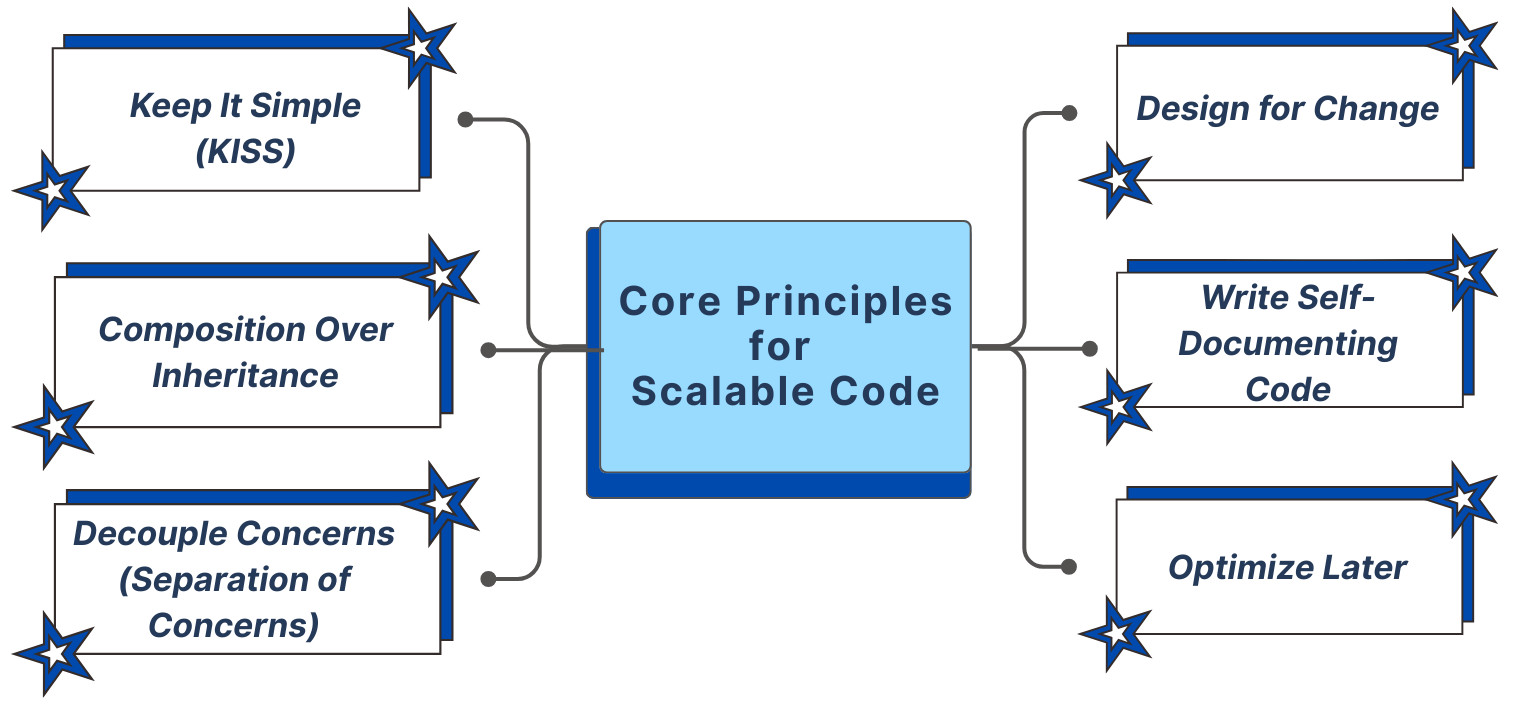
1. Keep It Simple (KISS)
The more complex the code is, the harder it is to scale. As a developer, always opt for the simplest working solution first. If a solution can be written in 10 lines instead of 100, go for it.
- Maintainability,
- Debugging ability, and
- Onboarding speed for new developers
A developer should be able to explain the code in a few sentences. If it’s not possible, then the code is too complex.
2. Composition Over Inheritance
class FlyingRobot(Robot):
  def flyingMachine(self): ...
class FlyMachine:
  def fly(self): ...

class FlyingRobot(Robot, FlyMachine):
  pass
Using composition, you can combine behaviors across domains and enforce reusability without the additional baggage of deep class hierarchies.
3. Decouple Concerns (Separation of Concerns)
- MVC (Model-View-Controller)
- Hexagonal Architecture (Ports & Adapters)
- Clean Architecture
With decoupling, you can change or scale individual parts without rewriting the entire system.
- UI logic should be separate from business logic.
- Business logic should not manage storage.
- Data access should not control the user experience.
4. Design for Change
- Requirements will keep changing.
- APIs will evolve as time passes.
- New use cases will emerge in addition to new domains.
When systems are designed with these considerations, they are said to be designed for change. As new changes are introduced, the system does not need to undergo drastic changes, as the provision to accommodate changes is already made.
Techniques like interfaces / abstract classes, dependency injection, feature flags, and plug-in architecture ensure the system design is scalable.
5. Write Self-Documenting Code
Clear naming conventions, small functions, proper variable names, and obvious logic make your code self-documented and reduce cognitive overhead.
If you need a separate comment to explain a line of code, consider changing that code.
function a(x) {
  return x + 42;       //add x to number 42
}
function addMagicNumberToScore(score) {
  const MAGIC_NUMBER = 42;
  return score + MAGIC_NUMBER;
}
Hence, in the above code marked Good, the function name is self-explanatory, the function body does not need additional comments to explain the code, and the return value indicates what exactly is being returned.
6. Optimize Later
“Premature optimization is the root of all evil.” — Donald Knuth
Do not optimize your code for performance before it is finalized. Early performance tweaks can lead to unnecessary complexity. Pay attention to readability and correctness first, then profile bottlenecks and optimize based on data.
Scalable Code Best Practices – Strategies that Help
The following are the key strategies you can use to make your code scalable in addition to core principles discussed above.
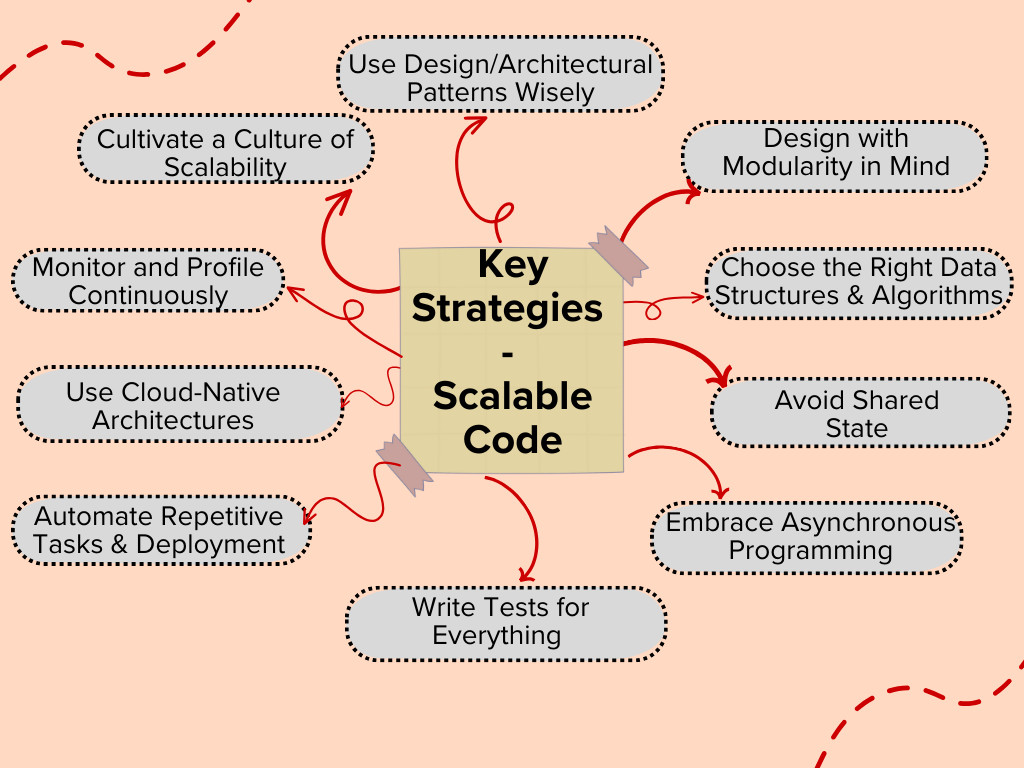
1. Use Design/Architectural Patterns Wisely
The fundamental strategy for making code scalable is to choose the right architectural or design pattern. Patterns are not just for academic purposes; they solve real-world scalability issues.
For instance, event-driven architectures (Observer pattern) decouple components through message brokers like RabbitMQ or Kafka, enabling asynchronous communication and improved fault tolerance.
- Factory Pattern: Used when objects are created without specifying the exact class.
- Strategy Pattern: Useful for designs that allow changing algorithms at runtime.
- Observer Pattern: Enables event-driven architecture.
With these design pattern implementations, the systems scale horizontally, maintain high availability, and accommodate evolving requirements.
Care should be taken that patterns are not overused because they should solve problems, not create complexity.
2. Design with Modularity in Mind
Modularity ensures scalable code by breaking down functionality into self-contained, discrete modules. These modular systems are easy to understand, test, and extend. This modular approach aligns with the core scalability principle of separation of concerns.
As the system is separated into independent modules, teams can enhance or replace individual components (modules) without affecting the entire system. Popular architectural patterns such as microservices adapt this idea of modularity by creating loosely coupled, independent services, each performing a specific function or focusing on a specific domain.
3. Choose the Right Data Structures and Algorithms
Choosing the right data structures and algorithms ensures your application is scalable. If the data structures and algorithms used are not efficient enough, they introduce bottlenecks as the system grows. For example, when representing the addresses of thousands of employees in a company, using a list will surely affect the performance and break the system when the number of employees grows.
Developers must also consider the time and space complexity of algorithms, ensuring that they can handle current and future workloads. Profiling tools such as perf can help identify inefficiencies in data structures and algorithms, guiding optimization efforts.
4. Avoid Shared State
Data that is shared and mutable (can be changed) introduces bugs that are hard to trace. In distributed systems or multithreaded applications, this can lead to disaster.
The systems that support shared and mutable data are unpredictable, prone to errors, and hard to scale.
Developers should use immutability in their code wherever possible. They should also use pure functions and resort to stateless components or services.
All these features promote predictability and concurrency. Such systems are easier to scale.
5. Embrace Asynchronous Programming
Asynchronous programming is crucial for handling high-concurrency scenarios, specifically in applications that process a large number of simultaneous requests. Developers should strive to maximize resource utilization and system throughput by using non-blocking I/O and event-driven programming models.
Modern languages and frameworks, including Python (asyncio), JavaScript (async/await, Promises), or Java (CompletableFuture), implement asynchronous patterns.
6. Write Tests for Everything
Scalability is more than performance tuning. It is also about the confidence to make changes, add features, and still run the system successfully.
- Unit tests to ensure the logical correctness of the code.
- Integration tests to ensure service compatibility and efficient integration of all system components.
- End-to-end tests to verify user flow and ensure it completes a cycle from input to output.
7. Automate Repetitive Tasks and Deployment
If the code is scalable, then the processes should also be scalable. Only then will the entire system be scalable. One crucial aspect of ensuring the scalability of a system is automation. It reduces human error and saves mental energy for complex problems.
By automating testing and deployment, you ensure that new features, bug fixes, and updates are delivered reliably and quickly. Continuous integration (CI) tools such as Jenkins or GitHub Actions, with continuous delivery/deployment (CD), enable teams to scale development efforts without regressions.
8. Use Cloud-Native Architectures
Cloud-native architectures like AWS, Azure, and GCP offer elastic resources that adapt to changing demands. This has changed the way developers approach scalability.
Cloud practices like containerization with Docker or orchestration with Kubernetes allow developers to build systems that scale horizontally with little or no manual intervention.
Serverless architectures have further allowed developers to focus on code by abstracting the infrastructure concerns and managing scaling automatically.
9. Monitor and Profile Continuously
Scalability is an ongoing process, and systems need to be continuously monitored to identify performance bottlenecks.
Tools such as Grafana, Prometheus, and New Relic help developers by providing insights into different metrics such as CPU utilization, memory usage, and request latency.
Profiling tools like Java Flight Recorder can pinpoint inefficiencies in code execution.
The metrics for resource utilization should be reviewed regularly to make informed decisions about optimization and scaling.
10. Cultivate a Culture of Scalability
Last but not least, scalability is as much about mindset as it is about technology. A culture of scalability should be encouraged within development teams to ensure that every decision, from architectural design to code implementation, takes into account the long-term growth of the system.
The alignment between developers, DevOps engineers, and business stakeholders is critical to building applications that can grow with the requirements of their users.
Tips for Writing Scalable Code without the Burnout
As you strive to achieve scalability, you are prone to losing your mind and experiencing frequent burnout. Writing scalable code is not just a technique; it is also related to mindset and habits.
- Refactor Continuously: Refactoring as part of your workflow rather than waiting for the big rewrite is beneficial. Adding tests, renaming variables, extracting functions, etc., are small improvements that eventually add up to give you scalable code.
- Document Decisions, Not Just Code: Create an architecture decision log (ADR) to record your decisions. Answers to questions like why use Redis instead of database, why use two services instead of one, or why use hash tables in place of lists, will help you and your teammates in future, understand the rationale behind complexity.
- Use Code Reviews as a Scaling Tool: Apart from finding bugs, code reviews enforce standards, share knowledge, and keep complexity in check.
Regularly perform code reviews and focus on clarity, test coverage, modularity, and naming conventions to catch common issues that might turn out to be bigger roadblocks in the future.
Conclusion
Writing scalable code involves making consistent, thoughtful decisions that support long-term growth. It is not about implementing a perfect system.
When you write code, it is not just your code; it is everybody else’s code. With the right tools and technologies, developers can follow the core principles, tips (best practices), and strategies discussed in this article to create high-quality, scalable code that meets users’ needs and is easy to update and maintain.
 |