
Lessons from Stripe’s Minions
If you work in software engineering or follow the industry closely, you’ve likely noticed how popular agentic coding has become. As the models have evolved and transformed, so has the distant possibility of unattended coding agents. These systems are now becoming a production reality.
You would have already witnessed an AI agent doing something impressive like spin up an app, refactor code, maybe even deploy something end-to-end. It feels like we’re one prompt away from replacing entire engineering teams.
Encouraged by the results online, you try to build one.
And suddenly things fail. The agent loops endlessly. Wrong files are selected. Something unrelated breaks. Or even worse, it almost works, just enough to be dangerous. For example, you ask the agent to fix a failing payment test. Instead, it changes a shared utility function used by multiple services as the retrieval layer pulled the wrong context. The original test passes, but a different workflow quietly breaks in production two days later.
This gap between demo magic and production reality is where most AI agent initiatives fail.
This is why the work coming out of Stripe (a global financial infrastructure and payments company), specifically their homegrown coding agents is of such interest. Christened Minions, they are built to one-shot tasks. The minions are fully unattended agents. These are not experimental prototypes or toy implementations. These are fully functioning agents that write real code, generate real pull requests, and work inside a high-stakes production environment.
Stripe hasn’t just figured out how to make agents function; they have mastered how to make them reliable.
| Key Takeaways: |
|---|
|
Read: Context Engineering for AI Agents: A Step-by-Step Guide
The Uncomfortable Truth about AI Demos
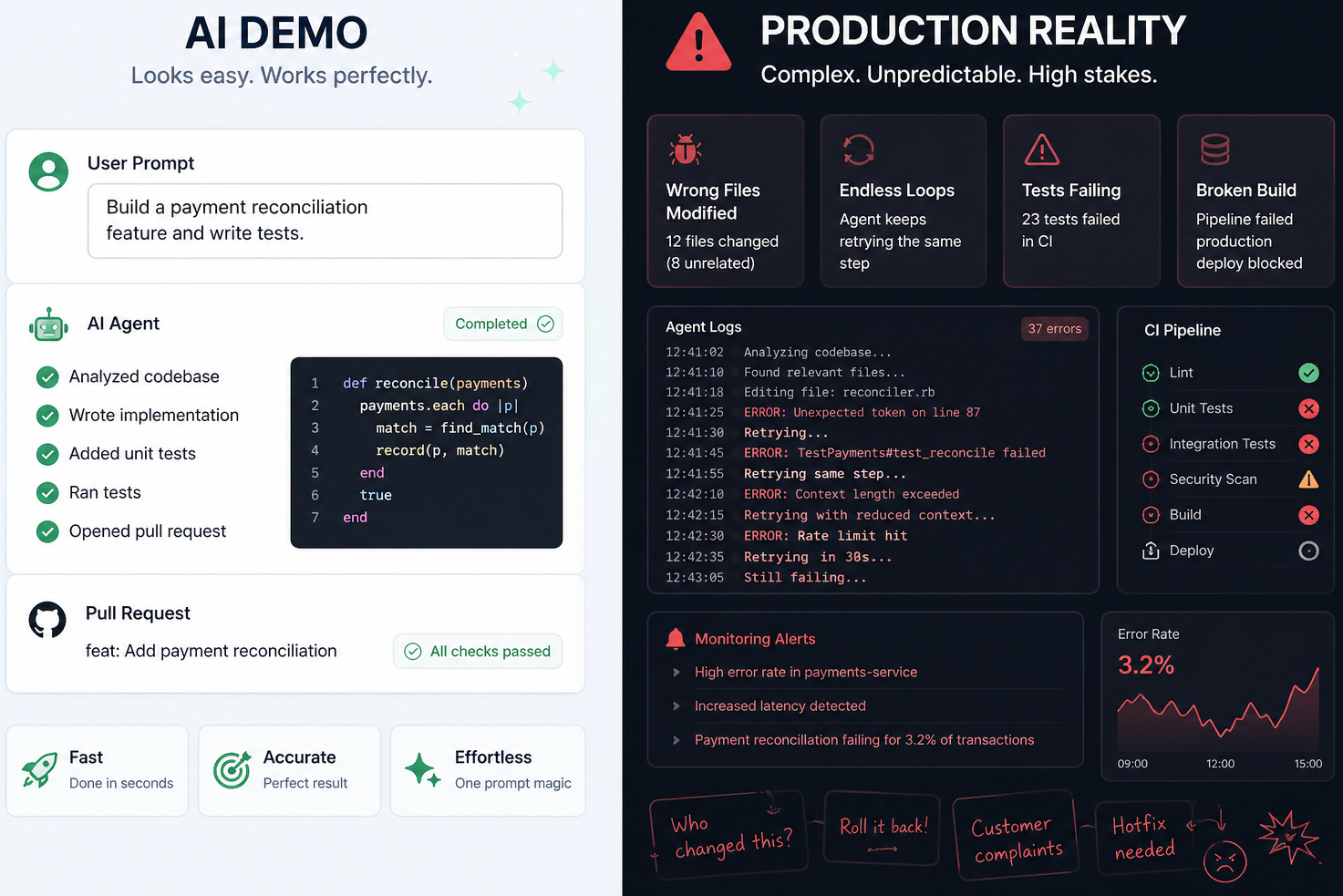
Most AI agents are refined to impress and not just to survive.
They typically run in clean environments with a small codebase, good context, no real consequences, and no competing priorities.
Production systems don’t look this at all. You’re dealing with years of accumulated complexity, partial migrations, inconsistent patterns, flaky tests, and a continuous stream of changes.
Say you are conducting a demo and an agent fails halfway through it. What would you do? Simply rerun it.
- break a pipeline
- introduce a regression
- or create a subtle bug that shows up days later
The main issue is rapidly scaling uncertainty. Every additional reasoning step an agent takes means another chance to drift. That’s why those multi-step “think -> act -> reflect” loops feel powerful, but become brittle very quickly.
Stripe’s approach starts by understanding this reality instead of fighting it.
Also read: What Is Prompt Engineering: 101 Guide for 2026
What are One-shot “Minions” and What Do They Do?
- the failing CI logs,
- related payment service files,
- recent commits touching that module,
- and Stripe’s internal coding guidelines.
It analyses that context once, develops the fix, executes validation checks, and opens a pull request. Once completed, the agent is discarded.
Each minion is disposable, stateless, and purpose-built for a precise class of work.
Its lifecycle is very simple: get context, execute once, return output.
So Stripe’s Minions are coding agents that take a task and return a ready-to-review pull request.
An engineer might drop a request in Slack:
"Fix the failing test in payments reconciliation"
- pulls relevant parts of the codebase
- understands the failure
- writes a fix
- generates tests if needed
- runs CI
- opens a PR
No back-and-forth conversation. No long chain of intermediate reasoning steps exposed to the user. Just input -> output.
This architecture sounds simpler compared to most agent architectures. There’s no complex orchestration layer with dozens of tools being dynamically selected at runtime.
That simplicity is intentional.
Why “One-Shot” Often Beats Conversational Loops
Multi-step agents look powerful, but they come with a hidden cost: error compounding. Every step introduces a chance of failure, and those small errors add up. Even if each step is 95% accurate, a five-step chain drops to around 77% reliability overall.
A one-shot approach avoids that cascade. You make a single, well-prepared call and get a result. If that single pass is more reliable than the combined multi-step chain, it’s the better choice.
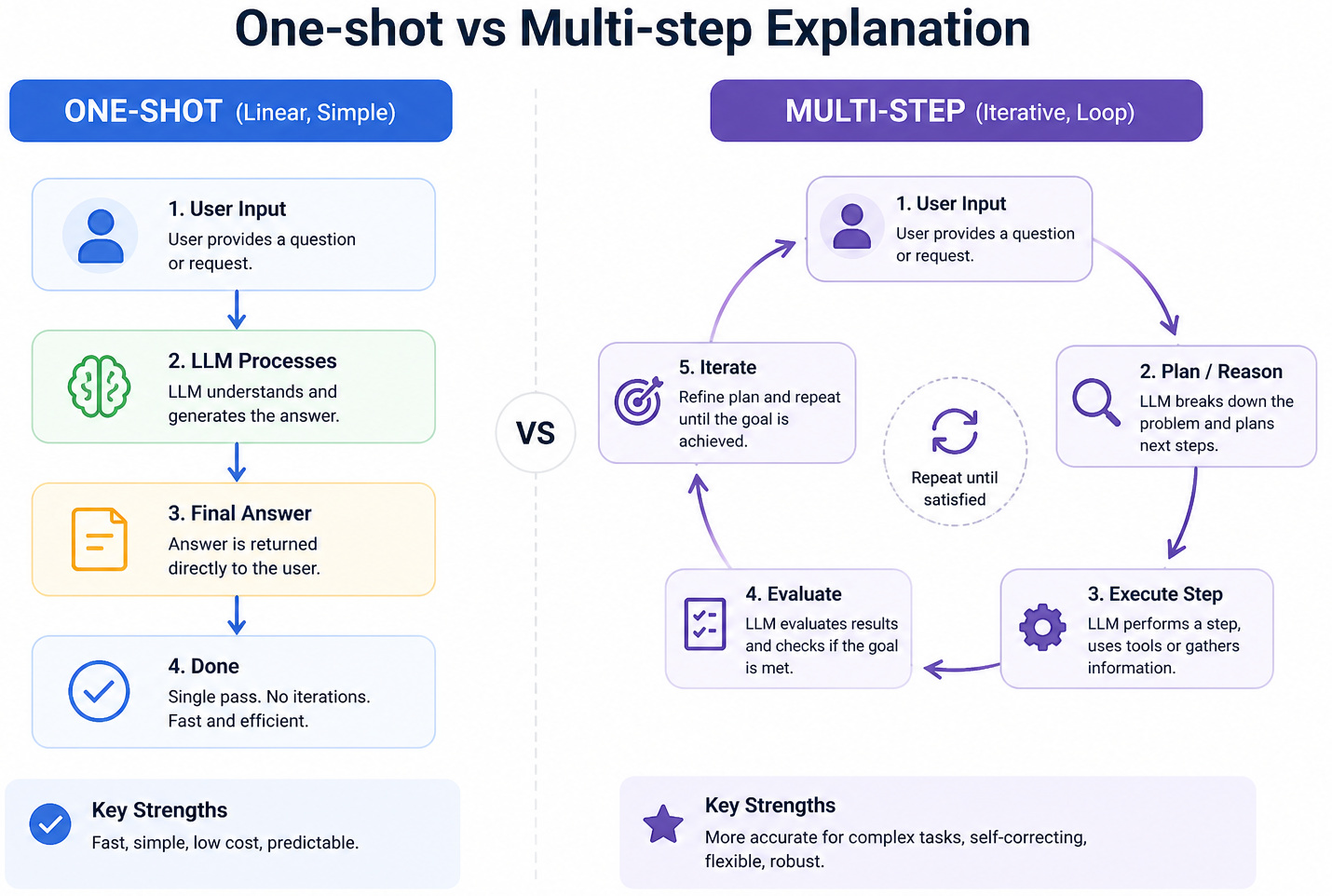
That doesn’t mean minions are simple. It means the complexity is shifted before the model runs, not after.
Instead of building a loop like:
think -> choose tool -> execute -> reflect -> repeat
gather context -> clean context -> constrain task -> execute once
This changes everything.
Imagine, instead of allowing the agent to constantly search the codebase during execution, the system preloads the exact files, failing test logs, dependency mappings, and recent commits related to the issue. The model invests less time “figuring out where to look” and more time generating the fix itself.
That decreases unnecessary tool calls, lowers drift between steps, and makes the output more predictable.
When the agent runs, it’s not “figuring things out” step by step. It’s operating with a carefully curated slice of the world, tailored for that exact task.
- fewer failure points
- lower latency
- easier debugging
And importantly, more predictable behavior.
That said, this only holds if your context-building step is efficient, something you need to measure for your own system.
- clarification
- exploration
- or iterative refinement
Things like research, ambiguous inputs, or conflicting sources still benefit from multi-turn interactions.
Lessons from the Story
Let’s understand the clear lessons to be gleaned from Stripe’s Minion story.
This is really an infrastructure story
It’s tempting to think Stripe succeeded because they used a better model.
That’s not the interesting part.
- how context is gathered
- how code is executed
- how results are validated
- how failures are handled
- sandboxed environments
- CI pipelines
- internal APIs
- code review workflows
Task request -> context retrieval -> sandboxed execution -> test/CI validation -> PR generation -> human review
If the generated code fails linting, breaks tests, or violates internal rules, the pipeline stops the change before it ever reaches production. That’s the part most demos skip. The reliability comes less from the model itself and more from the infrastructure wrapped around it.
If you strip all of that away and just keep the prompt, you don’t get Minions, you get a demo.
This is the shift a lot of teams underestimate: AI agents are not features, they’re systems.
Constraints are Doing the Heavy Lifting
There’s a common instinct when building agents to make them more flexible. Give them more tools, more autonomy, more room to explore.
In practice, that usually makes things worse.
- handles a narrow class of tasks
- has access to a limited set of tools
- operates within strict boundaries
This isn’t a limitation, it’s what makes them usable.
When an agent has too many options, it spends more time deciding what to do than actually doing it. It also increases the chances of choosing poorly.
Constrained agents, on the other hand, behave more like specialized workers. They don’t need to be brilliant; they just need to be consistent.
Determinism still Rules
One of the more subtle design choices in Stripe’s system is that the agent isn’t in full control.
- linting rules
- test suites
- CI checks
- human review
These deterministic layers act as guardrails.
task -> context builder -> AI agent -> CI validation -> human review -> merge
If the agent makes a mistake, the system catches it.
This hybrid approach, part deterministic, part probabilistic, is what enables AI to exist safely inside production workflows.
Compliance is Mandatory
- security
- auditability
- data handling
An unconstrained, fully autonomous agent simply wouldn’t pass that bar.
- observable (everything is logged)
- reviewable (humans approve changes)
- contained (they operate in sandboxes)
Even if you’re not in fintech, the same principles apply. The moment your agent touches real users or real money, trust becomes a first-class concern.
What are the Productivity Gains?
It’s easy to assume these agents are valuable because they write code faster.
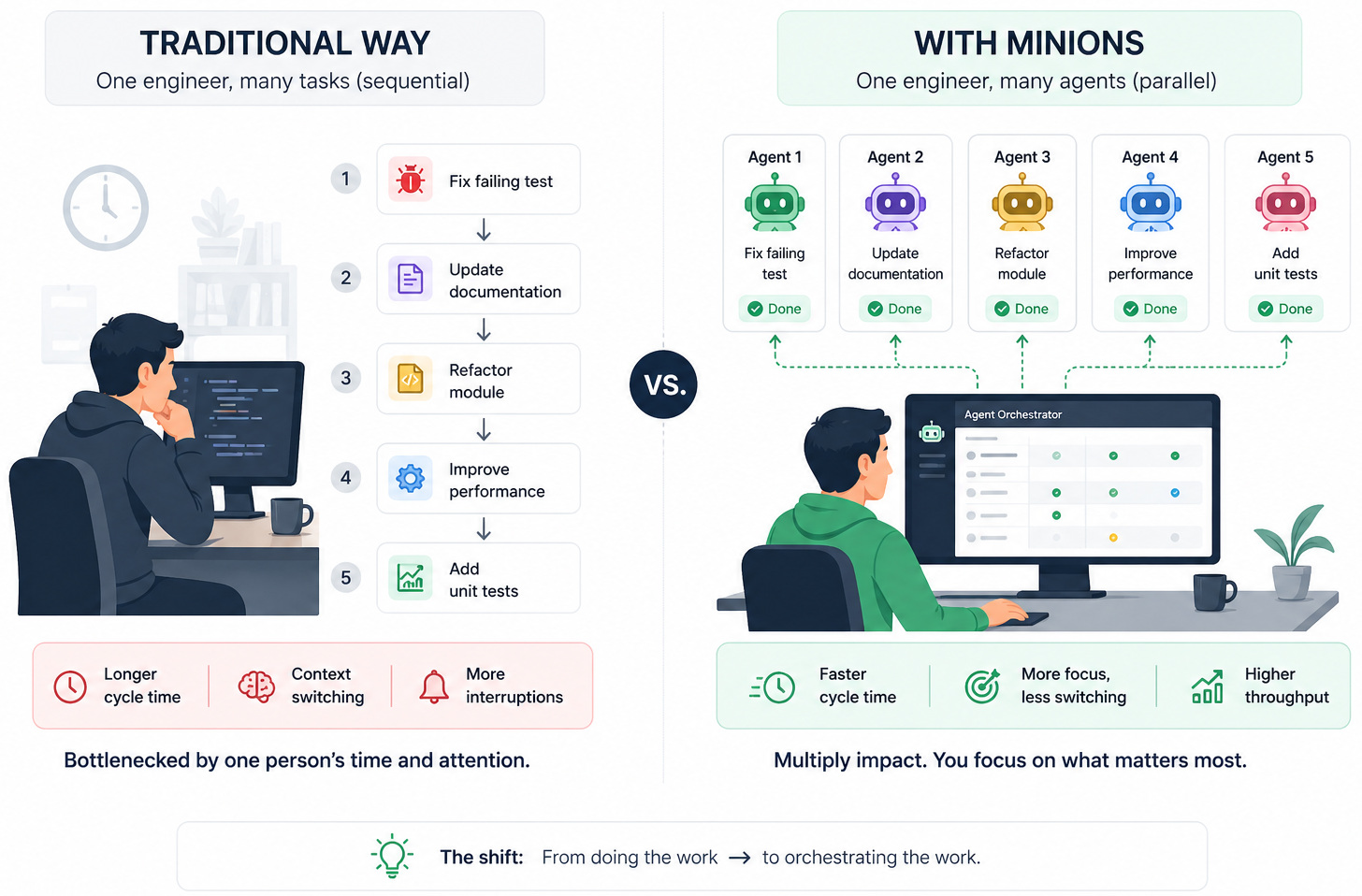
Partly true, but not the main story. The bigger shift is parallelization.
A single engineer can now kick off multiple tasks at once, each handled by its own agent. Instead of working through a queue of tasks sequentially, you’re effectively delegating.
It feels less like using a tool and more like managing a team.
- less context switching
- fewer interruptions
- more focus on reviewing and guiding
In a way, the agent becomes an extension of your attention.
Takeaways for Startups
Stripe’s system can seem aspirational and many may assume it’s out of reach. But the core ideas are surprisingly transferable.
You probably don’t need a fleet of agents generating thousands of PRs. But you can start small.
Pick a narrow, well-defined task. Something like fixing failing tests, updating documentation, or refactoring a specific module.
- collect the right context (logs, files, guidelines)
- run a one-shot agent
- validate the output (tests, linting)
- review manually
Even a minimal version of this can be useful.
What matters is resisting the urge to overcomplicate things. You don’t need a fully autonomous, self-improving agent system on day one. In fact, that’s more likely to fail. Keeping a human in the loop is extremely important especially for code merges and customer facing changes.
Where Teams could Possibly Fail
A pattern you’ll see again and again is teams trying to jump straight to a “general-purpose agent.”
They want one system that can debug issues, write features, deploy services, and answer questions.
In theory, that sounds efficient. In practice, it creates a system that’s hard to reason about and even harder to trust.
Stripe avoided this by focusing on specific, repeatable workflows.
Another common mistake is underinvesting in context. If the agent doesn’t have the right information upfront, no amount of clever prompting will save it.
And finally, there’s the temptation to remove humans from the loop too early. Full autonomy is appealing, but it’s rarely where the real value is, at least not yet.
A different way to think about AI agents
A clear takeaway from Stripe’s Minions is that the future of AI in engineering isn’t about eliminating developers.
It’s about reinventing how work flows through a system.
- define tasks
- provide context
- review outcomes
The agent handles the mechanical parts, but the structure, i.e., the architecture, the intent, the judgment, all these still comes from humans.
That balance is what makes the system work.
Final Thoughts
If there’s one most important lesson from Stripe’s Minions, it’s this:
AI agents don’t become useful when they get smarter. They become useful when they’re integrated into the right systems.
The demos will keep getting better. Models will keep improving. But the teams that actually get value from AI will be the ones that treat it as an engineering issue, not just a modeling one.
And that’s a much harder problem to solve, but also a much more interesting one.
Frequently Asked Questions (FAQs)
What are AI agents in production systems?
AI agents in production are systems that can autonomously perform tasks like writing code or handling workflows within real-world environments. Unlike demos, they must operate reliably under constraints like scale, security, and integration with existing infrastructure.
What makes Stripe’s Minions different from typical AI agents?
Minions use a one-shot architecture, meaning they execute a task in a single pass instead of multiple reasoning loops. They’re also deeply integrated with Stripe’s internal systems, including CI pipelines, sandboxed environments, and strict validation layers.
When should you use one-shot agents vs multi-step agents?
Use one-shot agents for well-defined, repeatable tasks like code fixes or PR generation. Use multi-step agents when tasks require exploration, ambiguity handling, or iterative refinement like research or complex decision-making.
Do AI agents replace software engineers?
- defining tasks
- providing context
- reviewing outputs
The human role becomes more about judgment and system design.
 |