
Quantum Software Engineering: Key Challenges
Around 20 years ago, quantum programming languages were present in theoretical content, as practical quantum hardware was not yet available. However, from that time onwards, the situation has changed significantly with the emergence of actual quantum computers, which are now accessible to anyone with an internet connection.
This article categorizes the key challenges faced in quantum software engineering across theoretical, practical, and socio-technical dimensions.
| Key Takeaways: |
|---|
|
The following topics are discussed in this article:
|
What is Quantum Software Engineering?
Quantum software engineering (QSE) is a specialized field that designs, develops, and maintains software solutions for quantum computers. It also develops and implements quantum algorithms and corrects errors in quantum code.
QSE is rapidly advancing in quantum computing research and application, but the documentation is scattered. By conserving the fundamental computing principles of software development and software engineering, QSE is helping to enrich quantum software development. However, this has led to a slow transition from traditional Von-Neumann architecture-based computing systems to quantum systems.
Recent times have seen the evolution of quantum computing, with a shift from classical computing to quantum computing in the coming years. Developments in QSE will boost future applications such as quantum AI and quantum machine learning. QSE is opening up new possibilities for software engineers, as quantum computing software is already compatible with many classical programming languages, such as C++ and Python.
Cloud-based quantum computing technology has been used to calculate the energy binding two atoms together and to test ML algorithms. However, despite these developments, significant challenges in QSE arise due to the major shift from traditional programming to quantum computing.
Key Challenges in Quantum Software Engineering
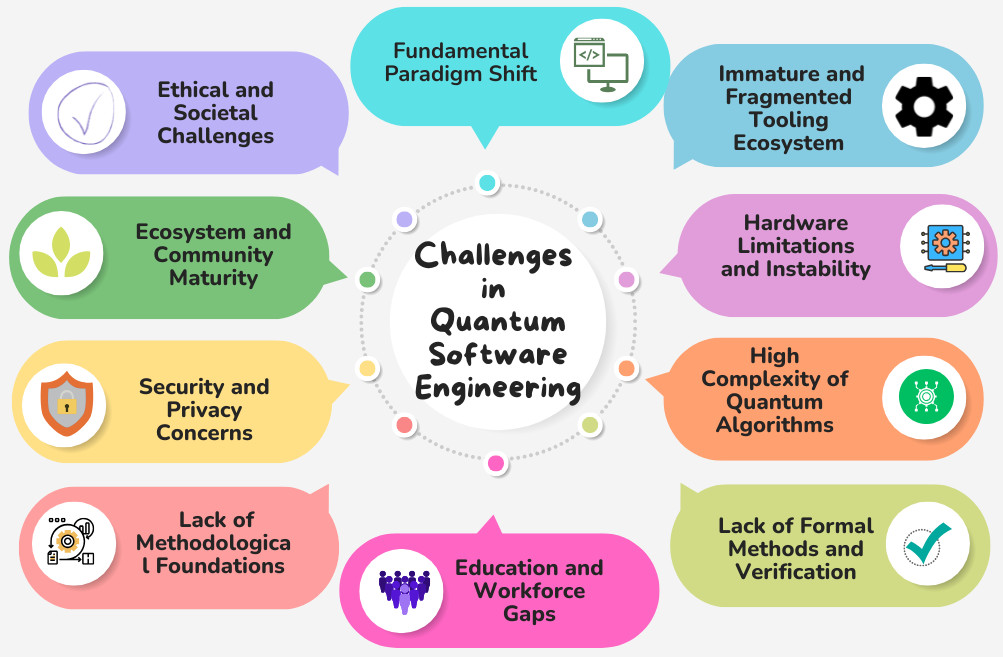
Various challenges arise in QSE, including adapting established software engineering practices to a fundamentally different paradigm and dealing with qubit instability, error correction, and hardware limitations. QSE lacks specialized algorithms, qualified professionals, educational resources, and development tools.
In this section, we discuss some of these challenges.
1. Fundamental Paradigm Shift
-
Quantum vs Classical Logic: QSE departs significantly from classical computing. Quantum software is based on the principles of quantum mechanics, including qubits, superposition, entanglement, and non-determinism.
- Qubits are fundamental bits of information in quantum computing. They can have values of 0 or 1 and exist in a superposition of both states, 0, 1, or both.
- Superposition is a feature that allows qubits to represent multiple states simultaneously, unlike binary bits.
- Entanglement causes qubits to become interdependent, with the state of one qubit affecting another.
- Measurement collapses quantum states to classical outcomes. This makes intermediate debugging and observation difficult.
These principles of quantum computing make designing and reasoning about algorithms more complex for engineers who are used to following classical computing. - Irreversibility and No-Cloning: Quantum operations are unitary and reversible. Quantum data cannot be duplicated arbitrarily (due to the no-cloning theorem). These limitations challenge conventional programming strategies like copying variables or undoing operations. Ultimately, they slow down development.
- Compilation and Debugging: Quantum program compilation and debugging require specialized knowledge and tools, and are far more complex than in classical computing.
- Error Correction: Developing a robust error correction mechanism for quantum systems is challenging, as they are inherently noisy and error-prone.
- Probabilistic Nature: The results of quantum computations are not deterministic. Interpreting these results is difficult and requires expertise in quantum mechanics.
2. Immature and Fragmented Tooling Ecosystem
-
Lack of Standardization: Several frameworks exist for QSE, including:
- Qiskit (IBM)
- Cirq (Google)
- Q# (Microsoft)
- PennyLane (Xanadu)
- Braket SDK (Amazon)
However, these frameworks are not standardized and are fragmented as they often target specific hardware backends. Choosing the right tools and porting code across platforms is challenging. -
Limited IDE and Debugging Support: Traditional software engineering has rich IDEs, profilers, and debugging tools. Contrary to that, QSE is lacking because:
- Due to measurement-induced collapse, quantum programs cannot be debugged by stepping through interactively.
- Debugging in QSE often relies on simulators that do not fully reflect real hardware constraints.
- Due to exponential state space growth, quantum state visualization works only for small systems.
-
Incomplete Simulation: In QSE, the simulators are inherently limited.
- As the number of qubits increases, simulators consume resources exponentially.
- They are not capable of capturing noise models or quantum decoherence accurately.
3. Hardware Limitations and Instability
-
Noisy Intermediate-Scale Quantum (NISQ) Devices: Latest quantum computers are in the NISQ era. This means:
- Quantum computers have tens to hundreds of qubits, and the majority are error-prone.
- Quantum operations are error-prone and subject to gate errors, decoherence, and readout noise.
A successful software must be hardware-aware, optimized for depth, error correction, and qubit connectivity. -
Resource Constraints: There are various resource constraints that quantum hardware faces:
- Limited coherence times that restrict the duration of computations.
- Connectivity maps dictate which qubits can interact directly.
- Job queueing on shared cloud hardware is leading to high latency.
It requires deep knowledge of the backend to design for optimal compilation, error mitigation, and hardware mapping. -
Scalability: It is challenging to scale up the number of qubits to tackle complex problems.
- Specialized Environments: Quantum computers require specialized environments and extremely low temperatures. It is costly and challenging to maintain.
- High Costs and Accessibility: Quantum hardware is expensive and has limited accessibility. Thus, its use is restricted to organizations with significant resources.
4. High Complexity of Quantum Algorithms
-
Lack of Algorithmic Templates: Engineers in the traditional paradigm rely on algorithm libraries and design patterns. However, in QSE:
- There are only a few high-level abstractions.
- Most of the existing algorithms are tightly coupled to the problem domain, rendering them useless for other applications.
- Quantum speedups require problem reformulation and are not universally applicable.
-
Complexity of Hybrid Algorithms: Many quantum applications use hybrid quantum-classical algorithms such as the Variational Quantum Eigensolver (VQE) and Quantum Approximate Optimization Algorithm (QAOA). However, managing these hybrid workflows is challenging and complicates the software stacks, requiring:
- Orchestration between classical optimizers and quantum circuits.
- Efficient use of classical computation to reduce quantum workload.
-
Quantum Algorithms and Data Structures: Algorithms and data structures in QSE are different from those in classical engineering. They require a deep understanding of quantum mechanics and the latest programming paradigms.
5. Lack of Formal Methods and Verification
-
Absence of Type Systems and Static Analysis: Quantum computing programming languages mostly lack tools and techniques for verifying and testing the correctness of code. This lack of features has the following repercussions:
- Programming errors, including invalid gates and incorrect qubit reuse, may go undetected until runtime.
- Type systems that enforce unitarity or linearity (e.g., in Q#) are still under development or underused.
-
Testing is Non-Trivial: Testing of quantum code is complex. Specifically, the classical method of unit testing is infeasible in QES due to:
- Non-deterministic outcomes
- Intermediate states are inaccessible.
- Hilbert space in QES is ample, making tests impractical.
However, other techniques, such as observable-based assertions, fidelity simulations, or statistical validations, are still under development.
6. Education and Workforce Gaps
-
Interdisciplinary Knowledge Requirements: Professionals working in QSE should know:
- Quantum mechanics
- Linear algebra and complex vector spaces
- Classical or traditional software engineering
- Optimization and machine learning
The learning curve for QES is quite steep and particularly challenging for existing engineers, who must retrain in these technologies. However, very few educational programs and courses offer QES. -
Scarcity of Training Resources: Contrary to classical computing, which has abundant learning and training resources, QES has a scarcity of textbooks, tutorials, and MOOCs. The resources present are too theoretical or tied to proprietary platforms.
7. Lack of Methodological Foundations
-
Absence of Established Software Engineering Practices: Quantum software development does not have standard engineering practices:
- Agile, DevOps, and CI/CD methodologies are difficult to adapt to due to the speed of simulators and hardware inaccessibility.
- Design patterns for quantum programming are still in research stages.
- There are no established best practices for project management and estimation.
- QES lacks well-defined software engineering methodologies, development tools, IDEs, and testing methodologies specific to quantum computing.
-
Reproducibility and Experiment Management: Quantum experiments are often non-deterministic and platform-dependent. Tracking results, tuning parameters, and reproducing the behavior across the runs is challenging.
-
Formalizing Testing: Formal methods and techniques for testing quantum software are an ongoing challenge, as input preparation, output verification, and replicability are still under development.
8. Security and Privacy Concerns
- Quantum Data Leakage: Quantum programs may be susceptible to data leakage through decoherence, device-level flaws, or unintended measurements. There are no mature security models yet in QES to prevent these.
- Post-Quantum Cryptography: Quantum computing affects the existing encryption methods, necessitating the development of post-quantum cryptography.
9. Ecosystem and Community Maturity
- Fragmented Collaboration: Classical computing has open-source projects that allow users to contribute to the development of applications. Quantum software, however, is heavily corporate-driven. Most existing frameworks are developed by tech giants that do not have community support or cross-compatibility.
- Versioning and Maintenance: Maintaining quantum software across versions is challenging, especially for long-term projects.
10. Ethical and Societal Challenges
-
Misaligned Hype and Expectations: There is substantial hype around quantum computing in the technical field, and engineers are pressured to deliver unrealistic outcomes due to inflated expectations.
-
Long-Term Impact and Governance: As QES matures, there will be questions that need to be answered:
- The role of quantum computing in breaking cryptographic systems.
- Lack or abundance of quantum resources.
- Ethical implications of simulating quantum systems.
To understand and fix these challenges, QSE must proactively engage with policymakers, ethicists, and regulators to ensure responsible development.
What Lies Ahead…
- Standardization initiatives: QIR by the Quantum Intermediate Representation Alliance is one such initiative that aims to unify backends and provide users with an intuitive experience.
- Domain-specific libraries: For example, for machine learning, chemistry, etc., are emerging.
- Hybrid cloud platforms: Development is simplified with access to quantum resources (IBM Quantum, AWS Braket, Azure Quantum).
- Education: More institutions and websites are launching courses and dedicated programs on quantum engineering, with MIT, ETH Zurich, and others leading the way.
Conclusion
Quantum software engineering is a frontier discipline combining physics, mathematics, and computer science. The challenges discussed in this article are deeply rooted in the fundamental nature of quantum computing due to current limitations of tooling, methodologies, and hardware.
To overcome these challenges, combined efforts across academia, industry, and government are necessary. Programming and engineering paradigms, educational models, and new abstractions must also be developed. Although the road ahead is complex and uncertain, quantum software engineering can still make a mark in important industry fields such as cryptography, drug discovery, and material science.
Additional Resources
 |