Top 10 Backend Technologies Every Developer Should Know
The software development industry has been evolving at a lightning-fast pace, and backend technologies have become the backbone of every modern software application. As mobile and web applications get smarter and faster, many technologies are working behind the scenes to drive these applications. These are the backend technologies.
| Key Takeaways: |
|---|
|
This article explores the top 10 backend technologies every backend developer should know.
What is Back-End Technology?
Backend technologies are programming languages, frameworks, or tools used in web development to create and manage websites or applications.
They are responsible for “behind-the-scenes” work such as storing data, managing user authentication, and providing application programming interfaces (APIs) for front-end applications.
When you access a website or a mobile application, you usually see buttons, forms, menus, text, and images on the front-end side (in the browser or application dashboard). The application’s back-end has all the logic written, like what actions to take when a button is clicked in the front-end, or how to authenticate a user when logged in. Thus, when the user fills in login information like username and password and clicks the login button, this information is sent to the back-end, where the program checks whether the user is valid. Accordingly, the response is sent back to the user.
Backend technologies handle everything related to a website or application, such as storing and managing user data, processing user requests, and connecting to servers and databases. They are essential for any web project and provide the foundation for all other application components.
What are the Different Components of Back-End Technology?
- Database Technologies: These technologies manage and store data in databases. Typically, relational databases or NoSQL databases are used in web development. Examples are MySQL, PostgreSQL, MongoDB, and Redis.
- Backend Programming Languages: The programming languages used to write code for web applications. Backend languages often used for programming are PHP, Python, Java, and Ruby.
- Frameworks: Frameworks provide an additional layer of structure to make development easier by providing familiar tools and functions for developers during software development. Frameworks such as Django (for Python), Rails (for Ruby), and Symfony (for PHP) are commonly used.
- Server Technologies: These are used to host and run the application or website. Node.js, Apache, and Nginx are the commonly used server technologies.
Features of Backend Technologies
- Scalability: A scalable backend technology can easily scale up or down depending on project requirements. It ensures the platform can handle traffic or data bursts without compromising security or performance.
- Security: Security is an essential feature of backend technologies, as it protects sensitive data and prevents malicious attacks on websites or applications. When selecting backend programming languages, you should choose those that support robust encryption and authentication protocols.
- Maintainability: Backend languages and tools support easy codebase maintenance, and incremental changes to the codebase can be made efficiently and quickly.
- Cost-effectiveness: The cost of development and maintenance is an important consideration when choosing a backend technology. It should offer cost-effective features that are efficient in development and maintenance.
- Community Support: Look for languages and frameworks that have strong community support. This ensures developers can quickly access resources if they are stuck during development.
Top 10 Backend Technologies
Multiple backend technologies and programming languages are available today that help developers write the backend logic. These technologies offer a wide range of features and capabilities that make them well-suited to web development.
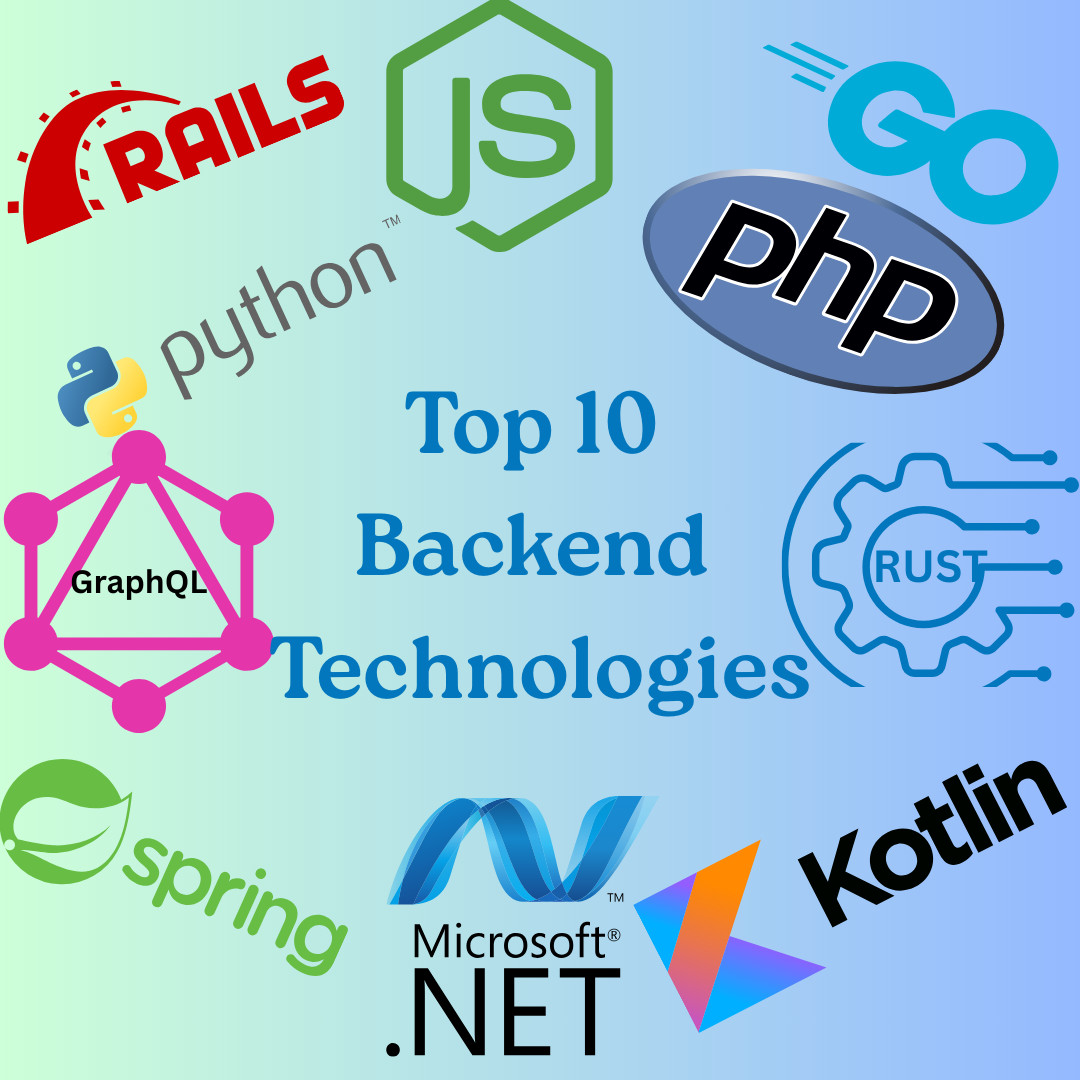
Here are the top 10 backend technologies that are more popularly used by backend developers:
1. Node.js
- Node.js is built on Google’s V8 JavaScript engine, ensuring fast execution.
- It supports a large ecosystem of libraries via npm (Node Package Manager).
- Node.js is highly scalable and can handle thousands of concurrent requests.
Node.js is perfect for real-time applications like chat apps, streaming platforms, and collaborative tools with its non-blocking I/O model.
- Messaging apps (e.g., WhatsApp Web).
- Streaming services (e.g., Netflix uses Node.js).
- Single-page applications (SPAs).
2. Python (Django & Flask)
Python is a widely adopted programming language loved for its simplicity, readability, and versatility. Frameworks like Django and Flask support Python, making it a top backend technology. Django is a full-stack framework with batteries, while Flask is lightweight and flexible.
- The language is easy to learn and understand.
- It is an interpreted language and simplifies debugging and enables rapid prototyping.
- Python has many pre-built modules and packages for various tasks, from web development and data science to networking and GUI creation.
- Python is excellent for machine learning and data-driven apps due to its ecosystem.
Django framework supports ORM, authentication, an admin dashboard, and built-in security, whereas Flask framework is minimal, giving developers control and flexibility.
- Content management systems (e.g., Instagram started with Django).
- APIs for data-heavy applications.
- AI/ML-powered apps integrated with TensorFlow or PyTorch.
3. Ruby on Rails (RoR)
Ruby on Rails is known for rapid prototyping and developer happiness. It adopts the philosophy of convention-over-configuration, which speeds up development while maintaining clean and readable code.
- It has pre-built modules for authentication, sessions, and database management.
- Ruby is highly productive for startups and MVPs.
- It places a strong emphasis on testing with built-in frameworks like RSpec.
- E-commerce platforms.
- MVPs and startups (e.g., Shopify, Airbnb initially used Rails).
- Social platforms and SaaS applications.
4. PHP (Laravel)
PHP is one of the older languages, but it is a highly relevant programming language. The PHP ecosystem has been modernized by the Laravel framework, which offers elegant syntax and powerful tools for building scalable and secure web applications.
- It supports MVC architecture for code organization.
- PHP has built-in support for authentication, routing, and caching.
- It has a strong community with packages like Composer.
- Dynamic websites (WordPress, the world’s most used CMS, is PHP-based).
- E-commerce platforms (Magento, WooCommerce).
- RESTful APIs.
5. Java (Spring Boot)
Java has been a workhorse in backend development for decades. With the Spring Boot framework, which is based on Java, developers can use a modern, opinionated framework that makes enterprise-level application development faster and easier.
- Java is a platform-independent, object-oriented programming language called “Write Once, Run Anywhere” (WORA).
- It is known for its strong type safety and scalability.
- Java is an interpreted language, and its performance is enhanced by Just-In-Time (JIT) compilation.
- It has built-in multithreading support.
Spring Boot framework automates configuration, reducing boilerplate code, and has a massive ecosystem for cloud-native applications.
- Banking and finance applications.
- Enterprise-grade web apps.
- Microservices with Spring Cloud integration.
6. .NET (ASP.NET Core)
ASP.NET Core by Microsoft is a cross-platform framework that brings the power of C# to web development. It’s widely used in enterprise settings, offering flexibility and high performance.
- It supports cloud-native and containerized applications.
- .NET has strong security and authentication tools.
- It runs on Windows, Linux, and macOS.
- Enterprise applications (Microsoft ecosystem).
- APIs for mobile and web apps.
- Internet of Things (IoT) and cloud services on Azure.
7. Go (Golang)
Google’s Go or Golang programming language is designed for concurrency, performance, and simplicity. Its lightweight features make it ideal for developing cloud-native, distributed, and high-performance applications.
- The language has excellent support for concurrency with goroutines.
- Go is a compiled language with blazing-fast execution.
- It is easy to learn and maintain with a clean syntax.
- Cloud services and microservices.
- Scalable backend systems (e.g., Kubernetes and Docker are written in Go).
- APIs and command-line tools.
8. Kotlin (Ktor & Spring)
Kotlin, developed by JetBrains, is perceived as an alternative to Java. Though it is officially supported for Android, its backend frameworks, such as Ktor and Spring, with Kotlin support, make it a suitable contender.
- Kotlin is fully interoperable with Java.
- It has a concise and expressive syntax.
- Kotlin has a strong ecosystem that supports modern microservices.
- Mobile app backends (paired with Android apps).
- Web APIs and microservices.
- Cross-platform development with Kotlin Multiplatform.
9. Rust
Rust is a systems-level programming language gaining traction in backend development due to its distinct features, such as memory safety, speed, and reliability. Frameworks like Actix and Rocket use Rust, making it a popular choice for developers seeking performance without sacrificing protection.
- Rust has no garbage collector, yet prevents memory leaks.
- It is extremely fast and concurrent.
- Rust has a strong type system, and the compiler guarantees safety.
- High-performance APIs.
- Blockchain and crypto projects.
- Systems programming combined with backend development.
10. GraphQL (Backend for APIs)
GraphQL is an essential backend technology for building APIs. It replaces REST in many modern applications by allowing clients to query the data they need exactly.
- It provides efficient data fetching with a single request.
- GraphQL has a strongly typed schema for predictable queries.
- It works with multiple languages and frameworks (Node.js, Python, Go).
- Mobile and web apps require optimized API calls.
- E-commerce platforms with complex product data.
- Microservices communication.
Choosing the Right Backend Technology
- Ease of Use: Choose a language or tool that is easy to learn and use.
- Project Size & Complexity: When choosing backend technology, consider the size and complexity of the project. For example, for a small MVP, prefer Django, Flask, or Ruby on Rails. For enterprise-grade, go for Java, .NET, or Go.
- Performance Needs: Select a language or tool that offers fast performance and scalability for larger projects. Real-time apps mostly benefit from Node.js or Go.
- Security: Ensure the chosen technology has built-in security measures such as password hashing and CSRF protection.
- Interoperability: Check if the language or tool can be easily integrated with other languages or services and if it is interoperable.
- Developer Skills: Utilize team expertise. For instance, Python teams shouldn’t force Go unless necessary.
- Libraries & Tools: Check to see if it offers access to libraries with thousands of useful tools and features for rapid development.
- Cost & Maintenance: Consider the cost of maintenance and upgrades and any license fees associated with the technology.
- Community & Ecosystem: Check if the technology or language has an active community with plenty of resources available. Technologies like Node.js, Python, and Java have massive support.
Conclusion
Backend technologies are evolving rapidly, but their fundamentals, scalability, reliability, security, and performance remain the same. The top 10 backend technologies listed in this article each shine in their domains.
Mastering a few of these ensures long-term relevance for backend developers in the industry. For businesses, choosing the right backend technology stack can mean the difference between building a scalable product and struggling with limitations.
The future of backend technologies lies in cloud-native architectures, AI integration, and high-performing systems, and the technologies discussed here are leading the way.
Related Reads
- What is Software Architecture?
- What is Code Optimization?
- Differences Between Continuous Integration, Continuous Delivery, and Continuous Deployment
- Which Version Control System is the Best?
- Serverless Computing in Software Engineering
 |