
Types of AI Agents
Artificial Intelligence (AI) is no longer a theoretical concept you study in academia. Over the years, it has rapidly evolved into a transformative technology that powers industries, businesses, and everyday applications. This transformation is centered around AI agents, intelligent systems that perceive their environment, process information, and take actions to achieve specific goals.
| Key Takeaways: |
|---|
|
This article explores the major types of AI agents, their characteristics, real-world applications, advantages, and limitations.
What is an AI Agent?
AI agents are at the core of many AI systems and are autonomous entities that choose responses and perform tasks based on their environment.
AI agents typically range from simple rule-based systems to advanced learning systems powered by large language models (LLMs) that adapt and improve over time.
- Perceive its environment using sensors or input data,
- Process the information,
- Make decisions, and
- Act to achieve predefined goals.
The environments in which AI agents operate may be simple or highly dynamic. They can work independently or collaboratively with humans and other systems.
- Sensors/Input Systems: Gather environmental information.
- Processing Unit: Analyzes data to make accurate decisions.
- Actuators/Output Systems: Perform actions based on decisions.
- Knowledge Base: Stores information and past experiences.
- Learning Mechanism: Helps improve performance over time.
AI agents are classified based on their intelligence levels, autonomy, adaptability, and decision-making complexity.
While some agents operate purely on predefined rules, others use learning algorithms to refine their behavior.
Classification of AI Agents
- Decision-making capability
- Learning ability
- Environmental awareness
- Goal orientation
- Complexity of behavior
Each type has its strengths and applications, ranging from basic automated systems to highly adapted AI models. It represents a progression in intelligence and functionality and can be deployed as part of a multi-agent system with each agent specializing in the part for which it is best suited.
The primary types of AI agents are:
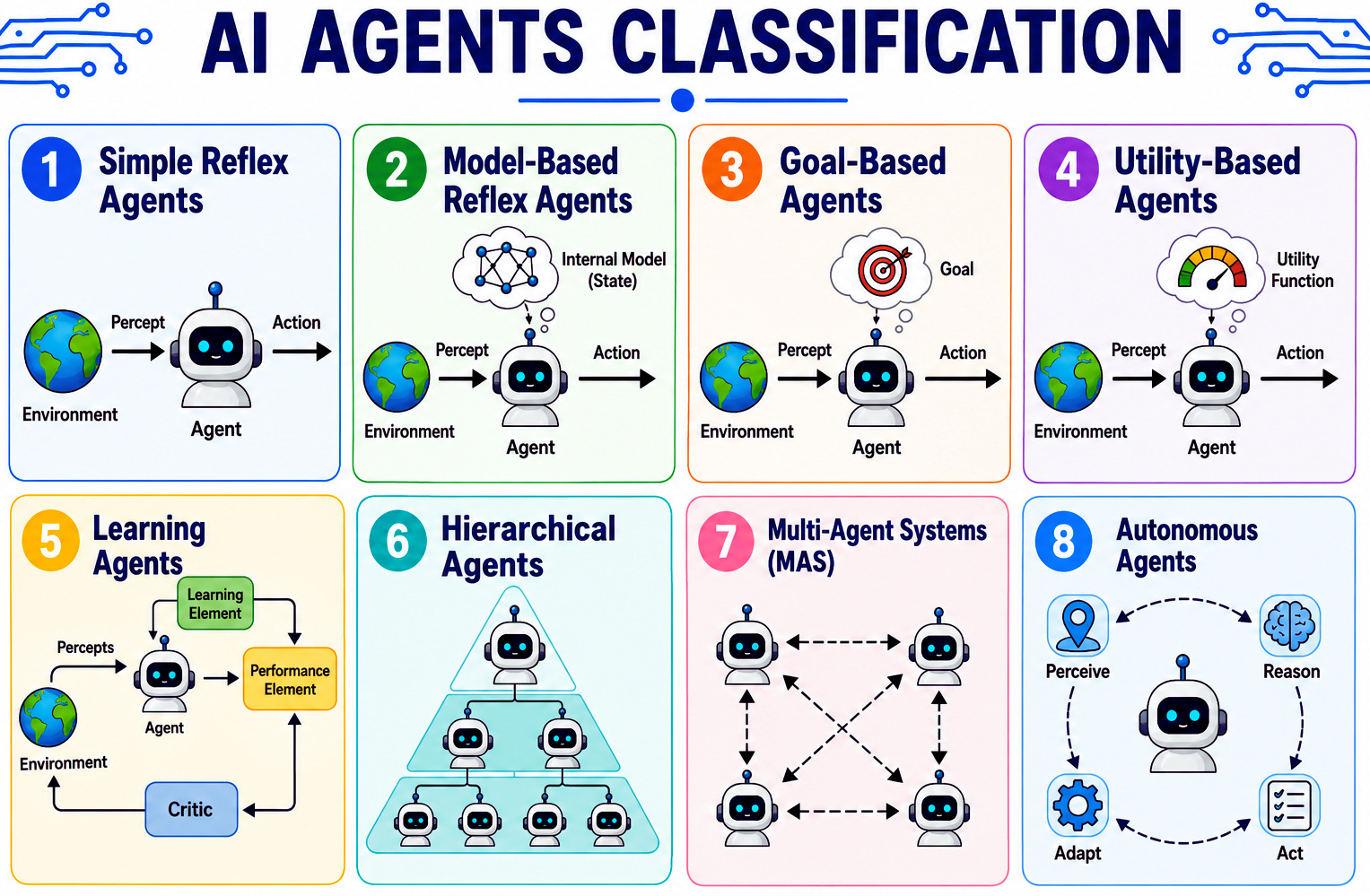
Here is the description of each type.
1. Simple Reflex Agents
This is the most basic type of AI agent that operates based on direct responses to environmental conditions or current perceptions or inputs. Simple reflex agents do not consider past experiences or future consequences.
Simple reflex agents follow predefined rules known as condition-action rules, defined as follows:
If condition X occurs, perform action Y
Characteristics
- A simple reflex agent does not have memory of past states
- It operates only on the current input
- Decision-making is fast
- This agent has limited intelligence
- A simple reflex agent is suitable for fully observable environments
Working Principle
- It observes the environment
- Then it matches the current condition with stored rules
- Finally, the agent executes the corresponding action
Example
- Turn the heater ON if the temperature < the desired value
- Turn the heater OFF if the temperature ≥ the desired value
Another example of a simple reflex AI agent is an automatic traffic light system that adjusts its signals in response to traffic sensor inputs. While doing this, it does not reference past states.
Advantages
- These agents are easy to design
- They are efficient for simple tasks
- Simple reflex agents work effectively in structured and predictable environments with well-defined rules
- These agents usually have low computational requirements
Limitations
- Simple reflex agents cannot learn or adapt, particularly in dynamic or complex scenarios
- They fail in partially observable environments
- These AI agents have limited problem-solving capability
- Since there is no memory of the past, simple reflex agents can repeatedly make the same mistakes
2. Model-Based Reflex Agents
This is a more advanced version that improves upon a simple reflex agent. While it still relies on condition-action rules to decide, it also maintains an internal model of the environment.
This agent tracks the current state of the environment and uses stored information to make more informed decisions.
Characteristics
- These agents maintain an internal state
- They use the memory of past events
- Model-based reflex agents handle partially observable environments
- They are better at decision-making than reflex agents
Working Principle
- The agent observes the environment
- It updates the internal state
- Then it uses a world model
- Finally, it applies condition-action rules
The agent predicts how the environment evolved using its internal model.
Example
A robotic vacuum cleaner is a good example of this agent. A robotic vacuum cleaner remembers cleaned areas, avoids obstacles, tracks battery level, and plans efficient movement.
Self-driving cars are another example of model-based systems. It is used to understand road conditions and nearby vehicles.
Advantages
- Model-based reflex agents are more intelligent than simple reflex agents
- They can operate in dynamic environments
- Since the past states are tracked, model-based reflex agents function more effectively in partially observable environments
- These agents are more adaptable, as they can handle situations where context needs to be remembered and used for future decisions
Limitations
- This agent requires accurate environmental models
- A model-based reflex agent is more computationally expensive
- It lacks the advanced reasoning and learning capabilities needed to solve complex problems in dynamic environments
3. Goal-Based Agents
Goal-based agents are yet another extension of simple reflex agents and incorporate a proactive, goal-oriented approach to problem solving by considering future outcomes before acting.
Unlike reflex agents, which react to environmental stimuli according to predefined rules, goal-based agents consider ultimate objectives and use planning and reasoning to evaluate actions in terms of whether they help achieve a specific goal.
Goal-based AI agents set a specific goal that guides their actions. They evaluate possible actions and then select the one most likely to help them achieve that goal.
Characteristics
- These agents exhibit a goal-oriented behavior
- They have planning capability
- Goal-based agents evaluate the future state
- They are more flexible in decision-making
Working Principle
- Initially, analyze the current state
- Compare it with the desired goal
- Search for actions leading to the goal
- Execute the best sequence of actions
Goal-based agents often use search algorithms and planning techniques.
Example
A GPS navigation system uses goal-based AI agents to determine the destination, calculate optimal routes, and adapt to traffic conditions.
Another example is the chess-playing AI systems, which also operate as goal-based agents by evaluating moves that maximize the chance of winning.
Advantages
- These agents exhibit more intelligent behavior
- They are flexible in problem-solving
- Goal-based agents can adapt strategies
- With their ability to reason, they can act with greater foresight compared to simple reflex agents
Limitations
- They require extensive computation
- Planning may be slow in goal-based agents
- It may be difficult in highly unpredictable environments
4. Utility-Based Agents
Utility-based agents are an improvement over goal-based systems. They go beyond simple goal achievement by using a utility function to evaluate and select actions to maximize overall benefit.
Utility-based agents consider a range of possible outcomes when choosing actions. They assign a utility value to each, helping them determine the optimal course of action. This approach enables more nuanced decision-making, particularly in situations involving multiple goals or trade-offs.
Characteristics
- These agents evaluate multiple possible outcomes
- They optimize decision-making
- Utility-based agents can handle uncertainty effectively
- They balance trade-offs
Working Principle: Utility Function
A utility function assigns numerical values to results based on their desirability.
- A faster route has higher utility
- A safer route also has higher utility
- An expensive option, however, has lower utility
The utility-based AI agent selects actions with maximum utility.
Example
As an example of a utility-based AI agent, consider a ride-sharing application. This application minimizes travel time, reduces cost, and maximizes customer satisfaction.
On the same lines, when navigating a route, a self-driving car might face a decision to choose between speed, fuel efficiency, and safety. It uses utility functions, such as minimizing travel time, maximizing fuel economy, or ensuring passenger safety, to evaluate each option rather than just aiming to reach the destination. The agent then selects the action with the highest overall utility score.
Advantages
- Utility-based AI agents have better optimization
- They are effective in uncertain, complex environments
- These agents are good at rational decision-making
Limitations
- It is challenging to design accurate and reliable utility functions
- The agent requires substantial computation
- It may produce unexpected trade-offs
5. Learning Agents
Learning agents are the most advanced AI systems, and they improve their performance over time by adapting to new data and experiences rather than relying solely on predefined rules.
Learning agents continuously update their behavior based on feedback from the environment rather than relying on predefined rules or models. With this ability, they improve their decision-making and perform better in dynamic, uncertain scenarios.
Characteristics
- Learning agents are self-improving
- They learn from data and feedback
- These agents easily adapt to changing environments
- They are highly flexible.
Working Principle
- Performance Element: Chooses actions based on a knowledge base.
- Learning Element: Improves the agent’s knowledge based on feedback and experience.
- Critic: Evaluates the agent’s actions and provides feedback, often in the form of rewards or penalties.
- Problem Generator: Suggests exploratory actions to help the agent discover new strategies and improve its learning.
Types of Learning
- Supervised learning
- Unsupervised learning
- Reinforcement learning
- Deep learning
Example
For example, in reinforcement learning, an agent might explore different strategies. It may receive rewards for correct choices and penalties for incorrect actions. As time passes and the agent evolves, it learns which actions produce the greatest rewards and accordingly refines its approach.
Similarly, recommendation systems on Netflix or Amazon learn user preferences, improve suggestions over time, and adapt to changing behavior.
Advantages
- Learning agents improve continuously and are highly flexible
- They can handle complex, ever-changing environments and are highly adaptable
- These agents are effective in complex environments
- Learning agents learn from interactions and are valuable for applications in fields such as persistent chatbots and social media
Limitations
- Learning agents require large datasets
- Training these agents can be expensive
- These agents are at risk of biased learning
6. Hierarchical Agents
Hierarchical agents, as the name suggests, organize decision-making into multiple levels of hierarchy. Agents at higher levels handle strategic planning while those at lower levels manage specific tasks.
High-level agents oversee lower-level agents. Hierarchical agents excel in coordinating and prioritizing multiple tasks and subtasks. They are utilized in various applications such as robotics, manufacturing, and transportation.
Characteristics
- Agents have a multi-level structure
- The tasks are decomposed
- Agents demonstrate improved efficiency
- Hierarchical agents have a scalable architecture
Working Principle
- Strategic level: Define overall objectives
- Tactical level: Involved in planning
- Operational level: Deals with execution
In essence, hierarchical agents work like a corporate organization, organizing tasks in a structured hierarchy of levels, with higher-level agents supervising and decomposing goals into smaller tasks.
Subsequently, lower-level agents execute these tasks and provide progress reports.
In complex systems, there may be intermediate-level agents that coordinate the activities of lower-level agents with those of higher-level agents.
Example
- High-level system schedules production
- The mid-level system allocates resources
- Low-level robots perform assembly
Military drone systems also use hierarchical control of various structures.
Advantages
- Agents offer better organization and resource efficiency by assigning tasks to the most suitable agents and avoiding effort duplication
- Agent decision-making is efficient, reducing action complexity and enhancing exploration
- They offer easier scalability
Limitations
- Hierarchical agents follow a top-down control flow, which can cause bottlenecks and delays, leading to communication overhead
- Coordination is complex when hierarchies are used for problem-solving
- Possible delays may occur between layers
7. Multi-Agent Systems (MAS)
A multi-agent system evolves from AI orchestration, integrating different types of AI agents, and consists of multiple AI agents interacting within a shared environment. AI agents cooperate, coordinate, or compete to achieve goals.
MAS can operate in real time, respond to dynamic environments, and continuously improve its performance based on past experience.
Characteristics
- There are multiple interacting agents in MAS
- They offer distributed intelligence
- Agents collaborate or compete to achieve objectives
- Problem-solving is scalable in MAS
Working Principle
- Cooperative agents – Work together toward a common objective
- Competitive agents – Compete for resources or rewards
- Hybrid systems – Combine cooperation and competition
Example
A smart traffic management system is an example of MAS. In this system, traffic lights coordinate dynamically, and vehicles communicate with the infrastructure. At the same time, congestion is minimized collaboratively.
Online gaming AI and stock market simulations also use MAS.
Advantages
- It handles large-scale problems
- MAS has increased flexibility
- It offers distributed decision-making
Limitations
- It may suffer from communication complexity
- MAS often has coordination challenges
- There is a risk of conflicts among agents
8. Autonomous Agents
Autonomous agents are advanced software systems that operate independently with minimal human intervention. They achieve complex, multi-step objectives by independently perceiving their environment, reasoning, making decisions, and taking actions without human supervision.
Autonomous agents learn iteratively, use tools, and adapt to changing conditions to improve performance.
Characteristics
- They are highly autonomous
- Decision-making in autonomous agents is independent
- They demonstrate self-learning capabilities
- Autonomous agents easily adapt to real-time environments
Working Principle
- Perception: Collecting data from various sources, including customer interactions, databases, and web scraping.
- Reasoning/Decision-Making: AI models analyze data, identify patterns, and plan actions.
- Action Execution: Tools are used to perform tasks such as sending emails, updating records, or making code changes.
- Learning/Adaptation: Knowledge base is updated to improve future performance.
Example
Self-driving cars use autonomous agents to detect surroundings, make driving decisions, navigate roads safely, and adapt to changing conditions.
Autonomous drones and warehouse robots are additional examples of autonomous agents.
Advantages
- They have reduced human involvement
- Autonomous agents have high operational efficiency
- They perform continuous operation
Limitations
- There are ethical concerns related to autonomous agents
- There are safety risks
- Autonomous agents have high development costs
Comparison of AI Agent Types
Here is the comparison of AI agent types discussed above based on the four parameters: memory, learning ability, goal-oriented, and complexity.
| Agent Type | Memory | Learning Ability | Goal-Oriented | Complexity |
|---|---|---|---|---|
| Simple Reflex Agent | No | No | No | Low |
| Model-Based Reflex Agent | Yes | No | Limited | Medium |
| Goal-Based Agent | Yes | Limited | Yes | Medium-High |
| Utility-Based Agent | Yes | Limited | Yes | High |
| Learning Agent | Yes | Yes | Yes | Very High |
| Hierarchical Agent | Yes | Optional | Yes | High |
| Multi-Agent System | Shared | Optional | Shared Goals | Very High |
| Autonomous Agent | Yes | Yes | Yes | Extremely High |
Applications of AI Agents
- Coding Agents: AI agents used for coding accelerate software development through AI-enabled code generation and coding assistance, and help ramp up on new languages and codebases. Coding agents like Claude have been making waves recently as many organizations are seeing significant gains in productivity, leading to faster deployment and cleaner, clearer code. AI agents are also utilized for other software tasks, such as testing.
- Healthcare: In healthcare industries, AI agents are used in medical diagnosis systems, robotic surgery, and patient monitoring.
- Finance: In the finance field, AI agents are handy for tasks such as fraud detection, algorithmic trading, and risk assessment.
- Transportation: Autonomous vehicles, traffic management systems, and route optimization use AI agents to operate accurately.
- E-Commerce: E-commerce sites use AI agents for product recommendations, customer support chatbots, and dynamic pricing systems.
- Manufacturing: Systems like industrial robotics, predictive maintenance, and automated quality control use AI agents.
- Education: The education field extensively uses AI agents for intelligent tutoring systems, personalized learning platforms, and automated grading.
Real-Life Examples of AI Agents
- Intel “Ask Intel”: This is an AI support assistant from Intel built with Microsoft Copilot Studio that can open and update support cases, check warranty status, provide troubleshooting steps, and escalate to humans when needed.
- Eneco: A multilingual AI agent built in Microsoft Copilot Studio and deployed to its website in about 3 months to improve customer support at scale.
- Oscar Health Member-facing Chatbots: Oscar deployed integrated chatbots that can answer benefits and cost questions and help members navigate care. The platform handles about 39% of benefits messages without human oversight and answers 58% of benefits questions instantly.
- Lowe’s Mylow and Mylow Companion (2025): These are agents deployed by Lowe’s that provide home-improvement guidance online and to store associates across 1,700+ stores. They handle nearly 1 million questions per month. The online conversion rate more than doubles when customers engage with Mylow, and customer satisfaction scores increase 200 basis points when associates use Mylow Companion.
Future of AI Agents
AI agents no doubt have a promising future. Advancements in machine learning, neural networks, and computational power lead to increasingly intelligent and autonomous systems.
- Fully autonomous personal assistants
- Collaborative robotic teams
- Human-like conversational systems
- Emotionally intelligent AI
- General Artificial Intelligence (AGI)
As AI continues to evolve, AI agents will become better at understanding context, emotions, and complex human needs.
One of the pioneering innovations happening right now is codeCake, an AI agent from testRigor for code generation. It uses Spec-Driven-Development (SDD) to generate application code.
codeCake provides a way to build runnable end-to-end test cases in plain English before engineers even write the code. This means the AI can iterate on code generation until the result passes the provided end-to-end test.
Conclusion
AI agents are the foundation of intelligent AI systems that interact with the environment, solve problems, and make decisions autonomously. From simple reflex agents that follow fixed rules to advanced learning and autonomous agents capable of self-improvement, each type serves unique purposes and applications.
These systems are already transforming industries such as healthcare, transportation, finance, education, and manufacturing.
Understanding the different types of AI agents is essential for everyone seeking to use AI effectively, from professionals to normal humans. As technology advances, AI agents will become even more powerful, collaborative, and integrated into daily life, shaping the future of human-computer interaction and intelligent automation.
Frequently Asked Questions (FAQs)
- How do learning agents improve over time?
Learning agents improve by analyzing past experiences, receiving feedback, and adjusting their behavior using machine learning algorithms.
- What industries benefit the most from AI agents?
Various industries that use AI agents for their benefits include:
- Healthcare
- Finance
- Transportation
- E-commerce
- Manufacturing
- Education
- Customer service
- What is the future of AI agents?
The future of AI agents includes more advanced autonomous systems, emotionally intelligent AI, collaborative robotics, and potentially Artificial General Intelligence (AGI).
- Why are AI agents important?
AI agents perform complex tasks intelligently and autonomously. They improve automation, decision-making, efficiency, and productivity across industries.
 |