
What is Agile Software Development?
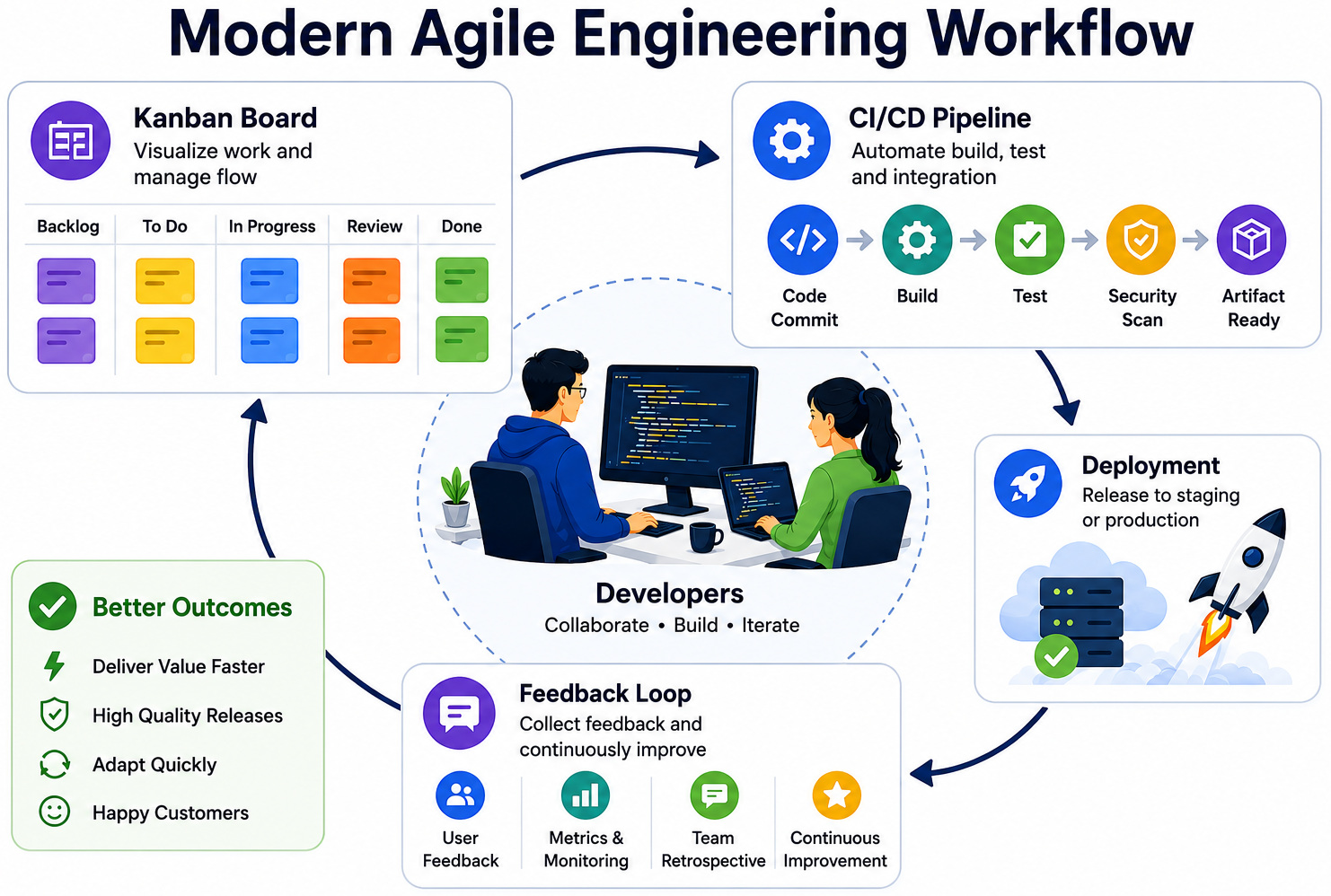
The Agile software development cycle is a simple, systematic method for code development. If followed and implemented in the right manner, Agile teams are able to deliver high-quality products within budget and on time.
A common misconception that people have about agile development is that it is only about standups, sprint boards, and moving Jira tickets across the columns throughout the day. This is the first symptom that the team has misunderstood Agile.
Agile is, at its core, a reaction against slow, rigid software development steps that made engineering teams waste months planning features nobody has verified yet.
As someone in the software industry, you are already familiar with the issue. Requirements can be modified midway though the implementation. Customers change their needs after seeing the first version. Something that was marketed as a “critical feature” is actually not useful. Systems behaving erratically in production compared to white boards leads to engineering estimates crashing.
The unpredictable nature of traditional SDLC is why Agile exists.
| Key Takeaways: |
|---|
|
The Agile Method
Let’s first quickly discuss traditional (or waterfall) project management. With this process, teams function in a linear phase that cannot progress until final approval. So, if a stage is finalized, it can be time-consuming and expensive for your team to regress back to a previous stage.
On the other hand, Agile is an iterative method to software development. Rather than working in long phases, teams work in smaller timeframes with consistent feedback loops. In Scrum, these phases are called sprints and are usually one to three weeks.
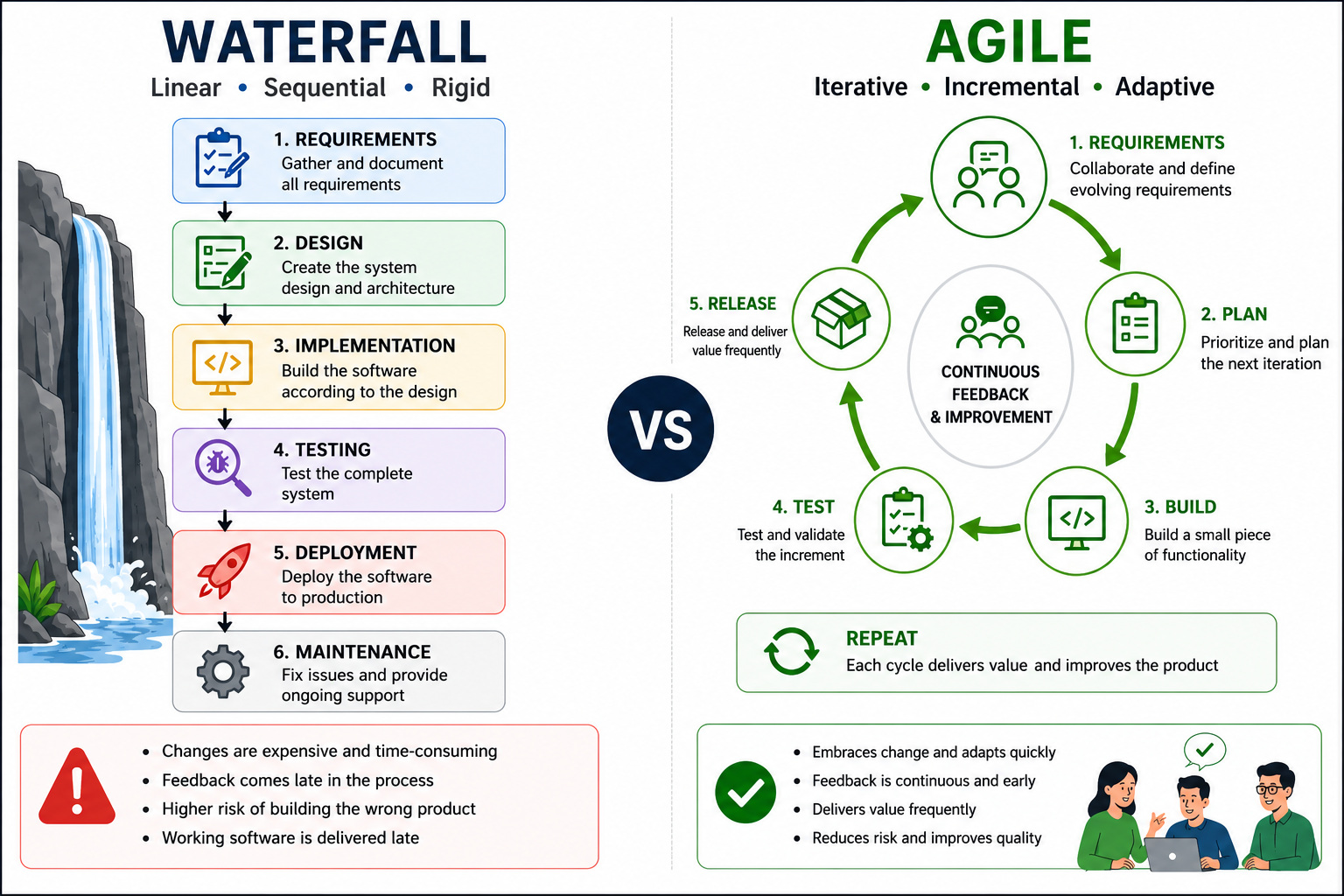
Throughout sprints, teams cooperate and offer feedback on the work in progress. Regular communication makes it easier to adjust to change business and user needs. This leads to the delivery of high-quality software products.
Phases of Agile Software Development Lifecycle
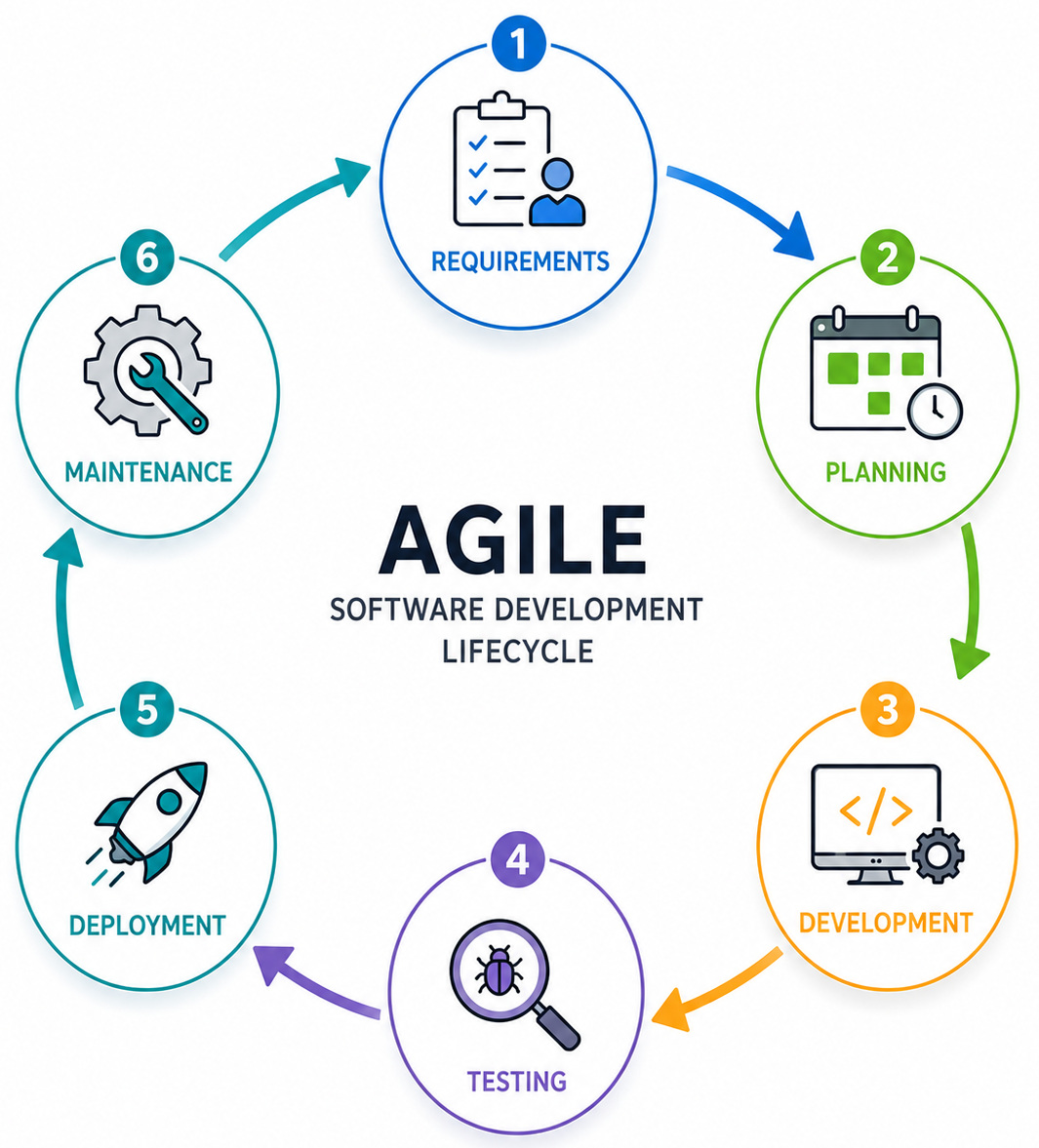
The Agile SDLC has mainly six structured phases: requirement gathering, planning, development, testing, maintenance, and deployment.
Requirements Gathering:
The development team works closely with the user to understand what they really require from the software. The team closely listens to the user’s needs, then prioritizes and organizes these requirements to make sure the most critical features are built first.
Planning:
Planning or the sprint planning is the phase where the team decides which functionality from the requirements or product backlog they are going to take up first in the sprint. The conversation is not restricted to choosing the features alone. Teams also determine effort, catch dependencies, discuss technical risks, and understand if the work can realistically be completed in the said timeframe. The purpose is to build a shared understanding of what needs to be developed and avoid surprises later during development.
Development
When development is complete, teams can start building the first draft of the software in incremental stages. This phase includes all related production tasks in the software development lifecycle, such as UX/UI design, architecting, and coding. Development stage is usually the longest phase. The use of AI tools, however, can help shorten the time by automating certain iterative tasks.
Testing
- Verifying that the code is clean
- Responding to bugs and errors
- Performing trial runs
- Deployment
Post extensive testing, security validations, and documentation updates, the team ships the software. This means customers or end-users can start working with the product, This is usually the most celebratory and also the nerve-wracking moment for developers.
Deployment
Once the development and testing is completed, the software progresses to deployment. This is the stage where the latest version is released into staging or production environments so users can start working with it. Modern Agile teams typically depend on CI/CD pipelines and automation to bring down deployment risks and maintain consistency across releases. Teams continue to monitor the app even after deployment, to catch unexpected problems faster.
Maintenance
The jobs aren’t finished once the software deploys. The team is tasked with maintaining the software. They continue to verify if the job has been done well. This support is necessary and involves preventing issues, responding to flaws, maintaining features, and improving features. There is an increased chance for feedback and optimize the release in next versions as users engage with the app.
Agile is Less About Process Than Learning
This is the part many teams overlook.
Agile is not restricted to Scrum ceremonies or sprint planning meetings. Those are implementation details. The deeper idea is continuous adaptation.
Good Agile teams optimize for learning speed.
- Are we solving the right problem?
- Are users actually using this feature?
- Can we release smaller changes more frequently?
- What technical debt is slowing us down?
- What assumptions turned out to be wrong?
That mindset is far more important than any framework.
A team can follow every Scrum rule perfectly and still build terrible software.
Meanwhile, another team might barely implement formal Agile terminology while practicing excellent iterative development principles.
Read: How Team Culture Drives Development Success.
Advantages and Disadvantages of Agile Software Development
Similar to any software development method, Agile is not a silver bullet solution. It helps teams move at a faster pace and adapt to change, it also brings in challenges if not implemented properly.
Advantages
Agile enables teams to deploy software faster because work is delivered in smaller, manageable increments rather than large one-time releases. Frequent feedback loops also help teams catch problems earlier and adjust requirements before they become expensive mistakes.
This method naturally encourages collaboration across development, QA, product, and business teams. Since changes can be introduced throughout the process, Agile is also better suited for projects where user needs or market conditions evolve quickly.
Disadvantages
Agile is challenging when requirements constantly alter without proper prioritization. Teams can end up struggling with scope creep, shifting deadlines, and unclear ownership.
There is also a risk of focusing heavily on speed while overlooking architecture, documentation, or long-term maintainability. Poor Agile implementations can lead to meeting overload and process fatigue, where teams spend more time discussing work than actually delivering it.
The framework itself is rarely the issue. Most challenges come from how teams apply it in practice.
Why Developers Sometimes Hate Agile
This needs to be discussed honestly.
Oftentimes, engineers dislike Agile because they’ve experienced bad implementations of it.
They’ve sat through pointless and lengthy meetings, endless estimation sessions, and sprint retrospectives that changed nothing. They’ve watched management use Agile metrics as surveillance tools instead of improvement tools.
Velocity became a metric of performance. Story points became deadlines. Standups became status reporting rituals.
At that point, Agile stops being Agile.
The original Agile philosophy focused on autonomy, collaboration, and sustainable development pace. It was specifically built to reduce friction, not create additional bureaucracy.
When companies turn Agile into a strict management system, you experience resistance from developers.
And they should.
What Agile Development Actually Looks Like
Real-world Agile development is not as structured as many teams are led to believe. Most engineering teams are not constantly focused on sprint rituals or story point estimates. Day-to-day Agile work is mostly about keeping delivery moving without destabilizing the codebase, deployment pipeline, or production environment.
In real-life, teams divide work into smaller increments because smaller changes are easier to review, test, deploy, and roll back. Large feature branches that stay isolated for weeks tend to create integration problems and risky deployments later.
For example, rather than assigning a developer a three-week feature branch with 20-25 backend and frontend changes bundled together, many Agile teams break it into smaller deliverables. Sprint one might initiate user authentication, sprint two adds profile management, and sprint three manages notifications. Smaller releases reduce integration risk and make issues easier to isolate if something fails in production.
This is also why many Agile teams gradually move toward Kanban-style workflows over time. Continuous delivery environments rarely fit neatly into rigid sprint cycles. Production bugs, infrastructure issues, and customer feedback arrive continuously, so work naturally becomes flow-oriented instead of batch-oriented.
Engineers merge code regularly, pull requests stay somewhat small, and releases happen across the week instead of accumulating into massive deployment windows. Over time, the focus shifts away from Agile ceremonies and toward improving cycle time, deployment safety, and feedback loops.
That’s usually what mature Agile engineering looks like in real projects.
Read: What is DevOps Lifecycle?
Agile Development is Moving Toward Specification-Driven Engineering
One interesting shift in modern Agile teams is that requirements are starting to move closer to executable specifications instead of static documentation.
Usually, product managers write tickets, developers analyze them, QA teams build tests later, and everyone hopes the implementation matches the original intent.
That workflow creates friction because requirements get translated multiple times between teams. Newer AI-driven development tools are trying to collapse those gaps.
For example, codeCake by testRigor looks at software development through specification-driven development (SDD). Rather than generating code from ambiguous prompts, it uses plain-English test cases and existing testRigor test suites as the primary source of truth.
This distinction is important.
A failing test highlights a bug that needs fixing. A new test can define functionality that does not yet exist. In both cases, the implementation target becomes crystal clear: make the test pass while preserving system behavior.
From an Agile perspective, this aligns surprisingly well with iterative development principles. Requirements become executable artifacts instead of static documents buried in ticketing systems.
A simplified example might look like this:
User logs into the dashboard
User clicks "Generate Report"
System downloads a PDF report
Instead of treating this as documentation alone, systems like codeCake can use it as the foundation for generating or modifying actual application code.
Feedback loop is what makes it relevant for Agile teams. codeCake does not directly deploy changes into production. It opens a pull request like a human engineer would, allowing reviewers to comment, request adjustments, and validate the implementation before merge.
That workflow fits naturally into modern CI/CD pipelines and collaborative engineering cultures.
As AI-assisted development tools mature, Agile teams are increasingly moving toward workflows where tests, requirements, implementation, and validation all become part of the same continuous delivery system.
Final Thoughts
Agile is still relevant, but maybe not for the reasons that most companies think. Most experienced engineering teams are usually not obsessed with frameworks or pointless rituals. Usually, they are the ones that deploy dependably, adjust faster, and improve systems without resulting in operational chaos.
Agile is simply the way to reduce friction between ideas, code, feedback, and production.
Frequently Asked Questions (FAQs)
Define Agile software development
Agile software development is an iterative approach where teams create software in smaller increments instead of long sequential phases. Teams release updates continuously, collate feedback early, and improve the product over time.
What is the difference between Agile and Waterfall?
Waterfall follows a fixed sequence of planning, development, testing, and deployment. Agile uses shorter development cycles with continuous feedback, allowing teams to adapt quickly to changing requirements.
What is Kanban in Agile development?
Kanban is a workflow-based Agile approach where work moves continuously through stages like development, review, testing, and deployment. It focuses on improving flow, reducing bottlenecks, and shortening delivery cycles.
 |