
What is Cloud Application Security?
In today’s digital-first world, cloud-native services are becoming increasingly popular among businesses. These services use the cloud to build, deploy, and scale applications. Cloud computing offers organizations flexibility, cost savings, and innovation potential.
| Key Takeaways: |
|---|
|
In this article, we will cover the following:
|
This article thoroughly explores cloud application security, including principles, threats, frameworks, tools, and strategies that provide organizations with a comprehensive roadmap for securing their applications.
What is Cloud Application Security?
Definition
Cloud application security is the process of protecting cloud-based applications throughout the development lifecycle from various threats, vulnerabilities, and unauthorized access.
It includes application-level policies, best practices, frameworks, tools, and technologies to protect cloud-native applications.
Key Points of Cloud Application Security
- Cloud application security is crucial for organizations that are operating in multi-cloud environments hosted by third-party cloud providers such as Amazon (AWS), Microsoft (Azure), or Google (GCP).
- These third-party applications or services increase the attack surface, providing adversaries with multiple points of access to enter the network and attack.
- Cloud application security aims to reduce the risk of exposing cloud-based applications to external or internal threats by enforcing policies, processes, and controls.
- It generally involves authentication and access control, data encryption, user and identity management, and vulnerability management.
- Cloud application security also includes secure development practices, security monitoring and logging, compliance and governance, and incident response.
- Organizations use cloud application security to follow secure coding practices, monitor and log activities, comply with regulations, and develop incident response plans.
Shared Responsibility
Depending on the requirements, many organizations host applications distributed over hybrid cloud environments and have a combination of private cloud, public cloud, and on-premise resources. In such environments, cloud application security is shared between the cloud service provider and the organization using the services.
For example, the provider secures the infrastructure if your application is deployed in a public cloud like Amazon Web Services (AWS). In addition, you are responsible for security within the application and configurations.
If your application runs on servers you manage in a private cloud or on-premises, you are responsible for securing the application, operating systems, network infrastructure, and physical hardware.
Why Do Organizations Need Cloud Application Security?
Traditional network, application, and infrastructure security measures are not enough in a cloud-based environment to protect cloud-native applications, making them vulnerable to various cyber threats during development.
In addition, many organizations have adopted an agile software development process known as DevOps. It combines traditional software development and IT operations to speed up the development cycle and accelerate the application release cycle.
This necessitates organizations using the cloud as part of the software development process and implementing a comprehensive cloud security solution to protect against rising threats and increasingly sophisticated attacks within cloud environments.
This is where the cloud application security makes its presence necessary.
- Growing Reliance on Cloud Applications: Due to their scalability, flexibility, and cost-saving features, more organizations are adopting cloud solutions. This growing reliance on cloud applications increases the risk of attacks.
- Protecting Sensitive Data: Cloud applications often handle sensitive data, and breaching this data can result in significant losses to the organization, including financial loss, reputation damage, and legal consequences.
- Maintaining Business Continuity: Cloud application security ensures the availability of critical applications and data without disrupting business operations.
- Distributed Cloud Applications: Cloud applications are distributed in nature, which increases the attack surface and provides new potential points of access to protected assets. Hence, a robust cloud application security strategy is necessary.
- Interoperability: Applications interact and collaborate effectively across different cloud environments. This interoperability makes them prone to security threats and attacks.
Key Principles of Cloud Application Security
- Zero Trust Architecture: No entity, whether internal or external, can be inherently trusted. A Zero Trust model emphasizes continuous authentication, authorization, and verification at every layer.
- Least Privilege Access: Users and services have only the minimum permissions required to perform their assigned tasks, reducing the risk of insider threats or compromised credentials.
- Defense in Depth: Multiple security layers are laid across the application stack, including network, application, and data layers, to reduce the risk of breach.
- Security by Design: DevSecOps integrates security into the software development lifecycle (SDLC), from architecture and coding to testing and deployment.
Common Threats to Cloud Applications
Cloud applications face both traditional and cloud-specific security threats. Here are some of the threats that most often occur:
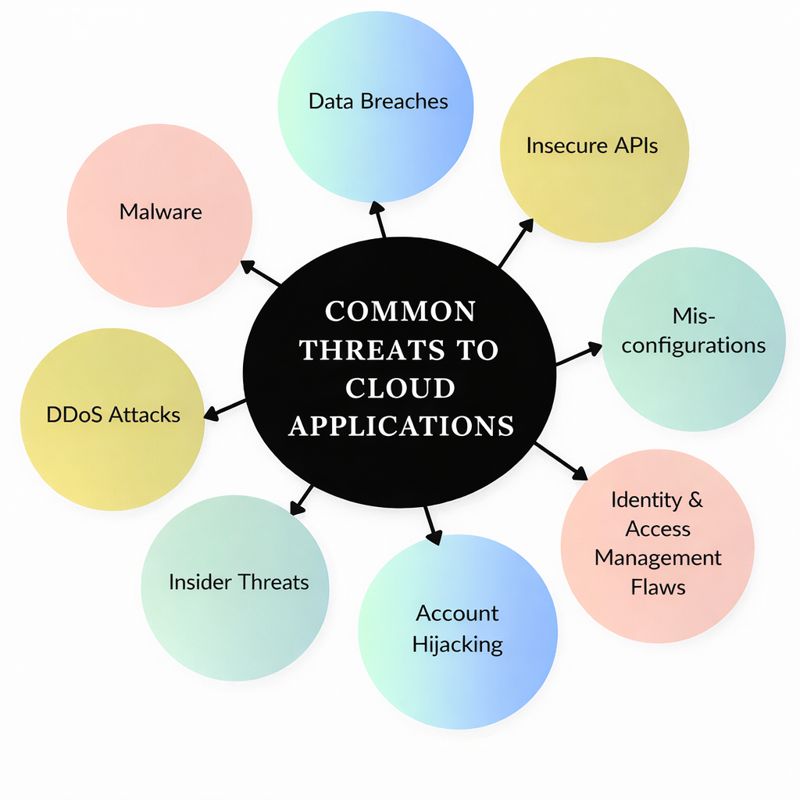
1. Data Breaches
A data breach occurs if data is not adequately protected. A breach results from poor access control, unencrypted data, or misconfigured cloud storage. Cloud applications often store sensitive information, such as financial information or customer PII. A breach in data leads to the exposure of this sensitive information.
2. Insecure APIs
Almost all cloud applications use APIs. APIs interact with cloud applications and resources. If an API is not properly secured with proper access controls and encryption methods, it can become an attack vector for denial of service, data theft, or privilege escalation.
3. Misconfiguration
Misconfiguration is a mistake or error in the configuration settings of a cloud application that leads to security vulnerabilities or exposes sensitive data. Misconfigured services, storage buckets, and databases are frequent causes of cloud incidents.
For many cloud applications, security tools are configured manually. This is prone to errors and takes considerable time to set up and update. Hence, these misconfigurations mainly occur due to human error, lack of visibility, or inadequate access controls. Organizations should adopt security tooling and technologies and automate the configuration process to take care of misconfigurations.
4. Identity and Access Management (IAM) Flaws
IAM policies may have some flaws, such as excessive privileges or stale user accounts, using which attackers can gain unauthorized access. Stolen passwords, weak authentication, or vulnerabilities in the application can also cause unauthorized access.
5. Account Hijacking
Cloud accounts are often hijacked via phishing, malware, or compromised credentials. Attackers successful in account hijacking can access sensitive data, manipulate services, and compromise other accounts. Organizations should enforce more stringent measures such as two-factor or multi-factor authentication, rigorous access management practices, and conduct user awareness about recognizing and avoiding phishing attempts.
6. Insider Threats
Apart from threats that come from external sources, organizations should focus on security risks originating from individuals within the organization, such as disgruntled employees or careless users who have access to applications, misusing user privileges, intentionally or unintentionally.
7. DDoS Attacks
Distributed Denial-of-Service (DDoS) attacks often overwhelm a cloud application with traffic, making it unavailable to legitimate users. Sending large amounts of spam or malicious traffic to the application is a form of DDoS attack. DDoS attacks overwhelm resources and disrupt service availability.
Some of the measures taken to reduce DDoS attacks include traffic analysis and filtering, implementing dedicated DDoS attacks, and overprovisioning bandwidth.
8. Malware
Malware can infect cloud applications and resources, giving attackers control of user access and other applications. This access can be used to steal data, launch denial-of-service attacks, or disrupt operations.
Cloud Application Security Framework and Tools
Compromised cloud applications leave businesses vulnerable to data exposure and exfiltration. Organizations, therefore, invest in security solutions to mitigate the risk of security threats. There are cloud application security frameworks and tools that are used as security solutions.
- Cloud Security Posture Management (CSPM): The CSPM automates the identification and remediation of risks across cloud infrastructures and monitors its current state. CSPM is used for risk visualization and assessment, incident response, compliance monitoring, and DevOps integration. Using CSPM, best practices for cloud security can be applied to hybrid, multi-cloud, and container environments.
- Cloud Workload Protection Platform (CWPP): Offers unified cloud workload protection across multiple providers and protects workloads of all types in any location. Technologies like vulnerability management, anti-malware, and application security are adopted by CWPP to meet modern infrastructure needs.
- Cloud Access Security Broker (CASB): These are the security enforcement points between cloud service providers and cloud service customers. CASB ensures traffic complies with policies before it is allowed network access. CASBs offer firewalls, authentication, data loss prevention, and malware detection.
- Web Application Firewalls (WAFs): They inspect HTTP/S traffic to protect applications from SQL injection, XSS, and other web-based attacks.
- Identity and Access Management (IAM) Solutions: These platforms deal with managing user identities, enforcing MFA (Multi-Factor Authentication), and defining role-based access controls (RBAC).
- Security Information and Event Management (SIEM): These are tools used to aggregate, analyze, and alert on security events from cloud environments. They offer visibility and threat detection.
- Container Security Platforms: Tools like Prisma Cloud or Aqua Security are used to scan vulnerabilities and enforce runtime protection in containerized applications like Docker and Kubernetes.
- Data Loss Prevention (DLP): DLP tools are used to monitor and prevent the unauthorized access and movement of sensitive data across cloud storage, email, and collaboration platforms.
Best Practices for Securing Cloud Applications
- Conduct Regular Risk Assessments: Regularly evaluate threats, vulnerabilities, and business impact. Doing this helps to prioritize security investments and remediation efforts.
- Secure APIs: Protect API gateways using authentication, tokens, encryption, rate-limiting, and input validation.
- Use Encryption at Rest and in Transit: Encrypt all sensitive data to prevent unauthorized access.
- Monitor and Audit Activity: Implement appropriate logging and auditing mechanisms to detect anomalies, policy violations, and track unauthorized access across the cloud environment.
- Implement DevSecOps: Automate security testing and remediation, and also integrate security tools in CI/CD pipelines to catch issues during code commits, builds, and deployments.
- Regular Patch Management: Apply patches and updates regularly to libraries, application components, and operating systems to mitigate known vulnerabilities.
- Employee Training and Awareness: Train developers and users regularly to ensure they understand and follow secure practices.
- Third-Party Risk Management: Evaluate third-party services, APIs, or code used within applications for security risks to avoid inherited vulnerabilities.
Compliance and Governance in the Cloud
- GDPR (General Data Protection Regulation)
- HIPAA (Health Insurance Portability and Accountability Act)
- PCI-DSS (Payment Card Industry Data Security Standard)
- ISO/IEC 27001
- SOC 2
Compliance adherence often requires data localization, encryption, access logs, breach reporting, and vendor due diligence. Tools and reports that assist with compliance mapping and audits should be used.
Future Trends in Cloud Application Security
- Confidential Computing: Data in use (or being processed) is encrypted, preventing unauthorized access even during execution.
- Infrastructure as Code (IaC) Security: With infrastructure defined in code (e.g., Terraform, CloudFormation), tools can scan IaC templates for vulnerabilities and misconfigurations.
- Security Service Edge (SSE): Is a concept that consolidates CASBs, secure web gateways, and Zero Trust Network Access (ZTNA) into a unified cloud-based service.
- Privacy Enhancing Technologies (PETs): Solutions like differential privacy and homomorphic encryption allow analytics without exposing raw data.
Conclusion
Cloud application security is a very crucial aspect of cloud infrastructure. It is a dynamic, multi-faceted discipline involving people, processes, and technology. The need to secure cloud applications will grow exponentially as the digital field evolves.
By embracing principles like Zero Trust, using modern tools like CSPM and WAFs, and employing a culture of continuous vigilance, organizations can confidently navigate the complex cloud landscape, protecting both their assets and customer trust.
Additional Resources
- Data Science vs Software Engineering
- 5 Types of Software Licenses to Know
- Serverless Computing in Software Engineering
 |