
What is Monolithic Software Architecture?
One might think that the days of monolithic software architecture are a distant memory in the world of distributed microservices and cloud-native apps. In actuality, it is far from outdated. A monolithic architecture was used to build many of the biggest systems in the world, including early e-commerce platforms and legacy backing solutions. Many modern startups continue to use monolithic architectures to launch products rapidly.
What does monolithic mean, then? Why does it still matter? And when is the right time to use or not use this strategy?
Let us understand monolithic architecture in its entirety, including its definition, operation, and place in the existing software environment.
| Key Takeaways: |
|---|
|
Understanding the Basics: What is Monolithic Architecture?
Let us start with the term itself before diving into the specifics.
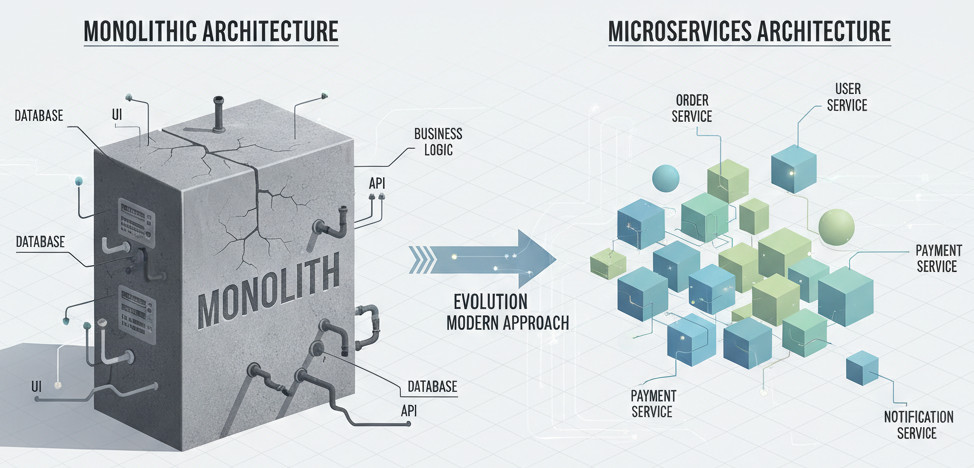
The Greek word monolithos, which means “single stone,” is where the word “monolithic” originates. It describes an application in software that is built as a single, cohesive, indivisible unit, a single, sturdy structure in which every component is linked to and used in tandem.
The user interface, business logic, and data access of an application are all stored in a single codebase and work as a single process in a monolithic software architecture.
Every change, even a minor one, generally needs to redeploy the entire application. Imagine you construct a restraint with a single room functioning as the kitchen, dining area, and storage. When it’s small, that’s convenient, but as it gets bigger, it quickly becomes crowded. That’s what a monolithic system is all about.
Monolithic Structure Meaning: The Idea Behind the Architecture
The system’s layout and design are what we mean when we discuss the monolithic structure’s meaning.
Within the same codebase, a monolithic structure is a closely linked, interdependent configuration in which different components, modules, features, or layers all depend on one another.
The HR, finance, development, and operations departments are all stored in one skyscraper. Everyone uses the same utilities, cafeteria, and elevators. Early on, it works well, but as more people (or modules) move in, it becomes more difficult to manage.
Software-wise, the monolithic structure offers speed and ease of setup. Without having to worry about communication between disparate services, you can build rapidly.
However, the structure may become inflexible as functionality scales, much like when you try to renovate one floor without affecting the others.
The Anatomy of a Monolithic System
What does the internal architecture of a typical monolithic system look like?
Its three primary layers are as follows:
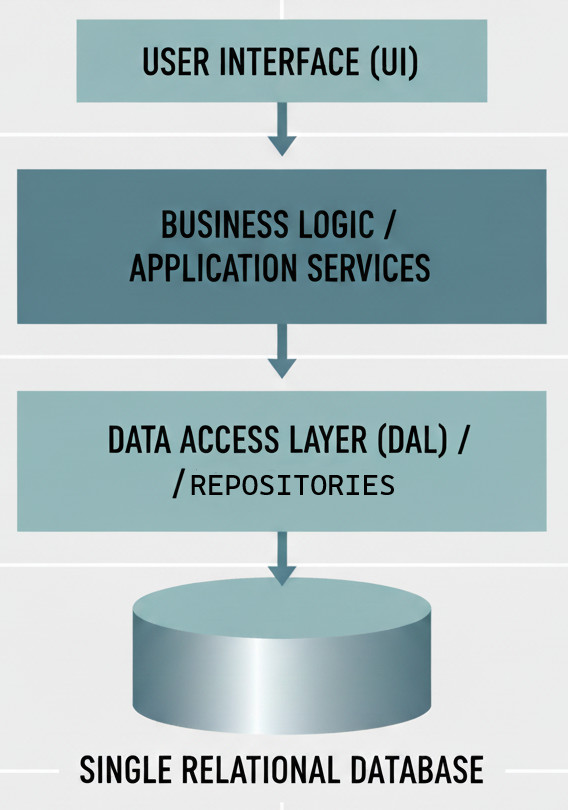
- Presentation Layer (UI): Manages the screens of apps or web pages that users view and interact with.
- Business Logic Layer: Oversees decision-making, data processing, and rules.
- Data Access Layer: This layer makes read/write connections to databases.
A single executable or deployment unit contains all of these layers. They have the same database and memory.
This implies that there is no network communication between components and that a request from the user interface is handled directly through internal function calls.
This structure has both benefits and cons: it is very quick for internal processing, but it is more difficult to scale separately due to its tight coupling.
Monolithic Architecture Diagram
Let us conceptualize it.
Despite the fact that we are unable to display an image at this time, visualize the monolithic architecture diagram as a three-tier stack:
Each layer performs the functions detailed below:
- The top layer, which includes dashboards, forms, and web pages, is where users interact. Every UI element makes a direct call to an application function.
- All rules and processing are located in the middle layer. For example, this layer validates the request, calculates totals, and handles payment when a customer places an order.
- Data is retrieved and stored in a single, centralized database by this layer. The same database tables or schemas are used by all features, including user management, payments, and the product catalog.
- When every layer is prepared, it is all compiled and packaged into a single deployable file or container (such as a binary, .jar. or .war).
- Deploying includes updating the entire application rather than just a portion of it.
Since they are connected like chapters in a single book, changes made to one layer frequently have an impact on the others, as this monolithic architecture diagram makes it clear.
Key Characteristics of Monolithic Architecture
Let us examine the characteristics that distinguish monolithic software architecture:
- One unified code repository stores all of the application logic. The build process creates a single deployable artifact, and each developer works on the same project.
- Modules are highly reliant on one another. Modifications to one layer might require changes to multiple layers.
- Usually, a single database instance is shared by all features. Although this makes the setup easier, performance and maintenance bottlenecks may be experienced.
- Together, the entire application is developed, tested, and made available. Complete redeployment is needed for even minor updates.
- In contrast to network-based microservices, communication between modules is incredibly quick because all calls are made within the process (either function calls or shared objects).
Because of these features, monolithic architecture is easy to create initially but more difficult to change as complexity increases.
Advantages of Monolithic Software Architecture
Despite modern trends, monolithic systems have true benefits, especially for smaller teams or early-stage products.
- Developers can easily understand the entire system when there is only one codebase. Coordinating APIs and managing multiple repositories are not necessary.
- One package, one server, and one instance are deployed. Deployment pipelines are therefore simple and predictable.
- There is no need to chase dispersed logs across services because everything works together, so debugging often includes tracing within the same environment.
- Calls to internal functions are faster than those to the network. For low-scale workloads, monolithic applications often perform better than distributed systems.
- Multiple services don’t need different infrastructure. Because of this, it is affordable for MVPs, prototypes, and small applications.
- As every module uses the same environment, configuration, and language, integration problems are reduced.
To put it in a simpler manner, monoliths are great places to start when simplicity and development speed are more important than scalability issues.
Disadvantages of Monolithic Architecture
The same simplicity that once helped can now become a hurdle as teams and systems expand.
- One component cannot be scaled on its own. You must scale the entire application, including the inactive portions, if one module (such as payment processing) needs increased resources.
- Every part is interconnected, so even minor modifications need testing and system deployment. Release velocity is slowed down as a result.
- The entire application may crash due to a bug in one module. Tightly coupled systems have limited fault isolation.
- The technology stack is the same for all modules. The entire codebase must be refactored when a new language or framework is embraced.
- The codebase grows larger and more interconnected over time; it is often referred to as a “big ball of mud.” It gets harder and harder to add new features without breaking existing ones.
- Productivity is decreased as more developers contribute to the same repository because of merge conflicts and increased coordination costs.
In other words, monolithic architecture does not scale well with the complexity and size of a team.
Monolithic Architecture vs Microservices Architecture
Nowadays, it would be impossible to talk about monoliths without comparing them with their modern architectural equivalent: microservices.
| Aspect | Monolithic Architecture | Microservices Architecture |
|---|---|---|
| Structure | Single, unified codebase | Collection of small, independent services |
| Scalability | The entire app must scale together | Each service scales independently |
| Deployment | One deployable unit | Independent deployments per service |
| Technology Stack | One language/framework for all | Each service can use its own tech |
| Fault Isolation | Failure can crash the whole system | Failures are isolated to individual services |
| Communication | In-process function calls | Over the network via APIs |
| Team Autonomy | One team or tightly coupled teams | Multiple independent teams |
Microservices offer flexibility, faster iteration, and resilience, but at the expense of increased operational complexity.
A monolithic system is still often the better first option for startups or small teams. Later, when scaling demands warrant it, you can always move toward microservices.
When to Use Monolithic Architecture
Context is important when selecting an architecture.
Select the option that best suits your needs; there is no one “best” option.
Monolithic software architecture should be taken into account when:
- A monolithic approach enables faster development and testing when time to market is more important than long-term scalability.
- Managing several microservices can add unnecessary complexity if your team consists of fewer than ten developers.
- A monolith is ideal if your application isn’t supposed to manage high traffic volumes or complex domain logic.
- It is less expensive to run a single application across multiple servers than to orchestrate serverless microservices or containers.
- You can easily scale vertically (to larger machines) without needing distributed scaling if the user load is low.
- When their initial architectures became unworkable, many prosperous businesses, including Netflix, Amazon, and Uber, switched to microservices.
When to Avoid or Evolve Beyond Monolithic Architecture
- When your team gets big and dispersed, you will know it is time to change.
- Deployment times become too long.
- Only certain system components need to be scaled.
- For different modules, you wish to use distinct technologies.
- Agility is impacted by downtime or coupling.
At this point, businesses start switching from monolithic to microservices architecture.
Evolving from Monolithic to Microservices
Relocating does not entail beginning anew. Using tried-and-true patterns, you can incrementally change your monolithic system.
The Strangler Fig Pattern
Begin by developing new features as unique services. Until the old system “shrinks,” gradually reroute a portion of the traffic from the old monolith to these services.
Domain Decomposition
Divide the monolith into logical domains, such as inventory, payments, and users, and gradually extract each into a unique microservice.
Database Segmentation
Switch to distinct data stores for every service instead of a single, big shared database. Performance and deployment are thus separated.
Event-Driven Communication
To increase scalability and fault tolerance, use event buses or message queues to enable asynchronous communication between services.
Incremental Refactoring
Don’t rewrite everything at once. Determine which areas (high coupling, scaling bottlenecks) are the most troublesome, then refactor gradually.
This method enables you to safely and gradually transition to a distributed architecture while maintaining the functionality of your current system.
The Future of Monolithic Architecture
Even though serverless, containerization, and microservices are currently making headlines, monolithic architecture is still vital to the software ecosystem of today.
For many business cases, monolithic development remains efficient and scalable due to modern frameworks like Ruby on Rails, Django, and Spring Boot.
Even cloud service providers like AWS and IBM agree that monoliths aren’t “wrong”; rather, they are just different tools in different phases of a product’s lifecycle.
A modular monolith approach, which segregates the codebase into unique modules within a single deployable unit, is actually used by some organizations. This removes the complexity of distributed systems while bringing some of the benefits of microservices (isolation, modularity).
Finding Balance Between Simplicity and Scalability
Now, what exactly is monolithic architecture?
One codebase, one database, and one deployment is the most basic and direct method for developing and implementing a software application.
When speed, ease of use, and cost-effectiveness are your main priorities, a monolithic system can get you very far.
That same simplicity, though, might end up becoming a bottleneck as your product expands. It makes sense to move toward modular or microservice-based designs at those points.
- When you are small and need focus, start monolithic.
- Grow modular as you scale.
- Switch to microservices when scalability and interdependence are vital.
Ultimately, architecture is not about trends but about trade-offs.
You can build a distributed system tomorrow on a solid foundation from a well-designed monolith today.
 |