
What is the Concurrent Development Model in Software Engineering?
Software engineering has evolved significantly over the years, and so have development methodologies. They have adapted to new complexities, faster delivery expectations, and increased requirements for collaboration and scalability. One of the methodologies that has emerged to address the realities mentioned earlier is the Concurrent Development Model, also known as the Concurrent Engineering Model or the Concurrent Development Process Model.
| Key Takeaways: |
|---|
|
This article examines the concurrent development model, including its definition, key features, workflow, benefits, drawbacks, and practical applications.
What Is the Concurrent Development Model?
The Concurrent Development Model is a software engineering development approach in which all stages of the SDLC proceed concurrently, rather than sequentially.
In traditional approaches, one stage must be completed before the next begins. In concurrent mode, software development activities often overlap and can inform each other of their progress.
Features of the Concurrent Development Model
- Parallel Workflow: In this model, several phases of the SDLC start and run in parallel, including the design phase, development phase, and testing phase, allowing for the completion of a project more expediently.
- State Transitions: Each activity in the model is represented as a state. Different states of different activities may coexist, and transitions between states occur as teams make progress across tasks.
- Real-time Communication: Everyone at every stage receives repeated feedback, allowing the team to work together to find solutions and ensure the common goal is achieved.
- Flexibility: As one phase operates in parallel with another, stakeholders can easily incorporate new changes and improvements.
- Iterative Development: The concurrent model continually receives input and testing and thus carries out iterative activities to revise the prototype. This makes it suitable for iterative activities.
- Reduced Time-to-Market: The work is divided between the tasks and stages that are performed in parallel, making the project faster.
The model is dynamic in nature because development processes continuously evolve as more information becomes available.
Rooted in Concurrent Engineering
This model gets its concept from concurrent engineering, which is a product development methodology extensively used in manufacturing industries such as automotive and aerospace. Concurrent engineering has multidisciplinary teams working in parallel and collaboratively to reduce development time and improve quality.
Key Principles of the Concurrent Development Model
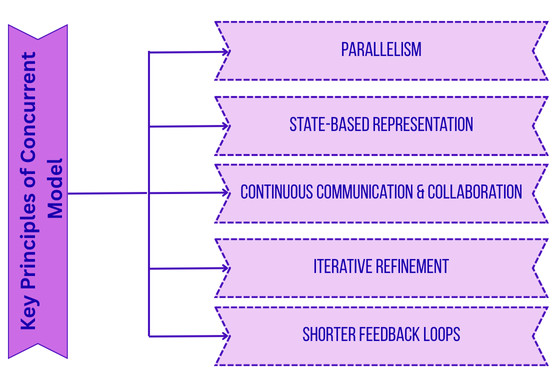
The Concurrent Development Model operates on a few core principles discussed here:
Parallelism
Various SDLC activities, such as design, coding, and testing, are executed concurrently rather than sequentially. For example, requirements gathering may still be in process when the design phase begins, or testing can start when modules are still being developed. This concurrent execution of activities enables different components or phases of a project to be worked on simultaneously, thereby accelerating the overall development lifecycle.
State-Based Representation
- Not Started
- Under Development
- Partially Completed
- Completed
- Under Revision
- Awaiting Changes
This division of activities into clear states allows flexibility and transparency in tracking progress.
Continuous Communication and Collaboration
Continuous and frequent communication and coordination are required among different teams for success. Information and feedback are shared in real-time among developers, testers, designers, business analysts, clients, and DevOps teams, which enables them to work together to solve problems promptly.
Effective collaboration between stakeholders with clearly defined roles, planned work schedules, and knowledgeable teams also helps manage parallel activities.
Iterative Refinement
The concurrent model is an evolutionary model where activities aren’t locked once completed, and revisions occur as new insights arise in other phases. A project can undergo various iterations, with each iteration around the development spiral producing a near-complete version of the final product.
Shorter Feedback Loops
In the concurrent model, teams identify issues earlier and reduce delay. This is because the phases are not strictly separated, and feedback from a later phase can be quickly integrated into the earlier phase. This allows for adjustments to be made without significantly affecting the project’s progress.
How does the Concurrent Development Model Work?
The concurrent development model operates by having multiple development phases, such as design, coding, and testing, run concurrently instead of sequentially. This approach enables teams to work on different parts of a project simultaneously, streamlining the process by overlapping stages and facilitating immediate feedback and iteration. The model is represented as activities that can transition between states, such as “under development” or “awaiting changes,” providing a clear view of the project’s status.
- Simultaneous Phases: Multiple development activities occur in parallel. For example, a design team might be creating UI elements while back-end developers build the API, and front-end developers create the framework, all while the testing team tests a feature.
- State Transitions: The model tracks the state of each activity. For instance, an activity might transition from an “under development” state to an “awaiting changes” state in response to events such as customer feedback.
- Overlapping and Iterative Phases: Phases in the concurrent model are not strictly separated, resulting in overlap between them. This allows work to continue on later phases while earlier ones are still being completed, and they can be revisited if necessary.
- Improved Visibility: By representing the project’s status more accurately, this model provides better visibility into which activities are active and their current state.
Example Flow of Concurrent Model
- Requirements gathering is not entirely complete, but it is partially done.
- The design team considers the early requirements (those that are completed ) and begins building the system architecture.
- Developers begin working on modules that have already been designed.
- Testers write test cases simultaneously as design decisions emerge and coding progresses.
- As new requirements emerge, they are incorporated immediately, potentially requiring some activities to be revisited.
State Transitions
- New inputs gathered
- Changes in requirements
- Testing feedback
- Review cycles
- Stakeholder/customer feedback
Thus, in the entire model, no phase is isolated, and all phases interact with one another.
Stages of the Concurrent Development Model
The concurrent development model involves multiple phases of SDLC, such as requirements gathering, design, development, testing, deployment, and maintenance, that are performed simultaneously rather than sequentially.
Activities can be in various states, moving between them based on events, such as the “under development” state for design. At the same time, “communication” is complete but awaiting changes, or “integration and testing” is running concurrently with development.
The concurrent model still includes recognizable SDLC stages:
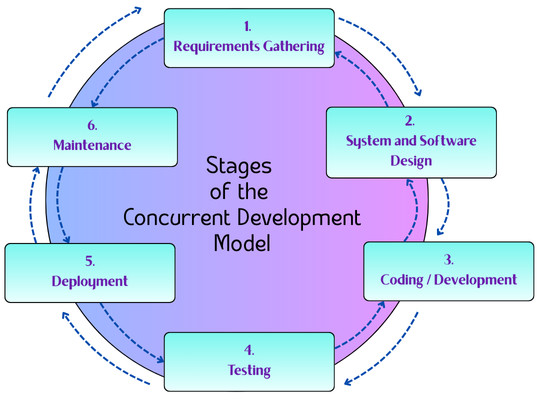
Requirements Gathering
In this phase, the requirements are gathered from customers through stakeholder interviews, workshops, and documentation. This initial activity must be completed before proceeding to the next phase. At this point, it may enter an “awaiting changes” state if new requirements will be available later on. Requirements may also evolve throughout the development, and changes ripple into design and testing processes concurrently.
System and Software Design
This phase involves creating the system’s design and potentially building prototypes. Early design can begin even with incomplete requirements, and the architecture evolves based on new insights that become available over time.
The design process can also occur alongside development and testing.
Coding / Development
This phase runs in parallel with the design and testing phases. Developers work on modules incrementally with continuous integration, ensuring consistent alignment throughout the development process. Developers code in parallel, allowing multiple teams to work simultaneously.
Testing
Testing is iterative and continuous. Newly developed modules are continuously integrated and tested as they are completed. Test cases are updated as requirements and design evolve. Test planning begins early, and the product is tested throughout the development stage, not just at the end of the process.
Deployment
Progressive deployment is possible in a concurrent model. With DevOps integration, releases are automated. Code is developed and tested in the CI/CD pipeline, and it is deployed when the tests pass.
Maintenance
This stage involves bug fixing and enhancements based on customer feedback. These activities are conducted in conjunction with ongoing development activities.
Types of Concurrent Development Model
The concurrent development model is not a single, distinct model, but rather a methodology that can be used in conjunction with other models to accelerate the development process.
They differ in the way they handle various SDLC phases, enabling organizations to select the most suitable approach for their specific project.
The types of concurrent development models are:
Waterfall Model
The waterfall model completes the SDLC phases sequentially, with each phase requiring completion before the next one begins. With the concurrent framework, different teams may work simultaneously on different sequential phases of separate parts of the project.
This concurrent model is most effective for projects with well-defined requirements that are unlikely to change during the development phase.
This model is straightforward to understand, comprising well-defined stages. Each phase is easier to monitor and manage. The model is documentation-centric.
However, the major drawback of this model is that once the phase is complete, it cannot change or accept feedback. Testing is performed after the development phase, and delivery is only after all the phases are completed.
Prototyping Model
This model builds a working prototype to gather user feedback and identify potential issues or areas for improvement before full-fledged development begins. The concurrent development is achieved by overlapping different parts of the prototyping and development process.
The developed prototype is revised concurrently with other system components, making it conducive to continuous user involvement and iterative improvements.
Prototyping improves the understanding of requirements and expectations in the early stage. The model is driven by user feedback, and modifications are possible at every stage of development if required. Chances of failing the project are minimized, and communication between users and developers is enhanced.
This model, however, is time-consuming as it is continuously improved, and feedback is obtained. Cumulative modifications in the model and documentation can be expensive.
Spiral Model
The spiral model is a combination of the waterfall and prototyping models, strongly emphasizing risk analysis. Each spiral iteration involves concurrently performing multiple activities, including planning, risk assessment, engineering, and evaluation. Each spiral produces a refined version of the system.
The model focuses on risk analysis, thereby reducing the risk of project failure. This model is suitable for projects with changing requirements, as it allows for changes and refinements throughout the software development process. User feedback is integrated into the development process, enhancing the overall development process.
However, the model is complex and costly, as it involves high costs associated with risk analysis. Another important aspect is that it requires a team of experienced specialists, and the model is not suitable for small projects due to the extensive resources it demands.
Incremental Model
In the incremental model, the software is built in a series of minor, incremental releases. Each increment is a fully functional version of the product that is then used in the next iteration. Multiple tasks are completed in parallel within a single increment, and different increments are also developed concurrently.
For example, one team could be developing the registration and login module while another could be working on the payment gateway feature for a later increment.
An incremental model accelerates delivery by allowing multiple teams to work in parallel. It can accommodate evolving requirements and provide fast feedback loops.
Advantages of the Concurrent Development Model
- Faster Development Cycles: Development time in the concurrent model is reduced significantly as many tasks run in parallel. Testers and designers are also involved in the early stages of development, thereby reducing the delays faced in sequential models.
- Improved Communication and Collaboration: Teams working in parallel maintain continuous synchronization, enhancing communication and cross-functional collaboration. This, in turn, improves product quality and resolves conflicts early, without affecting the development process. Customers are also involved in the entire process.
- Better Risk Management: Through parallel development, potential issues, such as design flaws, ambiguous requirements, or integration problems, are identified earlier. This helps mitigate risks before issues escalate.
- Flexible and Adaptive: With changing requirements, activities can be revised without stopping the project. New features are incorporated smoothly, and projects benefit significantly.
- Early Testing and Quality Assurance: Testing in the concurrent model begins early, allowing defects to be identified and resolved more quickly. This improves the product quality, reducing the rework costs.
- Efficient Resource Utilization: Team resources are appropriately utilized as they work simultaneously, reducing downtime.
Disadvantages of the Concurrent Development Model
- High Level of Coordination Required: Concurrent workflows need strong project leadership, effective communication systems, and a collaborative culture to manage the work. Poor coordination can lead to chaotic situations.
- Increased Complexity: Tracking multiple activities in different states that are performed simultaneously can become a significant challenge. Sophisticated tools are required for issue tracking, version control, communication, and continuous integration. This increases the project’s complexity.
- Potential for Rework: With overlapping tasks, early actions may need revisions, such as redesigning a module based on new requirements, rewriting code after design changes, or updating test cases constantly. These modifications can lead to inefficiencies if not managed well.
- Not Suitable for Very Small Projects: The concurrent models are not suitable for tiny teams or simple projects, as the overhead of parallelism may not be justified.
Use Cases of the Concurrent Development Model
- Complex and Large-Scale Projects: Projects with multiple subsystems, modules, and stakeholders benefit from concurrent models with simultaneous workflows, as these systems draw significant benefits by working in parallel.
- Systems Requiring Continuous Updates: Products and systems, such as operating systems, large enterprise applications, banking, and telecommunications software, require constant revisions as they are continuously updated. A concurrent model for such system development saves development time, reduces time-to-market, and increases the overall efficiency of the system.
- Projects with Frequently Changing Requirements: With dynamic business environments, projects and methodologies fail to adapt to changing requirements. Concurrent development helps in these situations.
- Organizations with Mature DevOps and Agile Practices: Companies that adopt automated pipelines for software development and foster a collaborative culture can seamlessly utilize concurrent models.
- High-Risk Software Projects: When the concurrent model is applied to high-risk software projects, it can facilitate the early detection of design and implementation issues, thereby reducing risks.
Tools Supporting Concurrent Development
Several modern tools support concurrent development as seen in the following table:
| Purpose | Tools |
|---|---|
| Version Control Systems |
|
| Project and Workflow Management Tools |
|
| Design and Collaboration Tools |
|
| Continuous Integration and Deployment |
|
| Testing Automation |
|
Concurrent Development vs. Other Models
Let us compare the concurrent development model with other development models.
Concurrent vs. Waterfall Model
Concurrent and Waterfall models differ in basic functionality, as the Waterfall model performs the SDLC phases in sequence, while the Concurrent model runs these activities in parallel. The key differences between the concurrent and waterfall models are given in the following table:
| Aspect | Concurrent Model | Waterfall Model |
|---|---|---|
| Workflow Approach | Activities and phases are performed simultaneously. | Phases run in a linear, sequential order. |
| Flexibility | Highly adaptive and flexible, designed to handle changes and rework more easily. | Rigid model, as it is difficult to go back and make changes to earlier phases. |
| Development Speed | Activities often overlap, and development occurs at a faster pace. | Development is slower due to the strict sequential progression. |
| Testing | Testing is performed early and is continuous across the phases. | Testing is done only after coding. |
| Requirements | Can evolve. | Must be fixed early. |
| Risk | Higher risk of errors if not appropriately managed due to the overlapping nature. | Lower risk of errors during early phases but higher risk of late, expensive bug discovery. |
| Best For | Projects where requirements can evolve, and speed is a priority. | Projects with stable, well-defined requirements from the start. |
Concurrent vs. Agile
The following table shows the key differences between concurrent and agile development models:
| Aspect | Concurrent Model | Agile |
|---|---|---|
| Philosophy | Parallelism of development stages. | Iterative increments. |
| Focus | Development tasks are overlapped to shorten overall project timelines and reduce costs. | Incremental delivery and adapting to change, emphasizing collaboration and customer feedback. |
| Flexibility | Less flexible than Agile for making changes in later stages, as the cost of change is higher in physical products. | Highly flexible, designed to welcome changes even late in the development cycle. |
| Structure | SDLC states are guided | Sprint-driven development. |
| Planning | Involves a more extensive upfront plan, with macro-planning at the beginning. | Minimal upfront planning, with plans adapted iteratively throughout the project (micro-planning). |
| Example | A car manufacturer has the design, manufacturing, and testing teams work in parallel from the beginning. | A software team releases a new feature, gets user feedback, and then incorporates that feedback into the next release cycle. |
When to Use the Concurrent Development Model
- When project requirements are evolving.
- The product is large and complex.
- Multiple teams need to collaborate for the product development.
- Early defect detection is crucial.
- Time to market is a priority.
- If the project is small or simple.
- When the requirements are stable and fully known.
- If the team lacks experience in parallel workflows.
Real-World Examples of Concurrent Development
- Aerospace and Defense: Projects involving the development of aircraft systems or defense platforms adopt concurrent engineering principles.
- Automotive Software: Modern vehicles utilize embedded systems that necessitate the parallel development of hardware, software, and firmware.
- Enterprise Software Companies: Large companies developing ERP, CRM, or cloud platforms use concurrent models for scalability and speed.
- Tech Startups with Mature DevOps: Organizations, primarily tech startups, focused on rapid innovation, use a concurrent development model to remain competitive.
Summary
The Concurrent Development Model is a dynamic, flexible, scalable, and collaborative approach to software engineering development. When SDLC activities are completed in parallel, it reduces development time, increases responsiveness to change, and improves overall product quality.
However, this development model demands strong coordination, experienced teams, and robust tooling. For large and evolving projects, it offers a robust methodology that aligns with modern software development practices.
 |