
What Is the YAGNI Principle?
As developers, we often look for simplicity when developing software. For a project’s long-term success, it is crucial to write code that is easy to understand, maintainable, and free of unnecessary complexity.
YAGNI, an acronym for “You Aren’t Gonna Need It,” is one principle that champions simplicity.
| Key Takeaways: |
|---|
|
This article explores what the YAGNI principle is, where it came from, why it matters, how to apply it effectively, common misconceptions, and real-world examples that illustrate its power.
The Origin of YAGNI
YAGNI emerged in the 1990s from Extreme Programming (XP), one of the early Agile methodologies, and was formalized by Kent Beck and other XP founders, Ron Jeffries, and Ward Cunningham. XP emphasized delivering small increments of working software, rapid feedback, and continuous improvement. Within this framework, YAGNI became a guiding rule that stated:
“Always implement things when you actually need them, never when you just foresee that you need them.”
This philosophy challenged the established developer mindset of anticipating every possible future requirement before writing code. According to the XP approach, building features based only on speculation wastes effort as most predictions about the future are wrong or at least incomplete. In general, the YAGNI principle discourages developers from premature, speculative, or over-engineered code.
- Test-Driven Development (TDD)
- Continuous Integration
- Refactoring
- Simple Design
What is the YAGNI Principle in Software Development?
YAGNI (You Ain’t Gonna Need It) is a principle of Extreme Programming (XP) that insists on not developing features that are not necessary.
Like the KISS (Keep it Simple, Stupid) principle, YAGNI also aims for a simple solution. The difference is that YAGNI focuses on removing unnecessary functionality and logic, while KISS focuses on the complexity.

At its core, YAGNI means:
Do not add functionality until it is necessary.
It simply means that you should not implement functionality just because you think that you may need it someday in the future. Instead, implement it when you really need it. This way, you will not be wasting your time on implementations that are not even necessary, and may never be used.
- Avoiding speculative features based on assumptions.
- Not building abstraction layers prematurely.
- Not optimizing for performance that isn’t currently considered.
- Not designing for scalability that may never be required.
- Not creating configuration options that no one has asked for so far.
- Pass all tests
- Reveal intent clearly
- Contain no duplication
- Include the fewest elements possible.
As you see, the last principle aligns directly with YAGNI. Developers will find it easy if the design is clean and adaptable. This is possible by avoiding unnecessary elements.
Key Aspects of YAGNI
- Prevent Over-Engineering: Do not add complex infrastructure or abstract layers of future scenarios that are not needed right now.
- Focus on Current Needs: Implement features that are part of current requirements only.
- Improve Maintainability: Use smaller, simpler codebases that are easier to understand, test, and maintain.
- Iterative Development: If a feature is needed later, add it at that time; if it is never needed, time was saved.
Example
Consider you are asked to write a function calculate (a,b) to calculate the sum of two numbers, a and b.
function calculate(a, b, operation = '+') {
  if (operation === '+') {
    return a + b;
  } else if (operation === '-') {
    return a - b;
  } else if (operation === '*') {
    return a * b;
  } else if (operation === '/') {
    if (b !== 0) {
      return a / b;
    } else {
      return 'Error: Division by zero';
    }
  } else {
    return 'Error: Unsupported operation';
  }
}
What you have done here is you have anticipated that you will need subtraction, multiplication, and division operations in the future, apart from addition. As a result, based only on your speculations, you have included the extra functionality in this function.
function calculate(a, b, operation = '+') {
  if (operation === '+') {
    return a + b;
  }
}
Why Developers Violate YAGNI?
You cannot predict the future. The most anticipated features either evolve differently or are never requested.
Despite this, sometimes developers build advanced features either because they are interested or because they are technically impressive. They are not developed because they are needed.
- Fear of Future Rework: Developers have a fear that if this feature is not implemented now, they might have to rewrite everything later. Sometimes they anticipate future requirements and create overly generic or extensible systems.
- Desire for Elegant Architecture: For skilled developers, creating generic frameworks or abstract systems feels intellectually satisfying. However, such implementations add unnecessary complexity.
- Optimism Bias: Teams falsely assume future needs are certain. In an actual scenario, product markets evolve, directions shift, market conditions change, and priorities change.
- Fear of Change: Developers often have a misconception that adding functionality later is more expensive than adding it upfront.
- “What if” Thinking: Developers think, “What if this is needed or if the client asks for this later?” and start coding for hypothetical scenarios.
Why is YAGNI Important?
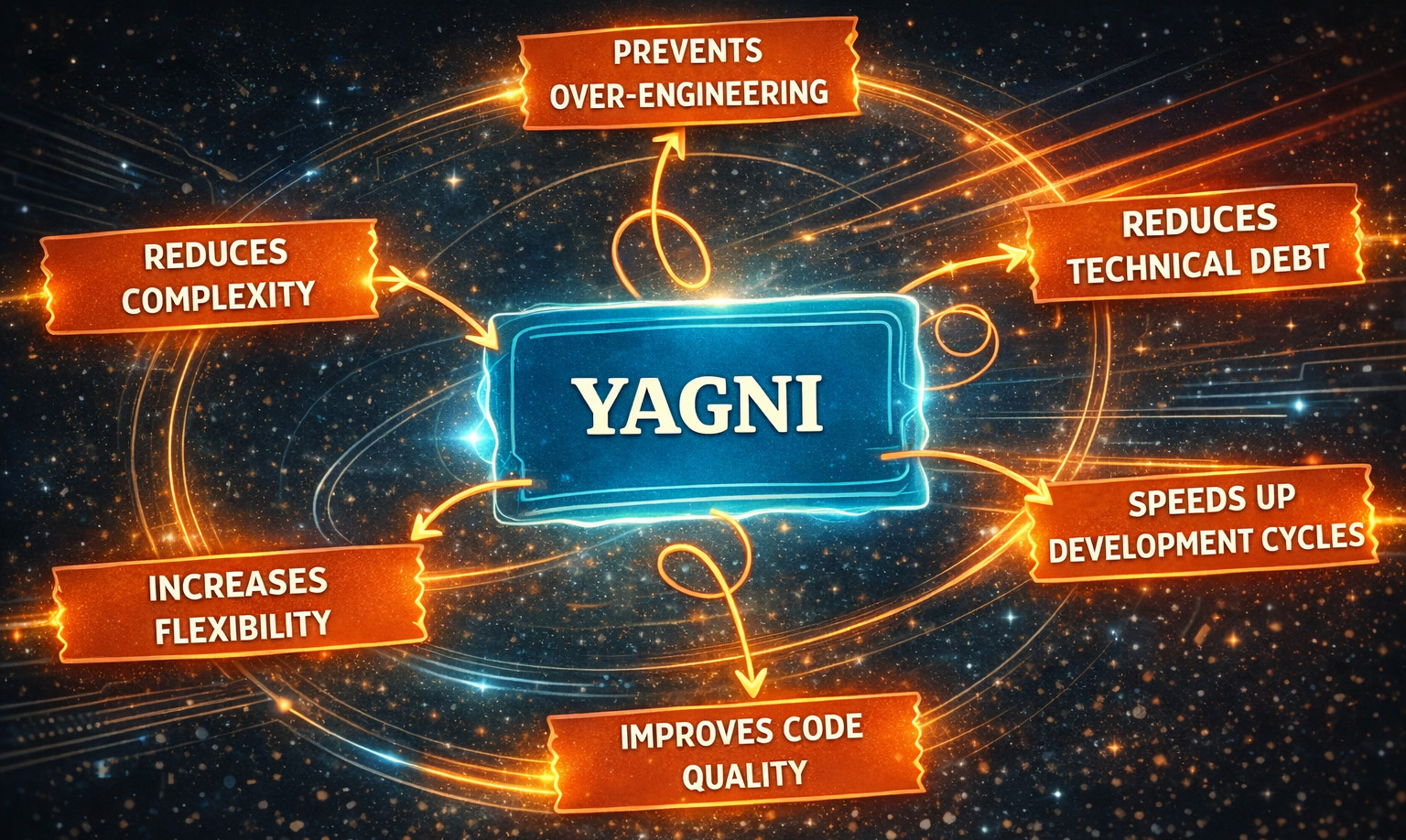
- Prevents Over-Engineering: YAGNI discourages developers from adding unnecessary features based on speculation, which often wastes time and resources.
- Reduces Technical Debt: With YAGNI, the codebase remains lean and manageable as it does not have unused code that must still be maintained, tested, and updated.
- Speeds Up Development Cycles: By adopting YAGNI, developers can avoid premature optimization and features not currently needed, and teams deliver value more quickly.
- Improves Code Quality: A simpler, focused codebase is easier to develop, understand, test, and refactor, resulting in fewer bugs.
- Increases Flexibility: Features are easier to add when requirements are actually known, rather than trying to build for every possible future scenario upfront.
- Reduces Complexity: Extra code makes debugging harder and increases maintenance costs.
YAGNI in Agile Environments
Truly Agile development practices revolve around the YAGNI principle. Agile methodology recognizes that it is better to deliver value as quickly as possible and respond to changing needs. This fits with releasing a minimum viable product (MVP).
YAGNI prevents developers from working on features that sound useful but are never used, thus saving their time. By the time the feature is needed, the product is in the hands of the customer earlier and generates value for them sooner than if it were delayed to add all the features.
- Iterative delivery of product
- Customer feedback
- Continuous improvement
- Encouraging minimal viable features
- Allowing real feedback before expansion
- Reducing development cycle time
- Focus on the MVP: YAGNI focuses on immediate, core features and encourages building a Minimum Viable Product (MVP), allowing for faster release and user feedback.
- Preventing Over-Engineering: Building complex, “future-proof” features is avoided, preventing over-engineering and saving time and effort.
- Lean Codebase: This is an additional advantage of YAGNI. It keeps the codebase lean. YAGNI helps maintain a cleaner, simpler codebase that is easier to manage and faster to refactor when requirements actually change.
- Iterative Development: YAGNI believes in designing for the present and not for the future, as it insists that future requirements can be added iteratively.
- Easy Refactoring: The YAGNI principle is successful only when there is clean code refactoring. When features are added, they need to be well integrated into the existing code by refactoring it to prevent code bloat and technical debt.
- Under-Engineering: Developers may misapply YAGNI, resulting in a code that is too simplistic, necessitating significant, time-consuming refactoring later.
- Ignoring Good Design: YAGNI is about avoiding unnecessary complexity. However, in doing so, developers may write poor code or avoid sound architectural practices.
- Difficulty in Predicting Needs: Although teams are focused on the present, they must also consider whether a small upfront investment makes future changes significantly easier.
When YAGNI Can Go Wrong?
- Ignoring Clear Requirements: If feature requirements are ignored and that feature has architectural implications, it may cause major rework. YAGNI does not justify ignoring roadmap commitments.
- Underestimating Infrastructure Needs: Certain decisions, such as compliance requirements or database schema design, require forward thinking. The key question here is: Is this a real, near-term need or speculation? Applying YAGNI here can cause catastrophic situations.
- Using YAGNI as an Excuse: It can also go wrong when it is misused to justify shortcuts or poor structure. YAGNI promotes simplicity, not sloppiness.
- When Lacking a Proper Technical Environment: If the development environment is poor and lacks features like automation testing or low-velocity development (no quick refactoring), YAGNI may not work and result in technical debt.
- When Ignoring Domain Knowledge: If you are operating in a domain such as finance or legal, then ignoring upcoming changes, such as new tax laws or safety regulations, “until they are needed” is foolish.
When to Ignore YAGNI?
The YAGNI principle is a valuable guideline, but there are instances where anticipating future needs is reasonable. When upfront investment prevents massive, unavoidable, and costly re-engineering later, YAGNI can be ignored. Key scenarios where YAGNI is ignored include foundational security, compliance, critical scalability, or when the cost of refactoring far outweighs building it now.
When to consider YAGNI and when to ignore it is purely based on judgment. You should focus on solving known problems while ensuring flexibility for reasonable future changes.
- Security and Data Integrity: Basic security, authorization, and data validation are critical and should never be delayed.
- Irreversible Architectural Decisions: These are the decisions that are nearly impossible to change later without a total rewrite (e.g., choosing a database type or core framework/library).
- High-Cost Refactoring: When you have a feature that, if added later, may require changing foundational code, then it is better to ignore YAGNI and implement it earlier.
- Performance Bottlenecks: In high-performance systems, retrofitting concurrency or specific data structures is challenging. In such cases, ignore YAGNI.
- Foundational Infrastructure: When you want to set up foundational infrastructure, such as CI/CD pipelines, logging, or monitoring, from day one.
- Internationalization/Timezones: A system guaranteed to be used globally is easier to implement early than to retroactively support.
Comparing YAGNI to Related Principles
YAGNI vs. KISS
YAGNI and Keep It Simple, Stupid (KISS) are complementary software development principles focused on reducing complexity.
The key differences between the two principles are:
| Aspect | YAGNI | KISS |
|---|---|---|
| Primary Focus | What to build – YAGNI focuses on scope | How to build it – KISS focuses on implementation |
| Goal | To eliminate waste of time and effort by avoiding speculative features. | To enhance readability and reduce maintenance. |
| Relationship | YAGNI is often considered a specific application of the broader KISS principle. | Has a broader scope than YAGNI. |
| What it does | YAGNI specifically warns against speculative functionality. | KISS promotes simplicity in design. |
| Benefits | YAGNI prevents over-engineering by deferring unnecessary features until they are needed. | KISS ensures that implemented solutions are straightforward and easy to maintain. |
YAGNI vs. DRY
Don’t Repeat Yourself (DRY) principle reduces repetition by consolidating shared logic, while YAGNI prevents over-engineering by avoiding premature, unnecessary features. DRY focuses on current code quality, whereas YAGNI focuses on future scope. Here are the key differences between the two:
| Feature | YAGNI | DRY |
|---|---|---|
| Goal | Avoids building functionality, abstractions, or “future-proofing” before it is strictly required. | Eliminates duplication in logic, data, or code structure. |
| Focus | Focuses on simplicity and minimizing immediate complexity. | Focuses on maintainability and reducing bugs by ensuring a single source of truth. |
| Action | Implements only what is necessary for current user stories. | Refactor similar code into shared functions, modules, or classes. |
| Risk | May suffer from under-engineering; failing to design for reasonable, inevitable changes, creating technical debt. | May risk over-abstraction of code, making it too complex by trying to reuse something that isn’t truly the same. |
YAGNI vs. BDUF
YAGNI, as an Agile principle, focuses on building only the required features now to avoid waste. It contrasts sharply with Big Design Up Front (BDUF), a traditional approach requiring comprehensive planning before coding. YAGNI promotes iterative flexibility, while BDUF aims for stability but risks high overhead and rigidity. The following table summarizes their key differences:
| Aspect | YAGNI | BDUF |
|---|---|---|
| Definition | The YAGNI principle states that you should not add functionality until it is deemed necessary. | BDUF involves extensive, detailed planning and architectural design that are completed before coding begins. |
| Philosophy | Focuses on the present requirement; avoid premature optimization and speculative coding. | Predicts future needs and plans for them to prevent later, costlier changes. |
| Pros | Reduces wasted development time, lowers complexity (KISS), keeps code lean, and speeds up delivery. | Provides a clear roadmap, ensures components fit together, and minimizes major, structural rework later. |
| Cons | Can lead to a lack of overall architectural vision if taken too far, potentially causing technical debt in long-term, complex systems. | Rigid, hard to adapt to changing requirements, and risks of building features that are never used. |
| Best For | Startups, MVP development, agile teams, and projects with high uncertainty. | High-stakes projects with immutable requirements (e.g., aerospace, medical software). |
Conclusion
The YAGNI principle is a commitment to disciplined simplicity and not a rejection of thoughtful design. By avoiding speculative features, teams reduce waste, save time, improve clarity, and maintain agility.
By adapting YAGNI, developers can focus on present requirements, deliver value fast, embrace quick refactoring, and resist over-engineering.
YAGNI is suitable in the modern world where technology changes rapidly, and requirements evolve constantly, and the ability to adapt is more valuable than the ability to predict.
It provides a practical rule:
Build what is necessary. Nothing more.
When the future arrives, build again, wisely, deliberately, and informed by experience.
Additional Resources
- Why Every Engineering Team Needs Version Control: Ensuring Safe, Collaborative, Traceable Code
- How to Refactor Legacy Code for AI Compatibility
- Cohesion vs Coupling
- What are the Different Types of Code Smells?
- Four Types of Software Maintenance: A Detailed Guide
Frequently Asked Questions (FAQs)
- What is the main purpose of the YAGNI principle?
The YAGNI principle emphasizes implementing only what is necessary and not what may be needed in the future. It helps reduce unnecessary complexity and wasted effort. Using it, teams focus on delivering real value, maintain cleaner codebases, and improve adaptability by avoiding speculative features.
- Does YAGNI mean no planning is required?
Not at all. YAGNI does not discourage planning. It, however, discourages implementing features based on speculation. Development should not be based on assumptions about the future. It should be driven by confirmed requirements using thoughtful design.
- Can following YAGNI cause problems later?
Yes, it can if applied blindly, particularly if it is applied blindly without considering the cost of future changes. While YAGNI is intended to prevent waste and over-engineering, its misuse can lead to structural limitations and significant technical debt.
- Is YAGNI only relevant to software development?
No. Although it originated in software engineering, the YAGNI principle applies to product development, business strategy, and even personal productivity. In general, it applies to any situation where adding unnecessary complexity can waste time and resources.
- Why is YAGNI important in modern software development?
As modern software environments change rapidly, YAGNI helps teams stay agile by reducing complexity, enabling faster delivery, and allowing systems to evolve naturally as requirements become clearer.
 |