
Spec-Driven Development
Over the last year, writing code has meant providing input to an AI agent. You describe your needs; you get the output as a block of code. It looks about right, but mostly doesn’t work. This was the gist of vibe coding, a term that had pretty much lit a wildfire in the software development community since 2025.
This method was great for fast prototypes, but way less dependable when creating serious, mission-critical apps or working with existing codebases.
Sometimes the code doesn’t compile. Some part of the issue was resolved, but the model didn’t understand the actual intent. The architecture is not what you decided upon.
The issue doesn’t lie solely with the coding agents; it also lies in our approach. We treat AI agents like coding experts when they should be treated as interns. AI agents are excellent at pattern recognition but need clear, unambiguous instructions.
This is why specifications are being re-examined. And this has given rise to spec-driven development (SDD).
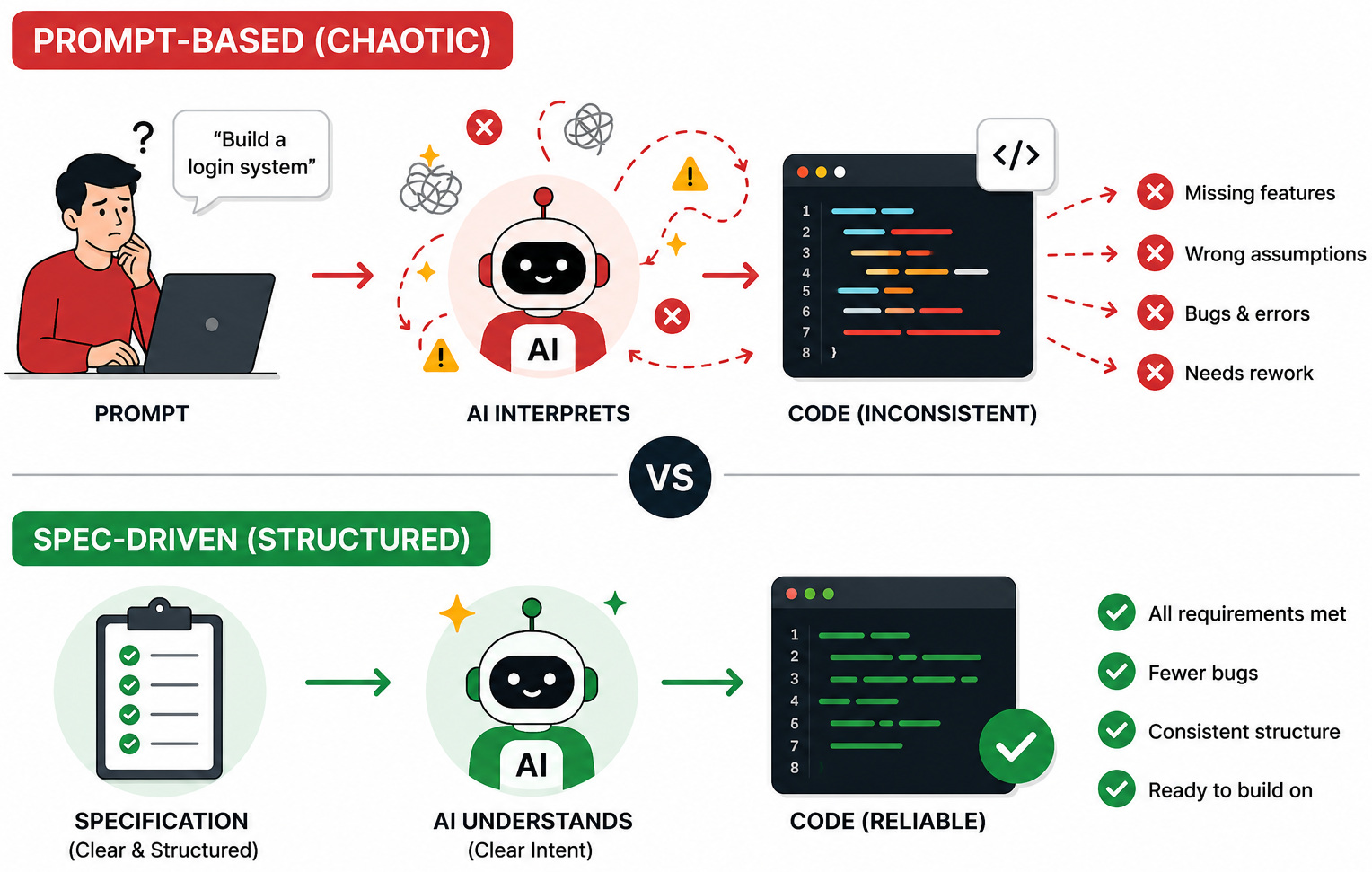
| Key Takeaways: |
|---|
|
Moving Beyond “Just Prompt It”
At its core, prompt engineering is conversational. You define and describe your needs in natural language, and AI responds with code. It feels quite intuitive because it simulates how we talk in a conversation.
However, software isn’t conversation, it’s precision.
When you prompt, "Build a login system", what are you actually referring to? Should it include password reset? What about rate limiting? How should errors be handled? What kind of authentication tokens should be used?
A human developer is trained to ask all of these questions before writing even a line of code. An AI model, on the other hand, will usually jump to conclusions and start coding. This is what leads to issues.
Spec-driven development takes a different approach. Instead of relying on loosely defined prompts, it asks you to slow down (just a little) and define what you want more clearly. Not in a vague paragraph, but in a structured, thoughtful way.
Read: Agentic Coding vs. Vibe Coding: Comparing AI-Coding Paradigms for Developers.
What is Spec-Driven Development?
As many assumed, Spec-Driven Development (or SDD as we will hereon refer to it as in the blog) is not a new term. The term, in fact, predates the LLM era. The attempts simply didn’t achieve success and reach actual development.
Software engineering has leveraged specs in different ways.
In behavior-driven development (BDD), meanwhile, specs are used as a vehicle to facilitate collaboration with business users. They’re typically written as scenarios and examples and treated as living documents of system behavior. This is supported by automated testing and continuous integration mechanisms.
At their core, these specs are still just structured text. And since modern AI models are exceptionally good at understanding and generating text, it’s no surprise they work well in AI-driven workflows.
Previous tools like GitHub Copilot focused mostly on generating small pieces of code. But as AI models have gained larger context windows, they’ve become capable of handling broader requirements and generating more complete systems from natural language.
To support this, newer AI coding agents tend to split development into two stages: planning and implementation. The planning phase involves understanding requirements, defining constraints, and organizing inputs more clearly. In essence, this step is about creating a specification, which then becomes the foundation for spec-driven development (SDD).
Also read: How to Write a Good SRS (Software Requirements Specification): A Complete Guide with Examples.
What is a Spec?
A specification is more than a product requirements document (PRD). While a PRD outlines what needs to be built, a spec defines how the system should behave in precise terms.
Technically, a spec describes the external behavior of software. It covers inputs and outputs, constraints, preconditions, postconditions, interfaces, and even state transitions. It focuses on behavior, not just business intent.
In the past, specs were written in strict, machine-readable formats. With modern AI, they can now be expressed in natural language. But their purpose remains the same: clearly defining system behavior.
What is a Good Spec?
Many principles from behavior-driven development still apply. A good spec should use clear, domain-focused language rather than being tied to specific implementations. It should be structured, often using patterns like Given/When/Then, and aim to be precise while still covering critical scenarios.
Clarity is still important. While AI models are not completely deterministic, well-defined specs help decrease ambiguity and reduce errors or hallucinations.
Also, structure still matters. Combining natural language with semi-structured formats (like schemas or templates) enhances how AI understands and runs instructions. Even in the LLM era, machine-readable elements remain valuable.
Finally, while people often separate business and technical specifications, in practice, the boundary between them is often blurred.
How to Practice Spec-Driven Development?
Spec-driven development starts by defining what the system should do before generating any code. The process is straightforward but much more structured than prompt-based workflows.
Levels of Adoption
- Spec-first: Development begins with a carefully defined specification, which is then used to direct AI-based implementation for a specific task.
- Spec-anchored: The specification isn’t discarded after implementation; it remains a reference point for future updates, improvements, and maintenance.
- Spec-as-source: The specification becomes the primary artifact over time. Instead of editing code directly, developers modify the spec, and the code is continuously generated from it.
Steps of SDD
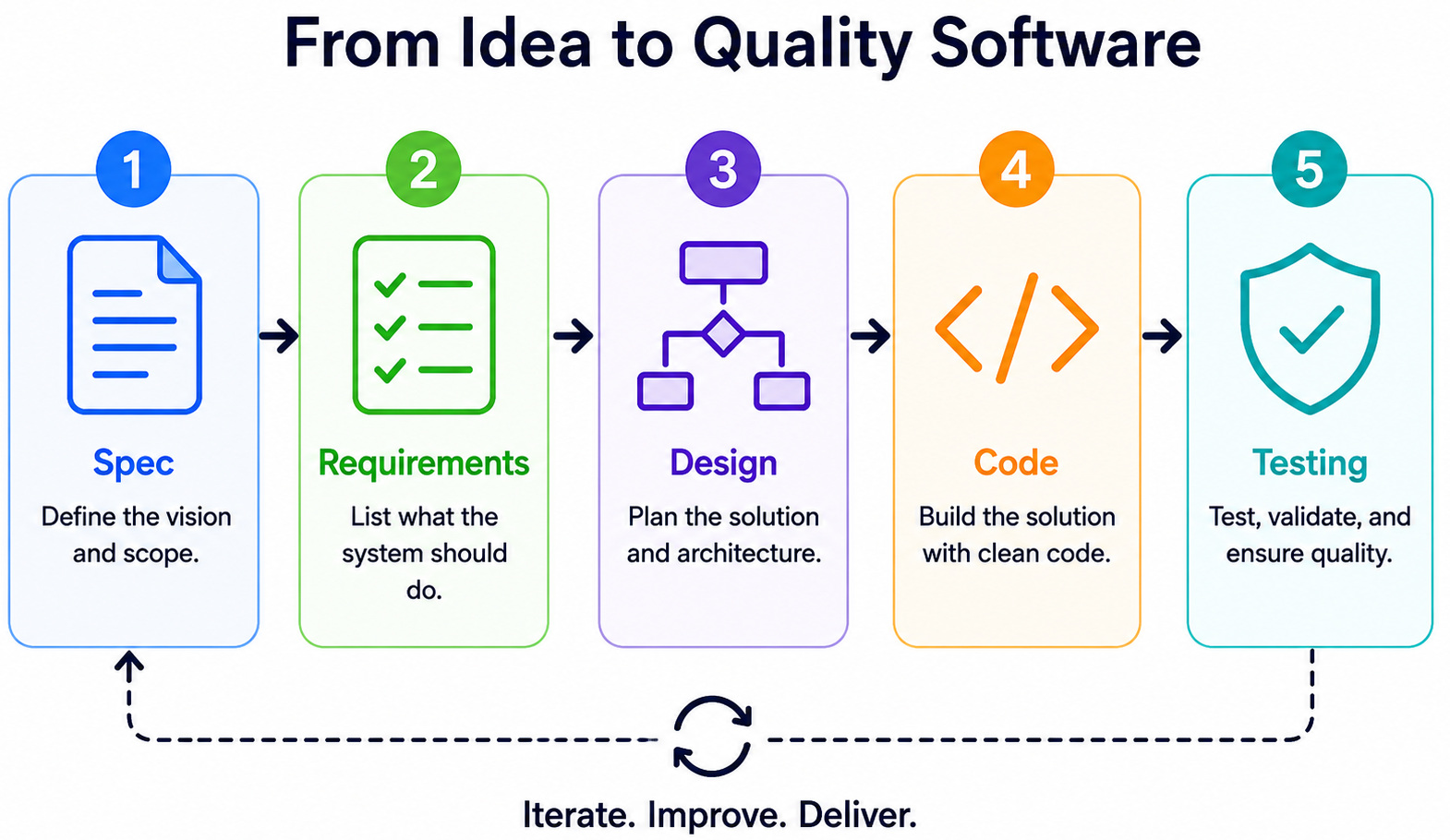
- Write the specification: Describe the system’s behavior clearly: inputs, outputs, constraints, and edge cases.
- Generate requirements: Expand the spec into structured requirements. This helps uncover missing details and ensures everything is well understood before moving forward.
- Create a design: Translate requirements into a technical plan: components, data flow, and tasks, without writing code yet.
- Implement: Now generate or write code based on the spec. Since decisions are already defined, the output is more consistent and reliable.
- Test against the spec: Use the spec as a contract. Test cases naturally follow from defined inputs, outputs, and edge cases.
For example, let us see what the steps would be if we were asking an AI system to build us a login system via SDD.
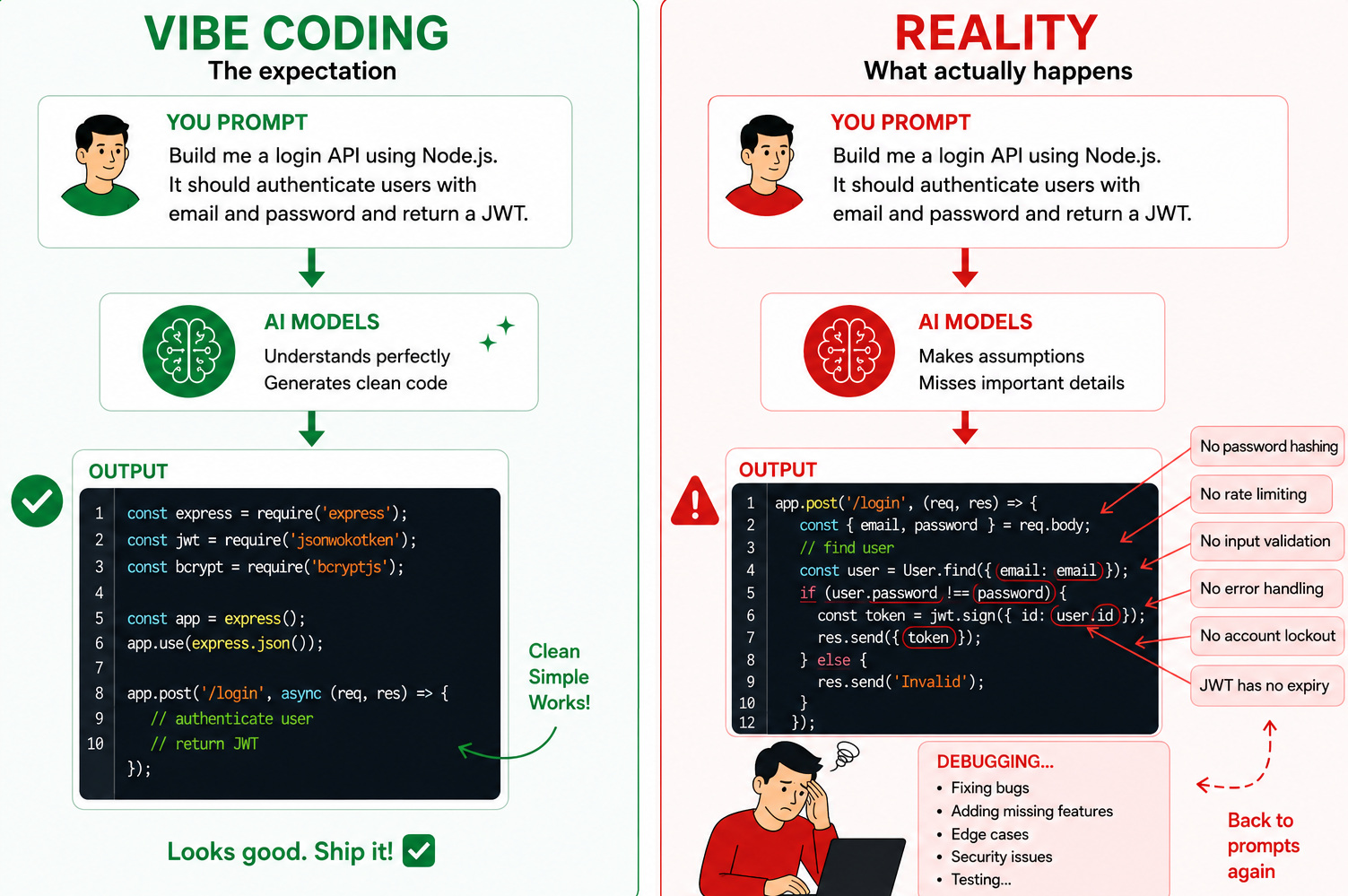
Vibe coding prompt would be: “Build me a login API using Node.js. It should authenticate users with email and password and return a JWT.”
Feature: User Login System

Endpoint: POST /auth/login
Headers: { Content-Type: application/json }

Input:
- email: string (valid email format)
- password: string

Behavior:
- Validate input format
- Find user by email
- Compare the password using the hashed value
- If valid -> return JWT token with expiry
- If invalid -> return authentication error

Constraints:
- Passwords must be hashed (bcrypt)
- Lock account after 5 failed login attempts (15 min cooldown)
- JWT expires in 1 hour
- Rate limit: max 5 requests per minute per IP

Error responses:
- Missing/invalid input -> 400 { error: "INVALID_INPUT" }
- Invalid credentials -> 401 { error: "INVALID_CREDENTIALS" }
- Account locked -> 403 { error: "ACCOUNT_LOCKED" }
At its core, SDD works because clear specifications lead to better, more predictable outcomes-especially when working with AI.
Read: Context Engineering for AI Agents: A Step-by-Step Guide.
Spec-driven Development in Action
An example of spec-driven development in real-life practice is codeCake by testRigor.
Instead of traditional specs, codeCake uses a test plan as the specification. These tests, written in plain English, describe how a feature should behave. The AI then generates or updates code to make those tests pass.
- If a test fails, codeCake fixes the code.
- If a test defines new behavior, it generates the feature.
Because tests clearly define expected inputs and outputs, they act as a precise and verifiable spec, reducing ambiguity and improving reliability. The tool gathers more context from Jira, internal, and external documentation.
codeCake also fits into real workflows by opening pull requests and iterating based on review, just like a human developer.
When to Use Vibe Coding vs. Spec-Driven Development
| Vibe Coding | Spec-Driven Development (SDD) |
|---|---|
| Ideal for quickly exploring ideas or building rough prototypes | Best for building features that need long-term reliability |
| Works well for small scripts or experimental projects | Good for systems maintained by multiple developers |
| Helpful when learning a new tool, framework, or concept | Supports when requirements and edge cases are clearly defined |
| Prioritizes speed and flexibility over consistency | Prioritizes predictability and repeatable outcomes |
| Fits situations where you’re the only contributor | Fits team environments with structured workflows |
| Less emphasis on testing and formal validation | Strong compatibility with testing, QA, and validation processes |
You could start with vibe coding for brainstorming ideas and then switching to SDD once the solution becomes more defined and needs to be built in a stable, maintainable way.
Conclusion
At a glance, it might feel like SDD is more work, a step back towards the waterfall method. But no, there are different issues here. With waterfall, there was an issue of excessively long feedback cycles, a disconnect between implementation and software design, inefficiency due to improper maintenance, etc.
Whereas with AI-generated code, we are suffering from high speed of code generation, lack of speed in verification of code, cognitive debt, neglecting good engineering practices, etc.
SDD saves time in the long run. It removes confusion and makes humans and AI more productive. A developer’s role is altered. They are now designing systems with intention rather than just writing or prompting code.
Frequently Asked Questions (FAQs)
- How is spec-driven development different from prompt engineering?
A: Prompt engineering relies on natural language instructions, which can be ambiguous. SDD uses structured, detailed specifications, making outputs more predictable, consistent, and reliable.
- Is spec-driven development only useful with AI?
A: No. SDD existed before AI, but AI makes it far more powerful. Clear specifications help both human developers and AI systems produce better, more accurate implementations.
- How does SDD reduce AI hallucinations?
A: By providing precise, structured instructions, SDD limits ambiguity. This reduces the chances of AI making incorrect assumptions or generating unintended behavior.
 |