
Prompt Engineering vs Context Engineering
2022 was the year of the generative AI boom, with the launch of the golden child: Prompt Engineering. It was the star of early GPT-3 hype. Overnight, everyone claimed to become a prompt engineer. What did it entail? Simply type ambiguous commands into the chat box and use whatever comes up.
Teams invest countless hours correcting prompts, experimenting with role-playing instructions, adding few-shot examples, and tweaking output formats to get better answers from Large Language Models (LLMs).
While these optimizations worked, after the AI apps moved from the demo environment to production environments, a different problem came up. Poorly crafted prompts are not the issue; the entire issue stems from irrelevant or poorly organized context.
A support chatbot doesn’t have access to customer history. A coding assistant can’t view the correct files. A RAG pipeline retrieved irrelevant documents. An AI agent had the right instructions but lacked the information required to complete the task.
As a result, this led to the advent of a new method: context engineering in mid-2025.
| Key Takeaways: |
|---|
|
What is Prompt Engineering?
Simply put, a prompt is an input to the Gen AI model to direct its output. Prompts can include text, sound, image, or other media. Prompt engineering is the iterative method of correcting and refining how you interact with the model to gain better results. It targets words, structure, and techniques you use in a single command.
Few-shot, chain of thought reasoning, role assignment, etc., are all common techniques followed in prompt engineering. These methods help address the ambiguity issue with prompts where one query can be interpreted in multiple ways, and the model needs to understand which interpretation the model meant.
“The right altitude”, a Goldilocks zone, is a common challenge with this method. The phrase, coined by Anthropic, refers to the two extremes: overly specific, hardcoded rules (flying too low) and overly ambiguous prompts (flying too high).
Prompt engineering’s typical method of working on a single-turn level, i.e., refining a prompt to get the best answer, is useful for simple conversations but has restrictions when tasks need persistent state, external data, or multistep reasoning.
What is Context Engineering?
Context engineering is deeper. You’re not just building the prompt. You are designing the entire system and management of all information that an LLM views before it provides the response. Prompt engineering focuses on “How should this question be phrased?” while context engineering focuses on “What information does the model need right now?”
The idea is not revolutionary; however, what is new is that the field has finally been named a discipline that users have been leveraging for years as the system becomes more complicated.
Context Engineering vs. Prompt Engineering
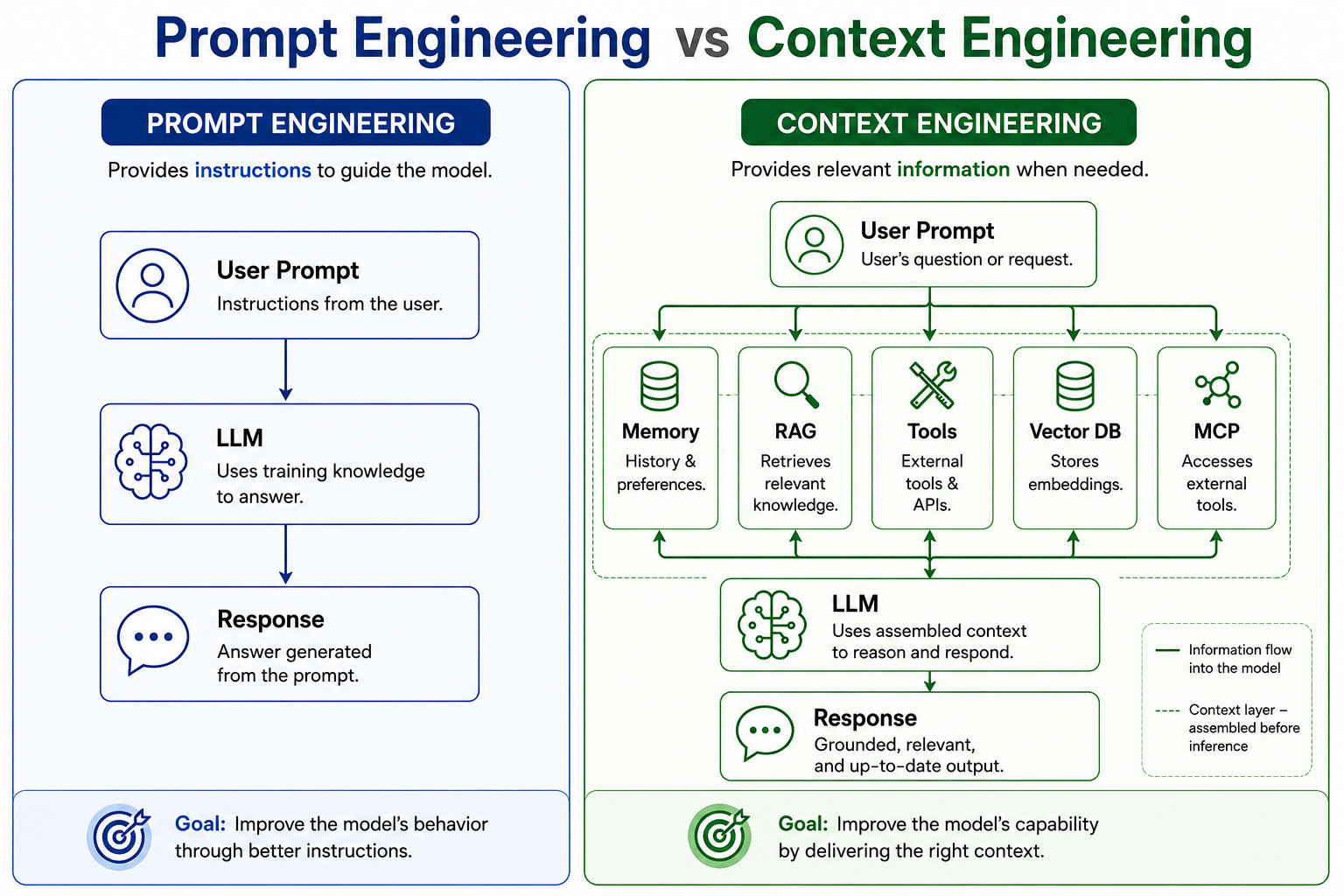
Prompt engineering is concerned with how we communicate instructions to a model. A typical prompt might define the model’s role, expected behavior, output format, constraints, and examples.
Say, for example:
You are a senior software engineer. Your responsibility is to review the code for security vulnerabilities and return findings as a markdown table.
This is prompt engineering. The goal is to improve outputs by improving instructions.
Context engineering operates at a different layer. Instead of targeting instructions, it focuses on information.
Imagine asking an AI coding assistant to investigate a production issue. A well-crafted prompt may tell the model how to reason about the problem, but it cannot compensate for missing stack traces, deployment logs, repository files, or monitoring data.
The model can only reason over the information it receives.
That contrast is important. Prompts influence behavior. Context determines capability.
But Why is Context Engineering More Relevant than Prompt Engineering in 2026?
Prompt engineering allowed teams to get initial wins. It was the fastest path from “this model is excellent” to “this demo succeeds.” But once you get to know what context engineering governs, the restriction becomes apparent.
Modern AI systems function with large context windows, retrieval pipelines, persistent memory, tool calls, and long conversations. In such environments, failure rarely occurs due to a poorly executed prompt. They are due to a badly designed context.
As AI systems turn multi-agent, multi-step, and stateful, prompt engineering fails as it is a local fix. Context engineering is the system design.
How Context Becomes the Hurdle?
One myth is that larger context windows remove context problems. In reality, they bring in new ones. Models may support hundreds of thousands of tokens, but attention remains a restricted resource. As more information enters the context window, the challenge shifts from storage to retrieval.
Researchers often evaluate this using needle-in-a-haystack evaluation guidelines, where a small piece of critical information is hidden inside a large context. Even when the information is technically present, models can struggle to locate it as context size grows.
Developers see the same issue in production systems.
If a retrieval pipeline injects twenty documents and only two contain relevant information, the model now has to identify useful signals from an ever-growing volume of noise. More context does not automatically lead to better answers.
In many cases, better context selection outperforms larger context windows.
AI Context Window Management
This is where AI Context Window Management becomes an important engineering problem. When building AI applications, every token has a cost. Context affects latency, inference expenses, and model performance simultaneously.
- Source code
- Documentation
- Git history
- CI/CD logs
- Previous conversations
- Monitoring data
Sending everything to the model isn’t practical. Even if the context window allows it, excessive information increases noise and costs.
- Which information should be included
- Which information should be summarized
- Which information should be discarded
In many ways, context windows are similar to application memory. Just as software engineers optimize memory allocation, AI engineers must optimize context allocation.
Strategies to Handle the Current AI Scenario
Let us review the changes in architecture or strategies that are helping the engineers to handle the demands of prompt and context engineering.
Designing LLM Prompts in a Context-First World
None of this means prompt engineering is dead. Designing LLM Prompts remains important, but its role has changed. In mature AI architectures, prompts often become relatively stable templates. Their job is to define objectives, constraints, and output requirements. The dynamic portion of the system is the context.
A common pattern is to maintain a reusable system prompt while continuously updating retrieved knowledge and task-specific information.
For example:
You are a senior backend engineer.
Provide concise and actionable recommendations.
[Retrieved logs]
[Relevant documentation]
[Recent deployment history]
The prompt remains constant. The context changes with every request. This method grows much better than endlessly refining prompt wording.
Read: Prompt Engineering for Beginners: How to Write Better AI Prompts.
RAG Context Optimization Beyond Basic Retrieval
Most developers experience context engineering through Retrieval-Augmented Generation (RAG).
- Generate embeddings
- Store documents in a vector database
- Retrieve top-k matches
- Inject them into the prompt
However, production systems quickly revealed the limitations of this approach. Documents may be semantically similar but irrelevant. Important information can be broken down across multiple chunks. Duplicate content can deplete valuable context space. Effective RAG Context Optimization focuses on retrieval quality rather than retrieval volume.
- Vector search
- Keyword search
- Metadata filtering
- Reranking models
- Query rewriting
The goal is not to retrieve more documents. The goal is to retrieve the right documents.
Read: Why RAG is the Backbone of Modern Enterprise AI Systems.
Semantic Chunking Strategies
One overlooked factor in retrieval performance is chunking. Many RAG implementations still split documents using fixed token sizes:
chunk_size = 500
overlap = 100
Simple, but often ineffective. A fixed-size chunk may divide an explanation across multiple documents, making retrieval less reliable. This is why many teams adopt semantic chunking strategies.
- Headings
- Sections
- Paragraph boundaries
- Topic transitions
When retrieval units align with semantic boundaries, retrieval quality generally improves because the model receives complete ideas rather than fragmented text.
Dynamic Context Window Assembly
A growing best practice is dynamic context window assembly. Rather than inputting every available document into the model, context is assembled on demand.
A usual pipeline might look like:
query
  -> retrieval
  -> reranking
  -> memory lookup
  -> context compression
  -> final prompt assembly
Each stage tries to improve the signal-to-noise ratio before information reaches the model. This architecture often yields better answers while reducing token usage and latency.
Context Hydration Pipelines and MCP
As AI systems become more agentic, context gathering is evolving into dedicated infrastructure. Many organizations now use context hydration pipelines to prepare information before model invocation.
- Internal databases
- APIs
- Knowledge bases
- Memory stores
- Monitoring platforms
Their objective is to construct a high-quality contextual snapshot of the problem being solved. This trend is closely related to the increased adoption of the Model Context Protocol (MCP). MCP provides a standardized way for models to access external tools and data sources. Instead of building custom integrations for every service, developers can expose systems through a consistent interface.
For context engineering, this is significant because it shifts information access from hardcoded integrations to a reusable protocol layer.
Challenges in Context Engineering
Let us review two major challenges that engineering teams face.
Context Token Optimization and Cost Management
As usage grows, context quality and cost become attached. A common anti-pattern in AI applications is continuously increasing context size to solve performance issues. Initially, accuracy improves. Finally, costs explode. This is where context token optimization becomes necessary.
- Context compression
- Summarization
- Deduplication
- Relevance filtering
- Hierarchical retrieval
The goal is not to reduce tokens at all costs. The goal is to increase information density. Closely related is token burn rate reduction. Every unnecessary token increases inference costs and response latency. At enterprise scale, even small reductions in average context size can produce meaningful savings.
Attentional Sink Mitigation
Another emerging challenge is the mitigation of attentional sink. Attentional sinks are sections of context that use up disproportionate attention despite offering little value.
- Repeated instructions
- Legal disclaimers
- Navigation text
- Duplicate content
These sections fill context space and compete with relevant information. Modern context engineering pipelines progressively include deduplication, reranking, and pruning mechanisms designed to bring down attentional sinks before information reaches the model.
Vector Database Retrieval Metrics That Matter
Many teams obsess over embedding models but fail to measure retrieval quality. Without measurement, retrieval systems quietly degrade over time.
- Recall@K: Measures if relevant documents appear in the top K retrieved results.
- Precision@K: Measures how many retrieved documents are truly relevant to the query.
- Mean Reciprocal Rank (MRR): Checks how early the first correct result appears in the ranking.
- Normalized Discounted Cumulative Gain (NDCG): Measures ranking quality by rewarding highly relevant answers appearing at the top.
- Retrieval Latency: Monitors how quickly the retrieval system can return results under production workloads.
These metrics reveal whether relevant information is actually reaching the model. In many production environments, improving retrieval metrics produces larger gains than changing the underlying LLM.
When to Use Prompt Engineering vs Context Engineering
Prompt engineering works best when the model already has the information it needs, but needs better guidance on how to use it. Tasks like content generation, summarization, formatting, or tone adjustment often benefit notably from clearer instructions, examples, and output constraints.
Context engineering becomes highly important when the model lacks access to the information required to complete the task. This is common in AI agents, RAG applications, coding assistants, and enterprise search systems, where performance relies on retrieving and assembling the right data before inference.
- If the model produces the wrong style, format, or reasoning process, improve the prompt.
- If the model is missing facts, hallucinating, or overlooking relevant information, improve the context.
In practice, the best AI systems rely on both. Prompt engineering helps the model reason effectively, while context engineering makes sure it has the information needed to reason in the first place.
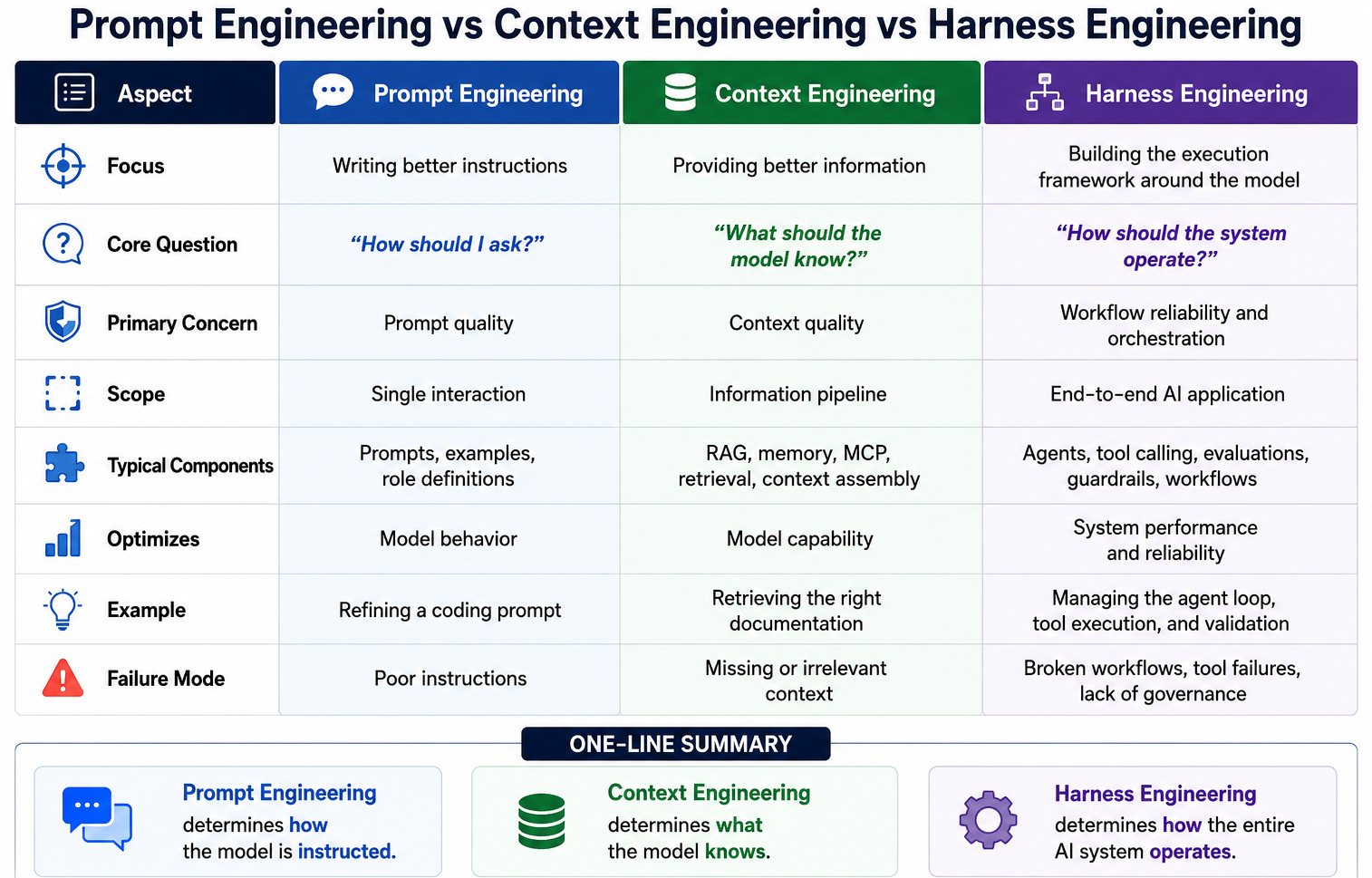
Prompt vs. Context vs. Harness Engineering: Comparison table
While summarizing the above differences is useful for readers, let us also touch upon a newer model that emerged in 2026, called harness engineering. Harness engineering is basically the application architecture that connects everything together. Currently, a lot of engineers consider prompt engineering as the smallest layer, context engineering as the information layer, and harness engineering as the orchestration layer that governs agents, tools, evaluation loops, and production workflows. We will not go into full details about the method in this blog; below is a short table that explains in short the differences between the three methods.
Context Engineering in AI Code Generation
Most coding assistants generate code from a prompt and whatever source files happen to be available in the context window. The quality of the output often depends on how well the developer can describe the requirement.
Tools like codeCake take a different approach. Instead of relying primarily on prompts, codeCake uses testRigor test plans as the starting point for code generation. A failing test can define a bug that needs fixing, while a new test can act as an executable specification for functionality that doesn’t yet exist.
From a context engineering POV, the interesting part isn’t the code generation itself. It’s the fact that the model is grounded in a much richer representation of the desired behavior. The test case becomes context, reducing ambiguity and giving the model a clearer target than a natural-language prompt alone.
Conclusion
Prompt engineering is still relevant. It helps you establish the right expectations and tone. But on its own, it can’t support complicated reasoning or safe tool use.
Context engineering resolves the bigger challenges of governance, scalability, and reliability.
As AI systems grow beyond chat interfaces into agents, autonomous workflows, and copilots, context quality is becoming the primary differentiator. Better retrieval, smarter memory systems, stronger RAG context optimization, efficient AI context window management, and disciplined context token optimization often deliver larger improvements than prompt refinements alone.
For developers building production AI systems, the future increasingly belongs to teams that treat context as infrastructure rather than an afterthought. The hurdle is no longer teaching models how to respond. It’s ensuring they have the right information before they start.
Frequently Asked Questions (FAQs)
Is Context Engineering replacing Prompt Engineering?
Prompt engineering and context engineering solve different problems. Prompt engineering helps the model understand how to respond, while context engineering ensures the model has the information needed to generate a useful response. Most production AI systems require both.
What is the relationship between RAG and Context Engineering?
Retrieval-Augmented Generation (RAG) is one of the most common implementations of context engineering. It focuses on retrieving relevant information and injecting it into the model’s context before inference.
How does MCP support Context Engineering?
Model Context Protocol (MCP) provides a standardized way for AI models to access tools, documents, and external systems. It reduces integration complexity and improves context accessibility.
What are Context Hydration Pipelines?
Context hydration pipelines collect information from sources such as databases, APIs, vector stores, documentation systems, and memory layers before assembling the final context provided to an LLM.
 |