
Deep-dive into the Model Context Protocol (MCP)
The past year has seen a definite shift in how users view large language models (LLMs). For quite some time, there role was pretty obvious: models generate text, users ask questions, and chat interfaces sit in the middle. Majority of the innovation happened around prompting, retrieval pipelines, fine-tuning, and squeezing better reasoning out of increasingly larger models.
However, that phase of AI development is already starting to feel transitional. More innovative systems being built today are no longer just responding to prompts. They are acting. Models are reviewing pull requests, querying databases, searching codebases, interacting with APIs, deploying infrastructure, managing workflows, and increasingly behaving less like assistants and more like autonomous software systems.
The moment models begin interacting with external systems, a serious engineering problem emerges: “How exactly should AI systems communicate with the rest of the software stack?”
Right now, the answer is fragmented enough that most teams are quietly rebuilding the same infrastructure over and over again. If you’ve worked with agent frameworks, tool calling APIs, or LLM orchestration systems recently, you’ve probably experienced this already.
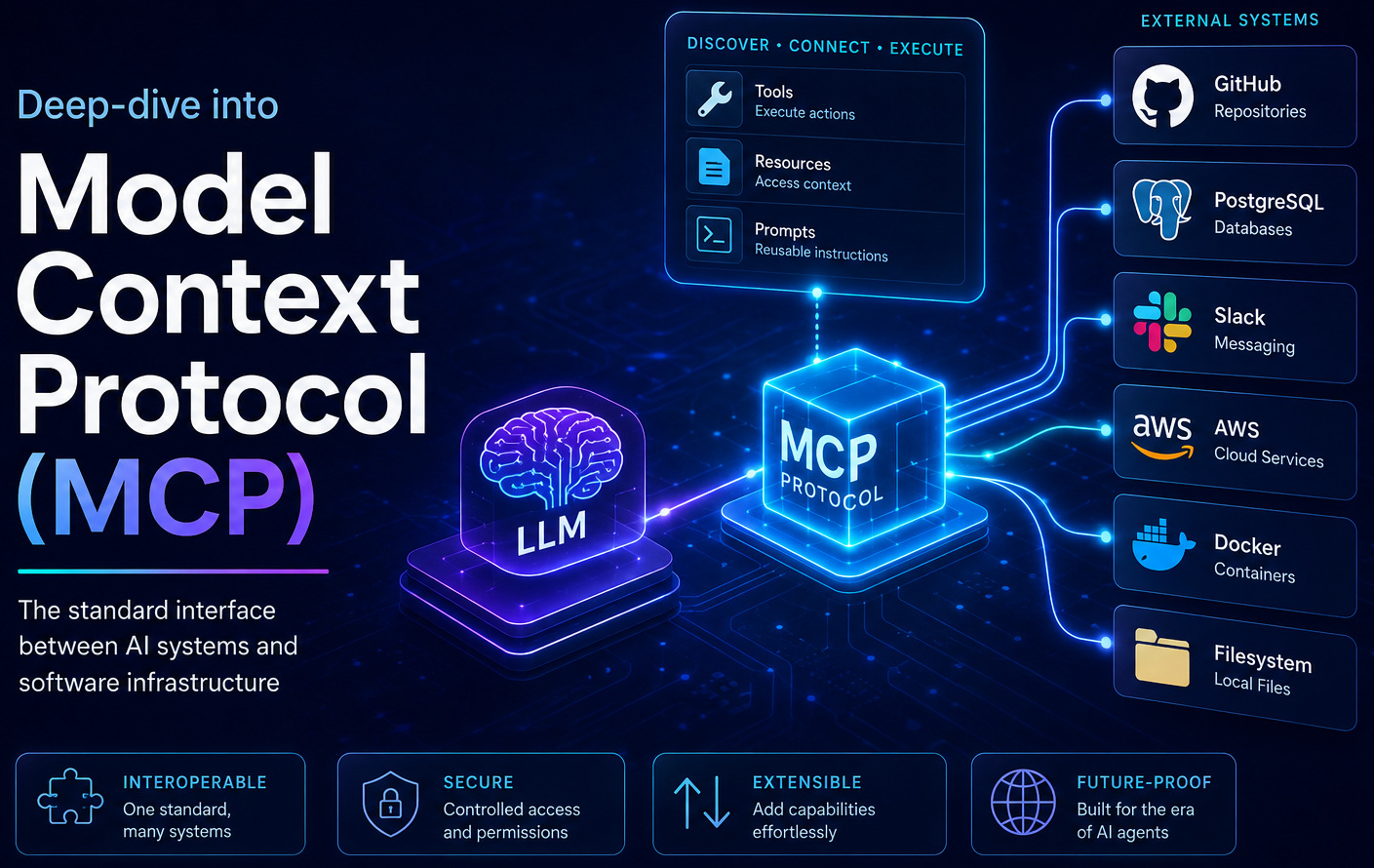
Last year Anthropic launched Model Context Protocol (MCP) as a way for LLMs to connect securely with external data sources, specialized software platforms, and local file systems. It was dubbed as the “USB-C for AI”.
At first glance, MCP looks like another protocol specification. But if adoption continues growing, I suspect developers will eventually see it as something much bigger: the standard interface layer between AI systems and software infrastructure.
| Key Takeaways: |
|---|
|
The AI Infrastructure Issue Everyone is Brushing Under the Carpet
Building AI systems that generate text is quite simple. Building AI systems that do things is an entirely different engineering challenge.
Imagine you are building an internal coding assistant for your engineering team. You want it to inspect GitHub repositories, analyze deployment logs, query your PostgreSQL cluster, check monitoring dashboards, and maybe create Jira tickets whenever it detects regressions.
Theoretically, this sounds simple. In real-life projects, every one of those integrations becomes custom infrastructure.
You expose APIs. You define callable functions. You write wrappers around authentication layers. You figure out how the model should decide when to call which tool. You design prompt logic around execution sequences.
A lot of modern AI engineering right now feels suspiciously like rebuilding RPC infrastructure, except the caller happens to be a language model.
Portability is the bigger issue that needs addressing. Say, you build this system around one model provider. Maybe you start with OpenAI’s function calling API.
A few months later, another provider ships a better reasoning model. Suddenly, large parts of your tool integration layer need to be reworked because every ecosystem has its own implementation assumptions.
This causes what engineers would immediately term as an integration explosion problem.
If you have ten AI systems and hundreds of external services, the number of possible integrations grows fast. There is no common interface layer. And this is exactly the problem MCP is trying to solve.
Read: Claude vs. GitHub Copilot: Which is Better for Coding?
What is a Model Context Protocol (MCP)?
- HTTP standardized how browsers interact with web servers.
- Docker standardized how applications move across environments.
- Kubernetes standardized container orchestration.
MCP is attempting something similar for AI systems.
It defines a common way for language models to detect tools, access contextual resources, and execute actions against external systems. Rather than building custom integrations between every model and every service, systems communicate through a protocol layer.
Conceptually, the architecture looks something like this:
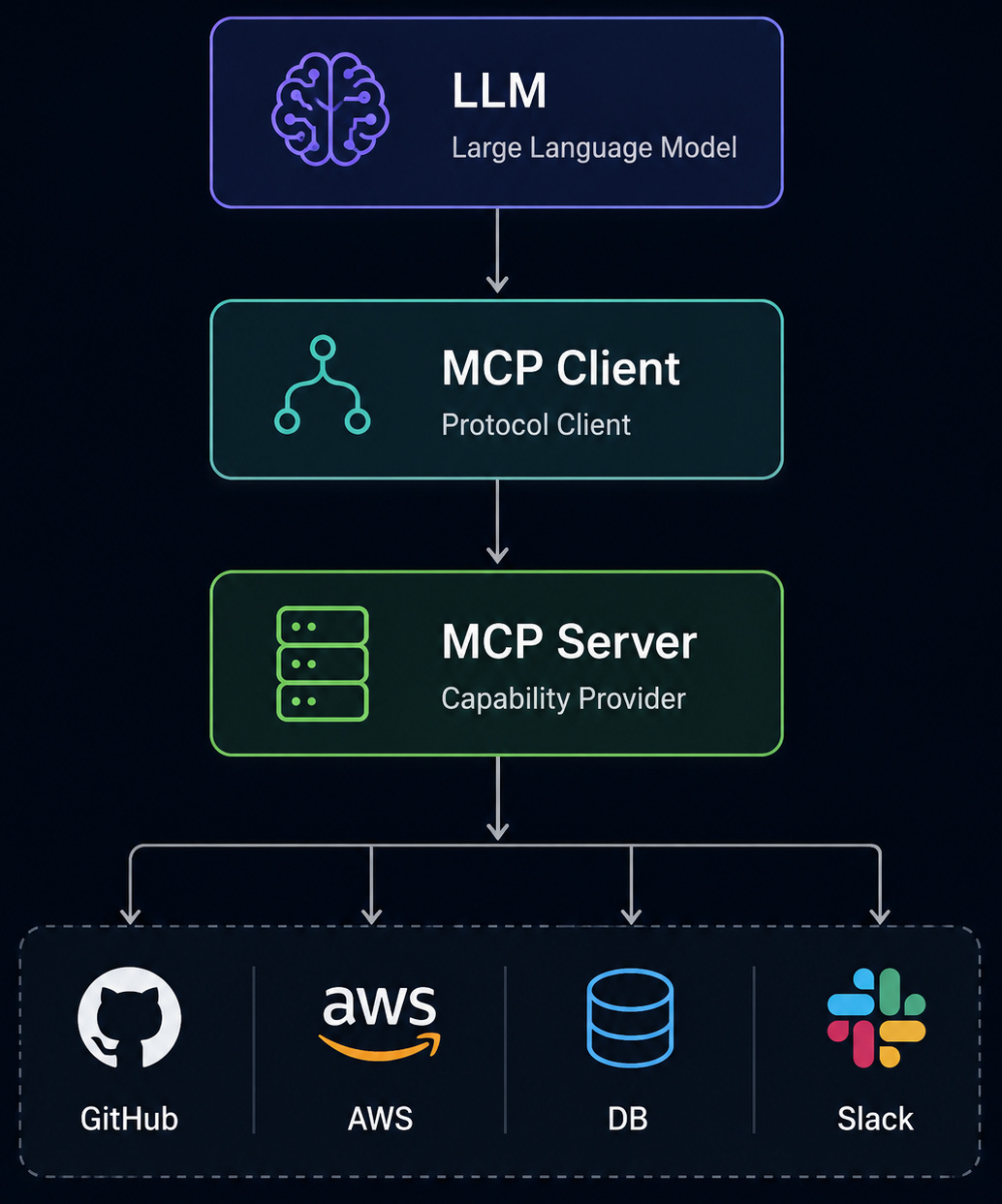
The architecture itself isn’t particularly revolutionary. What makes MCP interesting is what it standardizes. And more importantly, what it abstracts away.
MCP’s Building Blocks
Let us take a look at the pieces that make up MCP. At a high level MCP is built around a few distinct components, each responsible for a very specific part of the interaction loop between the model and external systems.
LLM
This is the reasoning engine sitting at the core of the system. The LLM interprets user requests, processes available context, decides which actions are needed, and determines how to move through a task step by step.
MCP Host
The host is the environment where the model is actually running. In most cases, this is the application the user interacts with directly, an AI coding assistant inside an IDE, a desktop chatbot, or an internal enterprise agent running inside some workflow system.
MCP Client
The client acts as the communication layer between the model and the outside world. It sits inside the host environment, maintains direct connections with MCP servers, passes available capabilities to the model, and routes requests whenever the model decides to interact with an external system.
MCP Server
This is where capabilities are exposed. An MCP server works as a standardized interface around external systems such as databases, APIs, repositories, or local file systems, making those resources accessible in a format the model can understand and interact with safely.
Context Types
This is where MCP becomes particularly interesting. Servers don’t just expose executable tools. They can provide multiple forms of structured context, including tools for taking actions, resources for retrieving information, prompts for reusable instructions, and sampling, which allows more advanced model-driven interactions during execution.
Together, these components build the execution loop that allows an AI system to progress beyond just generating text and start interacting with real software systems in a much more structured way.
Read: Context Engineering for AI Agents: A Step-by-Step Guide
Understanding the Non-Scalability Problem with Tool Calling
tools = [
    get_github_repository,
    create_github_issue,
    query_postgres_database,
    send_slack_message
]
The model reasons over the user request and chooses which function to invoke. This works. But the architecture is deeply application-specific.
Those functions exist inside your system. The schema definitions are tied to your implementation. If another team wants to reuse those integrations, they rebuild them from scratch.
There is no interoperability. MCP moves these capabilities outside the application boundary. Instead of defining functions inside the agent itself, capabilities live inside dedicated MCP servers.
The model doesn’t need hardcoded awareness. It discovers available capabilities dynamically. That changes the relationship between models and tooling completely.
Read: Limitations of Claude for Software Development
Understanding MCP Architecture Under the Hood
The protocol revolves around three major components: the host, the client, and the server.
The host is simply the application running the language model. This could be an IDE assistant, a coding agent, a desktop AI client, or some internal enterprise system.
The MCP client acts as the intermediary layer. It handles protocol negotiation, routes requests, manages communication, and brokers interactions between the model and external systems.
MCP server is where the interesting actions take place. Servers bring forth capabilities that models can interact with. Imagine a GitHub MCP server exposing operations for repository management.
{
  "name": "create_issue",
  "description": "Create a GitHub issue",
  "inputSchema": {
    "type": "object",
    "properties": {
      "repo": { "type": "string" },
      "title": { "type": "string" }
    }
  }
}
A model receives a task, inspects available capabilities, and determines that create_issue() helps solve the problem.
The execution flow becomes dynamic rather than deterministic. That difference matters. Traditional software systems follow explicit control paths defined by developers. Agent systems introduce probabilistic execution behavior. The model decides what happens next.
MCP Is Bigger Than Function Calling
A lot of early discussions compare MCP to function calling APIs. That comparison misses the bigger picture. Function calling solves a very narrow problem. It allows a model to invoke predefined functions.
MCP introduces a much broader abstraction layer built around three ideas: tools, resources, and prompts. Tools are simple. They represent executable actions. Resources are more interesting.
One of the biggest challenges in modern LLM systems is context management. We spend enormous effort chunking documents, building retrieval pipelines, and trying to decide what information belongs inside the prompt window.
MCP introduces the idea that context can be requested on demand.
resource://filesystem/architecture.md
resource://postgres/customer_data
resource://logs/error_stream
Rather than forcing developers to inject everything into context upfront, the model can request information when needed. From an infrastructure perspective, this is a pretty significant shift.
The third abstraction is prompts. Servers can expose reusable prompt templates.
prompt://analyze-codebase
This allows standardized prompt behavior across different systems instead of every application reinventing prompt engineering logic independently.
Taken together, MCP starts looking less like a function calling API and more like a universal runtime interface for agent systems.
Why MCP Changes the Future of AI Agents
- A chatbot produces language.
- An agent performs actions.
The moment an AI system starts talking with infrastructure, software complexity increases dramatically. Say a deployment agent running inside a production environment.
A developer asks:
“Check our Kubernetes cluster, identify unhealthy pods, inspect logs, and restart failing services.”
To execute that task, the system might need to inspect cluster state, fetch logs, analyze deployment history, diagnose errors, and determine whether restarting services is safe.
In traditional software, every step in that workflow would be explicitly programmed. Agent systems behave differently. The model reasons through the task dynamically. It selects which tools to trigger based on intermediate results. That means interoperability becomes extremely important.
Without standardized infrastructure, every agent framework becomes an isolated ecosystem. A common execution interface is offered by MCP. The long-term importance is present at this point.
Where AI Development Workflows Are Headed
One interesting consequence of this shift toward agent-based systems is that we are starting to see AI tools move beyond simply helping developers write code and toward actually participating in software implementation workflows.
A good example of this is codeCake, a system built by testRigor that approaches code generation from a very different angle than typical coding assistants.
Instead of depending only on prompts or conversational instructions, codeCake uses a specification-driven development (SDD) workflow where the primary source of truth is an executable test plan. A failing test can become the specification for a bug fix, while a new test describing functionality in plain English effectively becomes the requirements document for generating entirely new application code.
What makes this particularly interesting is that the AI system is not just generating code in isolation. It can pull context from test plans, Jira tickets, internal documentation, external resources, and then make changes across repositories before opening a pull request for human review.
Why Developers Need to be Vigilant About MCP
Every major shift in software engineering finally produces a standardization layer. The web had HTTP. Distributed systems standardized around RPC frameworks. Cloud-native infrastructure standardized around containers.
AI systems are approaching the same inflection point.
We are moving away from models as passive conversational interfaces and toward systems where models actively participate inside software environments. They will now review code, handle infrastructure, orchestrate workflows, and even operate enterprise systems independently.
The moment that happens, interoperability becomes essential.
That interoperability layer may very well become Model Context Protocol.
While still in nascent stages, the protocol will evolve significantly over the next couple of years.
But developers building agent systems today should probably be paying closer attention.
Not because MCP has already won. But because it is solving a problem the entire AI ecosystem is about to encounter at scale. And the teams that understand this infrastructure early will be far better positioned when autonomous AI systems stop being experimental and start becoming production software.
Frequently Asked Questions (FAQs)
- What is Model Context Protocol (MCP)?
Model Context Protocol (MCP) is an open standard that allows large language models to communicate with external systems such as APIs, databases, repositories, file systems, and enterprise applications through a standardized interface.
- How is MCP different from traditional API integrations?
Traditional APIs define how software applications communicate with each other. MCP defines how AI models discover and interact with external capabilities dynamically, allowing models to decide which tools to use during execution.
- Why is MCP important for AI agents?
AI agents need to perform actions rather than simply generate text. MCP provides a standardized execution layer that allows agents to interact with infrastructure, query external systems, and coordinate multi-step workflows without requiring custom integrations.
- Can MCP replace existing API architectures?
MCP does not replace APIs. Instead, it sits above APIs and provides a standardized way for AI models to discover and interact with API-driven services dynamically.
 |