
Advanced Prompt Engineering Techniques to Improve AI Accuracy
First off, the basics: What is prompt engineering? It is the method of designing, refining, and enhancing inputs (prompts) that direct generative AI models (LLMs) to generate relevant and accurate results. Even minor changes in prompt wording can produce significantly different outputs.
Large language models are built on advanced ML algorithms. They are capable of comprehending and producing human-like text. Prompt engineering uses this capability to create inputs that enable the model to perform complex tasks, like translation, summarization, problem-solving, or creative writing, with higher accuracy and precision. Through continuous experimentation and iteration with different prompt structures, users can influence the behavior of LLMs to enhance their performance across different applications.
With generative AI playing a critical role across multiple domains, it’s imperative to understand advanced prompt engineering techniques. This is essential to unlock its full potential and customize AI models to meet specific needs effectively.
| Key Takeaways: |
|---|
|
Why is LLM Prompting Vital?
Different tasks need customized methods of interaction. In the same way subject matter experts (SMEs) respond differently based on how questions are phrased, AI systems benefit from structured prompts that align with their training patterns.
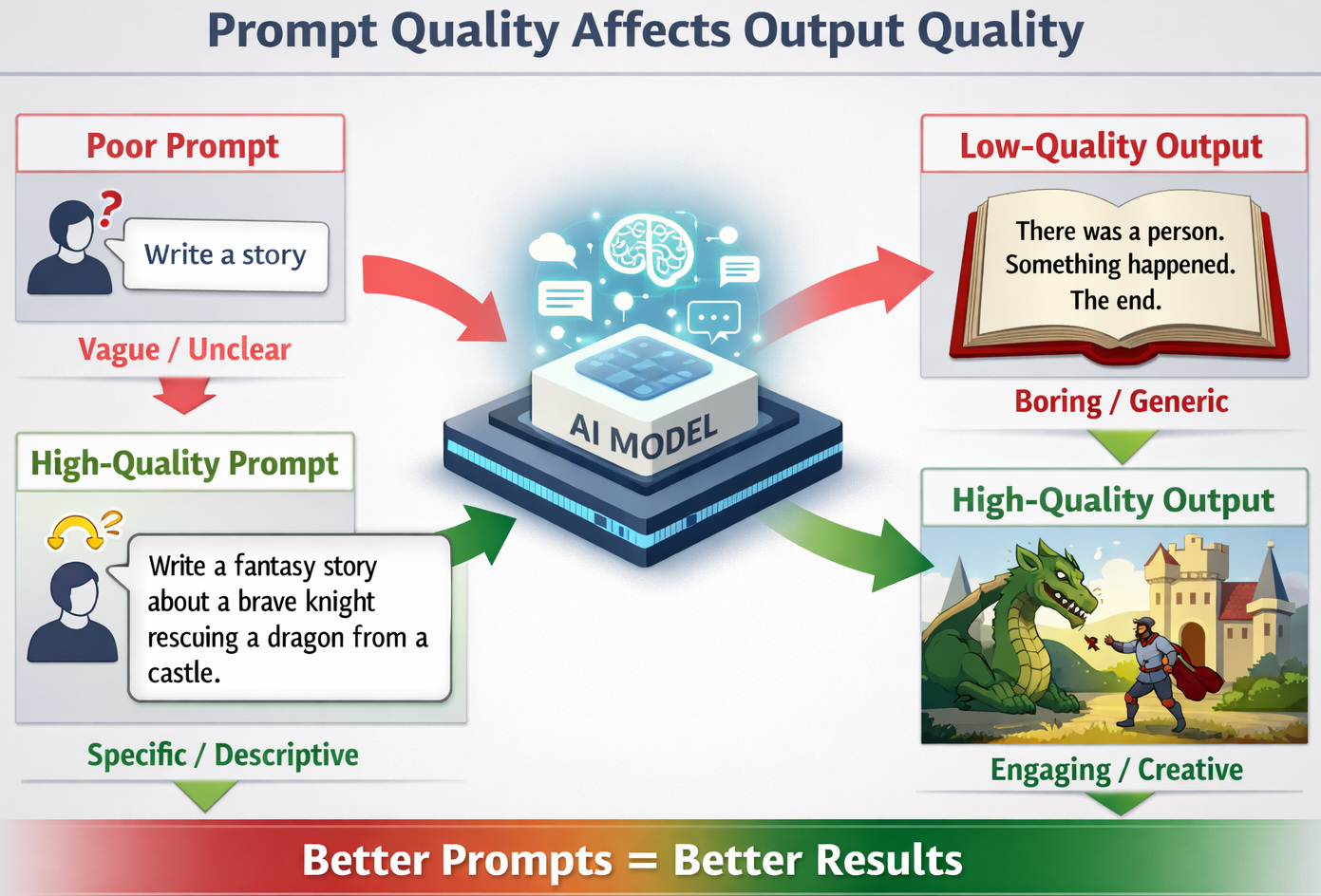
Well-written prompts reduce ambiguity, reduce misinterpretation and allow AI to access relevant knowledge more efficiently. Without proper structuring, prompts can lead to vague, off-topic or incomplete responses. Precision is necessary, especially for complicated business or technical scenarios. The strategies explained below offer frameworks that improve AI’s capability to “understand” your intent and generate context-appropriate outputs.
Read: Prompt Engineering for Beginners: How to Write Better AI Prompts
Prompt Strategy 1: Role, Task, Context, Expectation
- Role – who the AI is
- Task – what it should do
- Context – background info
- Expectation – desired output
This is also referred to as the PCTF (Persona, Context, Task, Format) Framework in the prompt engineering circles.
Example: "As a high school teacher (Role), explain photosynthesis (Task) to 9th-grade students with simple analogies (Context). Keep it under 150 words and easy to understand (Expectation)."
Helps AI stay focused and deliver expert-level, goal-oriented responses. This strategy is useful when you would like AI to assume a specific professional role or if the task requires specialized expertise.
Prompt Strategy 2: The Lede Structure
- What, Why, Where, How, Scale, and Impact
Example: "Develop a plan to improve customer onboarding (what) to reduce churn by 20% (why) for a fintech startup (where). Include step-by-step processes and tools (how) for teams of 5-8 members (how much), to improve retention and satisfaction (why impact)."
Best for complex tasks requiring depth and multiple perspectives. It ensures coverage for all important elements, making it particularly effective for complicated organizational challenges where even subtle details must be considered.
Prompt Strategy 3: Writing, Structure, Essence
- Writing – tone/style
- Structure – format
- Essence – core message
Example: "Write a friendly follow-up email (writing) in two short paragraphs (structure) reminding a client about a pending payment while maintaining a positive tone (essence)."
Ensures clarity, coherence, and strong messaging.
Prompt Strategy 4: Self-Critical Prompting
You can improve the quality of AI-generated results by asking AI to validate itself. This involves asking AI to detect potential vulnerabilities or missing data in its own reply.
Example: "Generate a business idea in the health tech space. Then analyze potential risks, limitations, and missing elements in the idea."
With this self-critical element, this strategy results in more defensible and robust outputs. This is useful for critical decision-making and strategic planning processes.
Prompt Strategy 5: Reverse Engineering
Work backwards from outputs to prompts. You can take existing content and ask AI to generate a prompt that would generate similar results.
Example: "Given this onboarding message [insert text], write the prompt that would produce a similar user-friendly and concise tone."
Improves quality, reduces blind spots, and strengthens outputs: great for high-stakes work.
Read: Context Engineering for AI Agents: A Step-by-Step Guide
Important Techniques in Prompt Engineering
To maximize the efficiency of AI models, prompt engineering uses a range of techniques customized to different tasks and goals. Below are several commonly used prompt engineering techniques, each is accompanied by an example for easier understanding.
Let’s use a single concept and demonstrate how different prompting techniques can be applied to it. Let the central use case be about: explaining photosynthesis.
The task is framed as follows: Explain the concept of photosynthesis.
Zero-shot prompting
This technique involves asking the model to perform a task without any previous examples or guidance. It depends on the AI’s pretrained knowledge to understand and reply to the query:
Example: "Explain photosynthesis in simple terms."
Few-Shot Prompting
This includes a small number of examples in the prompt to demonstrate the task to the model. This technique helps the model to understand the context and expected result.
Example:Here are some examples of how to explain complex topics: - Topic: Evaporation - Explanation: It is the process of water (liquid) turning into vapor (gas). - Topic: Gravity - Explanation: Gravity is the force that pulls objects toward each other, like how the Sun keeps Earth and other planets in their orbits. Now explain: Photosynthesis.
Chain-of-Thought (CoT)
CoT prompting encourages the model to reason through a problem step by step, breaking it into smaller segments to come at a logical response.
Example:Step 1: Define photosynthesis. Step 2: Explain how it works. Step 3: Describe its importance.
Meta Prompting
It involves asking the model to create or refine its own prompts to more efficiently perform a task. By leveraging the model’s skill to self-direct, we can improve the output quality.
Example: "Create a prompt that clearly explains photosynthesis for beginners, then answer it."
Self-Consistency
Self-consistency uses several independent generations from the model to detect the most coherent or accurate response. It’s specially useful for tasks needing reasoning or interpretation.
Example: "Give 3 explanations of photosynthesis, then select the clearest one."
Generate Knowledge
This method requires asking the model to produce background knowledge before responding to the main task, improving its capability to generate accurate and informed replies.
Example: "List key concepts (sunlight, chlorophyll, carbon dioxide), then explain photosynthesis."
Prompt Chaining
Example:
1. "What is photosynthesis?"
2. "How does it work?"
3. "Why is it important?"
The task is segregated into a chain of smaller prompts, with the result of each step feeding into the next for a more structured explanation.
Tree of Thoughts
This prompting technique encourages the model to check multiple branches of reasoning or ideas before coming to a final output.
Example: "List 3 ways to explain photosynthesis (analogy, scientific, simplified), compare them, then choose the best."
Retrieval-Augmented Generation (RAG)
Retrieval-Augmented Generation (RAG) combines information retrieval systems with LLMs, allowing the model to ground responses in external knowledge sources.
Example: "Using American Curriculum biology content, explain photosynthesis simply."
Tool Use / Reasoning
This technique connects reasoning skills with external tools or application programming interfaces (APIs), enabling the model to use resources like calculators or search engines.
Example: "Show the chemical equation of photosynthesis and explain each component step by step."
Automatic Prompt Engineering
This method includes using the AI system itself to produce and enhance prompts for specific tasks. It automates the process of building efficient instructions.
Example: "Generate the best prompt to explain photosynthesis to a 10-year-old, then answer it."
Active Prompting
This technique dynamically changes the prompt based on intermediate results from the model, refining the input for better results.
Example:
Initial: "Explain photosynthesis."
Follow-up: "Add an example and simplify further."
Directional Prompting
This technique leverages directional cues to guide the model toward a particular type of response or perspective. It influences the framing of the explanation.
Example: "Explain photosynthesis as a teacher speaking to elementary school students."
Program-Aided Language Models (PAL)
The PAL technique combines programming skills to improve the model’s reasoning and computational skills.
Example: "Write Python code to visualize the photosynthesis process, then explain it."
ReAct (Reason + Act)
It integrates reasoning and acting prompts, encouraging the model to reason critically and behave based on its reasoning.
Example: "Analyze the steps of photosynthesis and then explain how each step contributes to energy production."
Reflexion
It allows the model to evaluate its previous outputs, identify weaknesses, and revise them and then refine them for better coherence and accuracy.
Example: "Here is my explanation of photosynthesis: [Insert initial output]. Review and improve it for clarity and accuracy."
Multimodal CoT
This method combines a chain of thought reasoning across multiple modalities, such as images, audio, or text.
Example: "Analyze this diagram of photosynthesis and explain the process step by step."
Graph Prompting
It uses graph-based structures to organize and reason through complex relationships between concepts or data points.
Example: "Using a diagram showing light intensity vs photosynthesis rate, explain the relationship."
Best Practices for Maximum AI Accuracy
- Be specific and clear
- Use structured formats
- Provide examples when possible
- Set constraints and limits
- Ask for step-by-step reasoning
- Iterate and refine prompts
Think of prompt engineering as training the AI in real time.
Common Mistakes to Avoid
- Being too vague
- Asking multiple unrelated questions
- Ignoring output constraints
- Not providing context
- Overloading the prompt with unnecessary details
Fixing these alone can drastically improve results.
Conclusion
Advanced prompt engineering is the key to unlocking the full potential of AI. By using structured prompts, adding constraints, using examples, and refining your approach, you can dramatically improve accuracy and reliability.
Instead of blaming AI for poor results, focus on improving your prompts – because better input always leads to better output.
Frequently Asked Questions (FAQs)
What is the difference between prompt engineering and fine-tuning?
A: Prompt engineering involves crafting inputs to guide AI behavior without changing the model itself, while fine-tuning modifies the model using additional training data. Prompt engineering is faster, cheaper, and suitable for most use cases, whereas fine-tuning is used for highly specialized tasks.
What are the best prompt engineering techniques for beginners?
- Role-Task-Context-Expectation framework
- Few-shot prompting
- Chain-of-Thought prompting
These are easy to implement and significantly improve output quality.
How can I reduce hallucinations in AI responses?
- Adding clear constraints (e.g., “use only verified facts”)
- Using structured prompts
- Applying techniques like Chain-of-Thought or Self-Consistency
- Asking the AI to verify or critique its own response
 |