
Agentic Engineering: Moving From Vibe Coding to Orchestration
AI researcher and educator Andrej Karpathy coined the term vibe coding in early 2025. His tweet, a part of it read “There’s a new kind of coding I call ‘vibe coding’, where you fully give in to the vibes, embrace exponentials, and forget that the code even exists.”
What was it?
Well, it was software development embracing the most potent architectural switch since the start of open-source ecosystems and cloud-native computing.
Vibe coding started out as an intuitive teamwork between AI assistants and developers. Developers absolutely loved the concept. The term trended immediately. The internet was flooded with tutorials and blogs on “How to vibe code” overnight. Vibe coding became the default answer to every user who had a “how do I make this” question.
But the results weren’t stupendous when users tried to ship the vibe-coded apps to production.
In fact, Karpathy himself tweeted the popularity of a new term: “Today, programming via LLM agents is increasingly becoming a default workflow for professionals, except with more oversight and scrutiny. Personally, my current favorite term is agentic engineering.
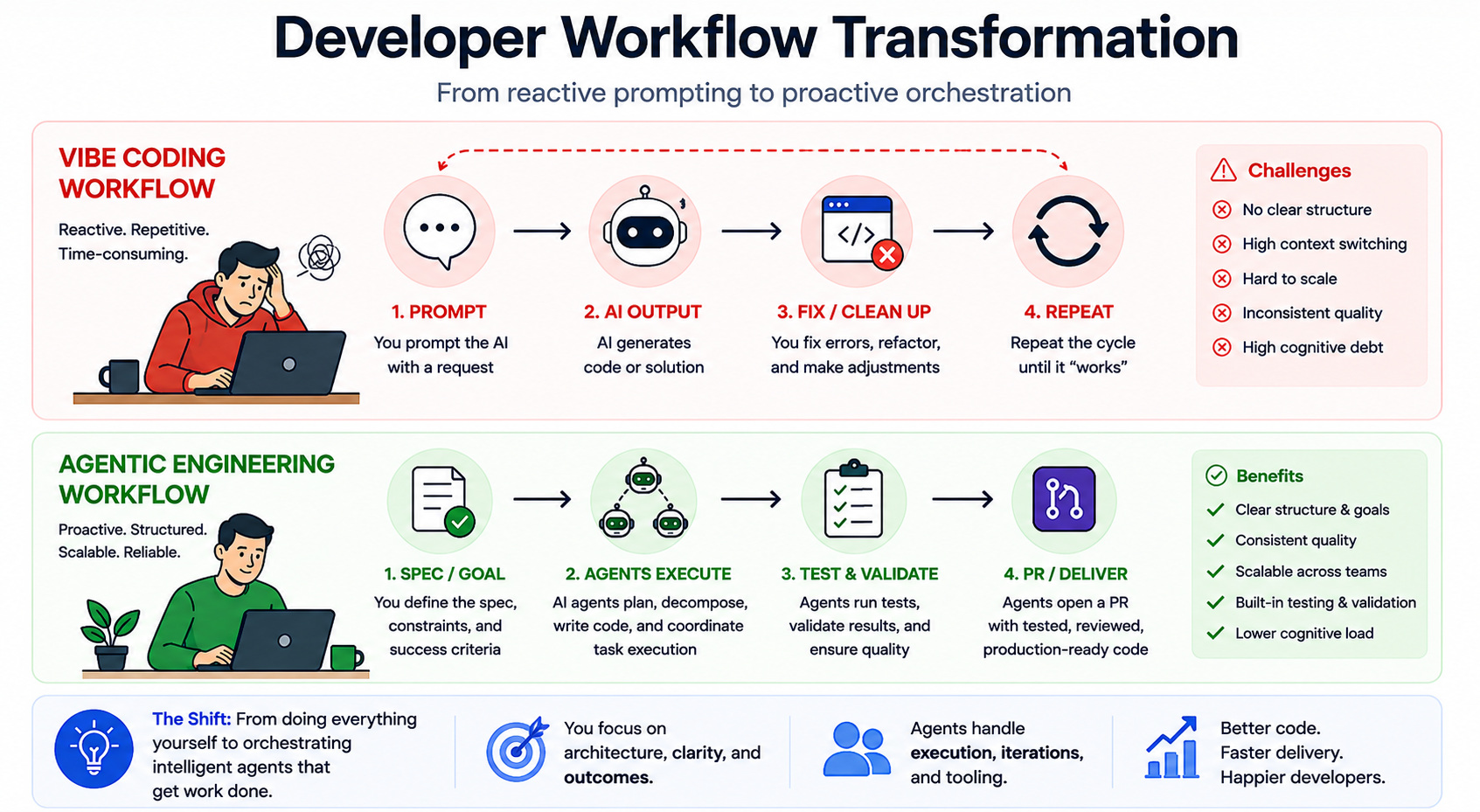
Vibe coding was basically you paste a prompt, get results, and you clean it up. Now developers are not restricted to one AI assistant anymore. They have moved on to orchestrating teams of AI agents that search, analyze, build, test, and debug simultaneously, as the human acts as an architect and reviewer.
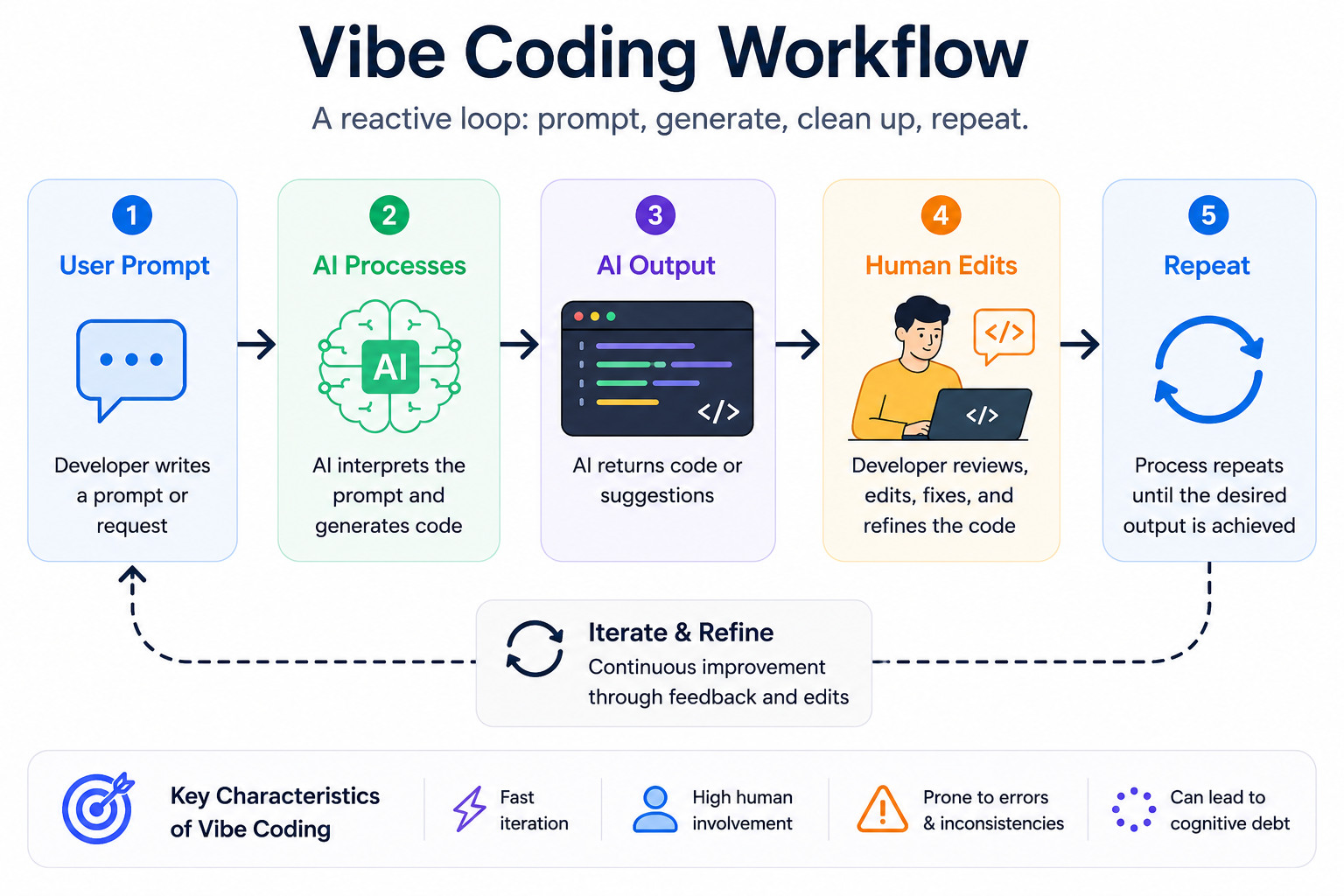
This change from reactive prompt-response to proactive, goal-guided agent architecture depicts one of the most important changes in software creation. We now call this agentic engineering. Under it lies the sophisticated orchestration frameworks that consider AI agents as a structured workforce rather than isolated AI assistants.
| Key Takeaways: |
|---|
|
Why Vibe Coding Fails?
While initially a hit, vibe coding had its limitations, such as difficulty scaling across teams and a lack of built-in structure for testing, auditing, or secure deployment. Also, vibe coding lacked the modularity and reliability needed in production-grade systems.
There was a critical question of security. Just because an AI agent codes fast does not mean that it codes securely. Agents were, in fact, introducing vulnerabilities that scaled over time. With no quality gate in sight, you ship what you generate.
The lack of a design phase meant that once the code was shipped as generated, no one could justify the codebase structure. How can you follow a reasoning when there was no reasoning at the start?
The infamous lack of remembering content by LLMs. As the vibe coding sessions extend, the agent loses track of context and earlier decisions. Final code malfunctions.
Cognitive debt is the final cost of poorly handled AI interactions, unreliable agent behavior, and context loss. The volume of cognitive debt created by vibe coding was faster than any of the previous methods.
What is Agentic Engineering?
It is what happens when we switch from coding with AI to building with AI agents. These systems don’t just support, they function autonomously, with clear roles, execution loops, and decision paths.
- Specification: What does the system need to do?
- Pseudocode: Define the logical flow
- Architecture: Build modular agent roles (Planner, Executor, Validator, Memory, etc.)
- Refinement: Optimize through defined test loops
- Completion: Finalize, execute, and monitor
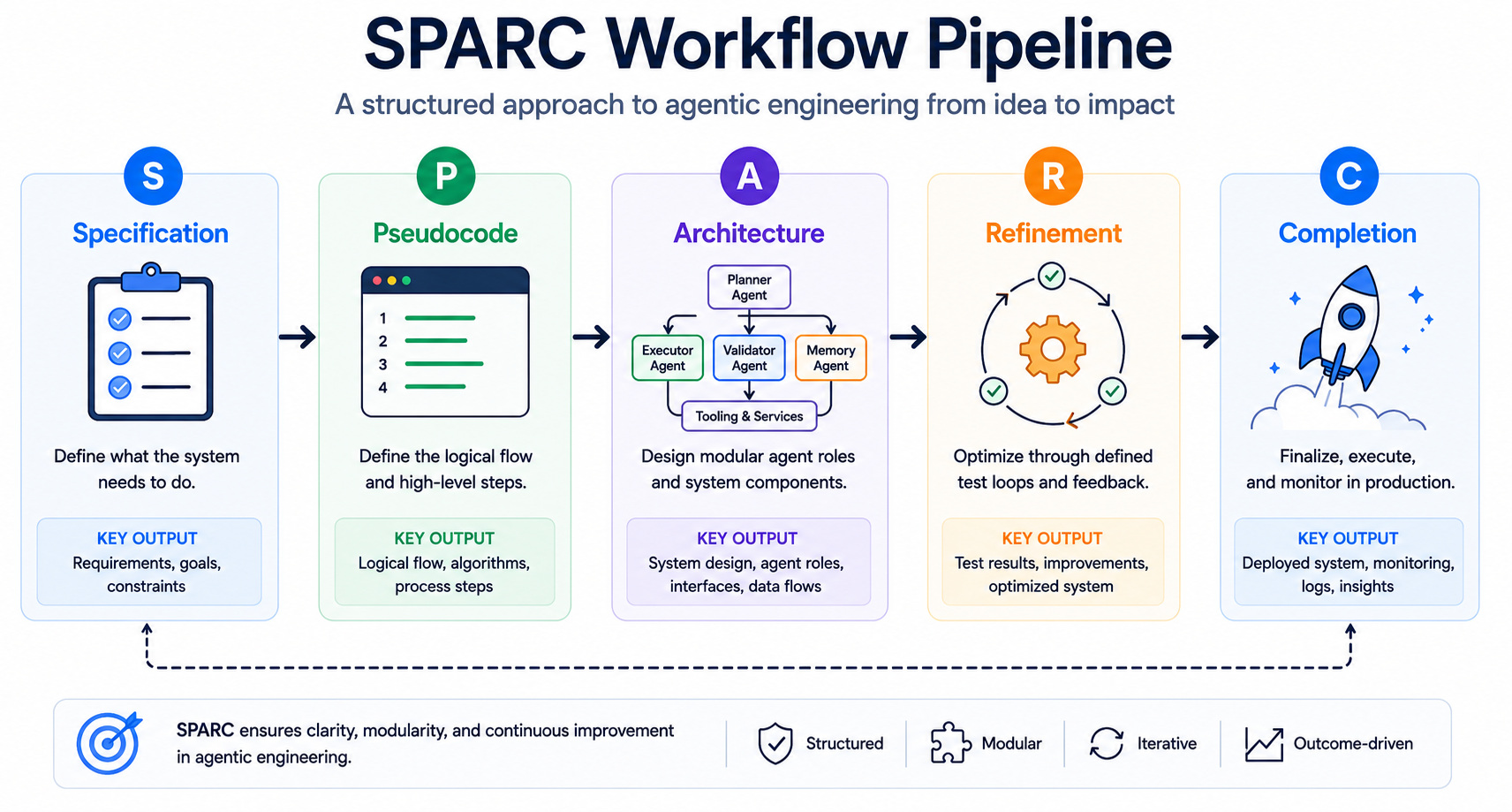
- A Planner agent breaking down a goal
- A Coder agent writing and validating code
- A Security Validator agent verifying results against policies
- Secure (defined boundaries, fallback plans, config management)
- Scalable (agents can work together or run in parallel)
- Auditable (decision logs, memory tracing)
But it needs a deeper design mindset, understanding agent lifecycles, state management, and trust boundaries.
Read: Ralph Loop Explained: A Smarter Agentic Loop for Building and Testing Software.
Steps to Agentic Engineering
Here are the four steps to take to achieve agentic engineering.
Step 1
Write a design document before writing the prompt. Answer these questions: What is a possible edge case? What does the feature do? What can failure look like? What could cause it? What should the data model look like?
An often-overlooked step for vibe coders. Unfortunately, this is the step that determines whether the agent is producing nonsense or efficient code.
Use an AI assistant to write the spec if needed, but write it. This needs to be done before the agent touches a single file.
Step 2
Well-built agentic systems divide tasks into smaller modules, allowing agents to create self-contained elements in real-time that integrate correctly into the current codebase without escalating the technical debt.
"Build me a REST API for an e-commerce app." This is a vibe coding prompt. It’s too vague, encompassing, and the agent will make architectural decisions you aren’t even aware of or approve of.
Agentic engineering does it better with "Create a REST endpoint /orders/{id} to fetch order details. Use our existing PostgreSQL schema. Include items, total price, and status. Follow our OpenAPI spec and return a 404 if the order doesn't exist." It follows all the factors of the framework.
Step 3
You have to make sure you review the AI-generated code with the same intensity as a human’s PR. The code shouldn’t be deployed if you can’t explain what a module does.
It’s a difficult practice to maintain. AI agents churn out code fast. But reviewing takes time. The obvious temptation is to just fast read and pass it. But this actually produces the unmaintainable codebases everyone complains about.
Always review with a keen eye. Understand every function. If something doesn’t make sense, ask the agent to explain it before merging.
Step 4
Testing is the biggest distinction between agentic engineering and vibe coding.
Vibe coding ships code if it looks like it works.
Agent engineering allows it to ship only when the code passes tests that are human-written and reviewed.
Read: What Is Agentic Coding? Understanding Autonomous AI in the Developer Workflow.
Agentic Engineering vs. Vibe Coding
| Aspect | Vibe Coding | Agentic Engineering |
|---|---|---|
| Core Philosophy | Human-AI co-creation driven by intuition and rapid iteration. Focused on boosting individual developer productivity. | AI as an autonomous or semi-autonomous executor. Focused on orchestrating systems to achieve complex goals. |
| AI Autonomy Level | Low to moderate, acts as a responsive assistant following prompts step-by-step. | Moderate to high: plans, decomposes, and executes tasks with minimal step-by-step input. |
| Developer’s Role | Prompter and co-pilot. Vibe coding defines tasks, guides outputs, and iterates constantly. | Architect and supervisor. Agentic engineering sets goals, constraints, and reviews outcomes. |
| Interaction Model | Continuous prompt-response loops with frequent manual intervention. | Goal delegation with periodic monitoring and strategic feedback. |
| Planning & Task Decomposition | Handled mainly by the developer, AI executes small-scoped prompts. | Handled largely by the agent within defined constraints and systems. |
| Tool Utilization | Mostly code generation; the developer manages tools like Git, tests, and deployment. | Agents can orchestrate tools (APIs, databases, CI/CD, testing) autonomously. |
| Execution Environment | External (IDE-driven); developer manages runtime and integration. | Integrated or sandboxed environments with built-in execution, logging, and guardrails. |
| Error Handling | Manual. The developer identifies bugs and asks AI for fixes at the end of the SDLC. | Semi-autonomous, a shift-left design. Agents detect errors, run tests, and attempt self-correction. |
| Task Scope | Small, component-level (functions, UI elements, scripts). | Large, system-level (features, workflows, full pipelines). |
| Context Management | Limited. It depends on the prompt context and the developer’s memory. | Advanced. It uses persistent memory and multi-step reasoning across tasks. |
| Output Focus | Code snippets and partial solutions requiring manual integration. | End-to-end features including code, tests, and configurations. |
| Maturity | Widely adopted (Copilot, Cursor, Replit). | Emerging but rapidly evolving (multi-agent frameworks, orchestration tools). |
Also read: Agentic Coding vs. Vibe Coding: Comparing AI-Coding Paradigms for Developers.
Agentic Engineering vs. Prompt Engineering
Let us take a second to compare Agentic Engineering with another trending term in the AI-assisted software development field: Prompt Engineering.
| Aspect | Prompt Engineering | Agentic Engineering |
|---|---|---|
| Approach | Single interactions | System design |
| Control | Manual | Automated |
| Scalability | Limited | High |
| Reliability | Variable | Structured |
| Use Case | Simple tasks | Complex workflows |
Prompt engineering isn’t going away, but it has become a subset of agentic engineering.
Real-World Use Cases of Agentic Engineering
Agentic systems are already being used in production across industries.
- Autonomous Research Assistants: These agents go beyond simple web searches. They can collate information from multiple sources, identify relevant insights, summarize findings, and turn them into structured reports, reducing hours of manual research.
- Customer Support Automation: Rather than relying on a single chatbot, multiple agents can work together. One agent understands the request, another generates responses, and another decides whether the issue should be escalated to a human representative.
- Software Development Workflows: AI agents are increasingly becoming part of development teams. They can write code, review pull requests, run tests, identify bugs, and even suggest fixes before developers manually step in.
- Business Process Automation: Organizations use agentic systems to manage routine operations such as invoice processing, extracting information from documents, and supporting data-driven decisions without continuous manual input.
From Vibe Coding to Agentic Engineering in Practice
To understand the shift from vibe coding to agentic engineering, it helps to look at how modern tools are evolving.
One example is codeCake, a platform designed to move beyond simple AI-assisted coding into fully orchestrated development workflows.
- Developers define a feature using a Jira ticket and an end-to-end test
- The AI generates code based on these specifications
- The system continuously iterates until:
- The code compiles
- All tests pass
- No regressions are introduced
- Once validated, it automatically creates a pull request for review
This process reflects a key principle of agentic engineering: systems don’t just generate outputs; they validate, adapt, and improve autonomously.
Final Thoughts
Vibe coding helped developers quickly unlock the power of AI. It lowered barriers and accelerated innovation. But it’s not enough for the next phase.
As systems grow more complex and expectations rise, we need structure, reliability, and scalability. That’s exactly what agentic engineering provides.
The shift from prompts to orchestration is already underway, and developers who embrace it early will define the future of software.
Frequently Asked Questions (FAQs)
What is agentic engineering in AI?
Agentic engineering is a software development approach where autonomous AI agents plan, execute, and validate tasks with minimal human intervention. Instead of writing prompts, developers design systems that achieve goals through orchestration.
Why does vibe coding fail in production environments?
Vibe coding often lacks structure, testing, and context persistence. This leads to security risks, inconsistent outputs, and unmaintainable code when scaling beyond prototypes.
How is agentic engineering different from vibe coding?
Vibe coding relies on iterative prompts and intuition, while agentic engineering uses structured workflows, defined constraints, and multi-agent orchestration to deliver reliable, production-ready outcomes.
 |