
When to Use a Spike, PoC, Prototype, or MVP (Without Confusing Them)
You have a cool idea and have established a startup to bring it to life. Before you market the idea, you have to explore it and assess whether it is feasible, technically viable, and market-ready. For this, you use various exploration and research techniques.
In digital product development, misusing early-stage exploration techniques can lead to significant confusion and wasted effort. These exploration techniques include terms such as Spike, Proof of Concept (PoC), Prototype, and Minimum Viable Product (MVP), which are often used interchangeably but serve very different purposes.
Choosing the wrong one at the wrong time can lead to overbuilding, underlearning, or misaligned expectations across teams.
| Key Takeaways: |
|---|
|
This article clarifies what each of these artifacts is, when to use them, and how to move from one to the next without confusion.
Why Does This Distinction Matter?
Differentiating the terms Spikes, Proof of Concept (PoC), prototypes, and Minimum Viable Products (MVP) matters as it mitigates risk, prevents wasteful overspending, and aligns team expectations. All this makes sure that you solve the right problem at the right time. These stages are often confused, leading to building too much functionality too early, such as a high-cost prototype or trying to validate technical feasibility with a consumer-facing product on a shaky MVP.
Before looking into individual definitions, it’s important to understand why this matters.
Each of these approaches- Spike, POC, Prototype, and MVP- answers a different type of uncertainty. Thus, understanding their differences and functions ensures you use each term at the right time.
The following table explains this:
| Aspect | Spike | POC | Prototype | MVP |
|---|---|---|---|---|
| Motto | Learning before building | Technical feasibility | Design & usability validation | Market validation |
| Core Question | Can we figure this out technically? | Is this idea technically feasible? | Will users understand and like this? | Will users actually use and pay for this? |
| Purpose | To learn enough about a specific technology, risk, or unknown to proceed. | To validate technical assumptions | To test UI/UX, user flows, and engagement before coding. | To release the smallest functional version that delivers real value to real users. |
| Why Distinguish? |
|
|
Prevents teams from trying to “scale” a mockup, which cannot handle real-world traffic. | Gathers revenue, user feedback, and traction |
- Engineers building production-grade systems when exploration was enough
- Product managers testing user behavior with incomplete or misleading artifacts
- Stakeholders assume something is “ready” when it’s not.
And the consequences of this? Delays, rework, and flawed decisions.
Now, let us move on to defining each term.
Spike: Fast Learning for Technical Unknowns
Let us find out what a Spike is, when to use it, its types, examples, characteristics, and common mistakes.
What is a Spike?
A Spike is a short, time-boxed technical research used to reduce uncertainty. Spike is common in Agile environments, especially Scrum. A Spike does not build anything, but is plain research to quickly learn technical unknowns.
When to Use a Spike
- You find it difficult to implement something.
- You need to assess and evaluate multiple technical approaches.
- There’s a risky dependency on an unfamiliar technology.
- It is difficult to estimate without exploration.
Example
Let’s say you’re building a system that needs real-time video processing. The team isn’t sure what will work best: WebRTC or a third-party API.
Here, you decide to explore both approaches first instead of committing to a full implementation. You decide to run a Spike, test both approaches, and measure latency, reliability, and complexity.
With this data, you can now learn more about both approaches and make informed decisions.
Key Characteristics of Spike
- Spike is time-boxed (typically 1–3 days).
- It has disposable code.
- Spike does not focus on design, scalability, or polish.
- Output is knowledge, not a product.
Common Mistakes
- You may treat Spike code as production code.
- You may let Spikes run indefinitely (no time limit).
- Documentation of findings may be skipped.
Proof of Concept (PoC): Validating Feasibility
Let us find out what a PoC is, when to use it, its types, examples, characteristics, and common mistakes.
What is a PoC?
A Proof of Concept or POC is used to validate if a specific idea can work in principle. It’s more concrete than a Spike but still not user-facing or production-ready. While a Spike explores, a PoC proves. In a Spike, you understand the complexity of something you have to do; in POC, you evaluate whether an idea is worth pursuing.
When to Use a PoC
- You need to verify a risky or unique idea.
- You need to present evidence to stakeholders before investing.
- You’re integrating complex systems.
- There’s uncertainty about the feasibility, not just the approach.
Example
If you want to build an AI feature that generates summaries from user data, and you need to give a presentation to stakeholders to garner their attention for this new project. You have already run a Spike and gathered enough data to ensure this is a concrete idea. Now you have to convince your stakeholders that this project is technically feasible.
Hence, before committing, you build a POC to demonstrate the project idea to stakeholders. You feed a sample of data into the AI model and show that meaningful summaries can be generated.
Key Characteristics
- POC is focused on one critical assumption.
- It is functional but minimal.
- POC is not optimized for performance or scale.
- It is often internal-facing.
- It is time-boxed.
Common Mistakes
- They may turn PoC into a production system.
- The scope may be expanded beyond the core assumption.
- POC may ignore real-world constraints (data quality, scale).
Prototype: Exploring User Experience
Let us find out what a prototype is, when to use it, its types, examples, characteristics, and mistakes that can be made.
What is a Prototype?
A prototype is a small model representing a product used to test design, usability, and user interaction. It answers: Does this make sense to users?
Unlike Spikes and PoCs, prototypes are often user-facing. It can be a low-fidelity wireframe, a 3D-printed model, or a non-functional design.
When to Use a Prototype
- You want to verify UI/UX concepts.
- You need user feedback before building.
- You are required to validate workflows or interactions.
- You need to align stakeholders on the design.
Types of Prototypes
- Low-fidelity: These are used for structural validation. Examples are sketches, wireframes, and basic flow maps.
- Mid-fidelity: These prototypes are more detailed than low-fidelity prototypes. They show layout and navigation without full functionality or final design. Clickable mockups (e.g., Figma) and digital wireframes are examples of mid-fidelity prototypes.
- High-fidelity: These prototypes are close to the real product in appearance and functionality. They are often used for final stakeholder approval and user testing. Some examples of high-fidelity prototypes are interactive, animated UI prototypes in Figma/Adobe XD, functional, and 3D-printed products.
- Proof of Concept (POC) Prototype: This type of prototype is built to determine if a design concept is technically feasible. For example, a rough assembly of sensors and wires to see if a motion-activated light will work.
Example
Let’s say you are designing a new dashboard. Instead of building the entire application, you create a clickable prototype to conduct usability testing. This way, you can observe where users struggle and then improve the design.
Key Characteristics
- A prototype focuses on user experience, not backend logic.
- It may not have real data or functionality.
- A prototype is fast to iterate on.
- It is often disposable.
Common Mistakes
- You may add real backend logic to the prototype too early.
- You may confuse visual realism with validation.
- You may skip user testing for the prototype.
MVP: Testing Market Value
Let us find out what MVP is, when to use it, examples, its characteristics, and common mistakes that can be made.
What is an MVP?
A Minimum Viable Product or MVP is the smallest version of a product developed to test business hypotheses and deliver value to real users. Unlike the previous three techniques, an MVP is real, deployed in production, and actually used by users.
When to Use an MVP
- You are in a position to test product-market fit.
- Core risks related to the product (technical + usability) are reduced.
- You want real-world feedback for the product from real users.
- You need data on usage, retention, or revenue to improve the product.
Example
Once you have validated your new idea by running a Spike and found it technically feasible through a POC, you develop a prototype for it, and it is found to be viable and aligned with stakeholders. After validating your idea, you build an MVP with core features only. Then you release it to early adopters and track user engagement and feedback.
Once you gather feedback from users, you accordingly plan your further development.
Key Characteristics
- An MVP is functional and usable.
- It has a limited scope.
- An MVP is built primarily for learning, and not perfection.
- It collects real user data.
Common Mistakes
- You may deviate from the concept of MVP and overbuild it (turning MVP into a full product).
- You may launch it too early without a core value.
- You might ignore feedback after release.
How Do They Fit Together?
Spikes, POCs, Prototypes, and MVPs fit together as a sequential validation ladder that reduces technical, design, and market risks from “can we build it?” to “should we build it?”. While Spikes and POCs validate technical feasibility, Prototypes help you refine the user experience, and the MVPs validate the business model with real customers.
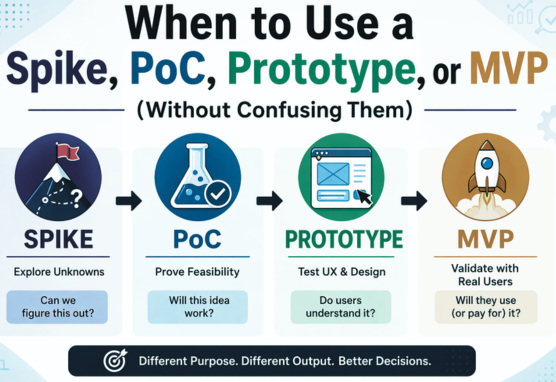
- Spike: Explores unknowns and is a learning technique. You learn what you need to know to proceed. A Spike is a research-oriented, time-boxed effort that reduces uncertainty about a specific technology or approach.
- PoC: Proves feasibility. You can view it as a small-scale, internal-facing project to test technical feasibility. A POC primarily answers: “Can we build this?” without needing to make it pretty or fully functional.
- Prototype: A prototype validates the usability of your idea by building an interactive, visual model that showcases user experience (UX) and navigation. It answers: “How will this work and look?” and is used for stakeholder feedback.
- MVP: An MVP is used to test the viability of a product and assess its real-world value. It is the first functional version of the product released to real customers, featuring only essential functionality. It answers: “Will they use/buy this?” and tests the business hypothesis.
- Sequential Risk Reduction: You use Spike to explore unknowns, move to create a POC to test technical feasibility, and then develop a prototype to map the user journey. Finally, you release an MVP to test market adoption.
- Iterative Evolution: A prototype developed can evolve into the frontend of an MVP. However, a POC is often discarded as it is “throwaway” code designed just to prove a point.
- Cost Control: This progression saves cost by allowing teams to fail early (via a $5k POC) rather than failing late (via a $100k failed product launch).
A Practical Scenario
Let’s say you’re building a new AI-powered personal finance app. Using the progression of four techniques- Spike, POC, Prototype, and MVP- you can generate a detailed scenario as follows:
Step 1: Spike
- Using Spike, available AI models are investigated.
- APIs are tested for transaction categorization.
The outcome of these steps is that you learn what is possible.
Step 2: PoC
- Once you figure out the unknown with step 1, you build a small system that categorizes transactions.
- Then you demonstrate it works with sample data.
In this step, you prove the feasibility of your proposed app.
Step 3: Prototype
- In the next step, you develop a prototype by designing the app interface.
- You then test this prototype with users: “Do they understand the insights?”
At the end of this step, you validate the prototype’s usability.
Step 4: MVP
- Once the usability of the prototype is verified, you can build a working app with core features.
- Launch this app to early users for testing and gathering feedback.
At the end of this step, you have validated the demand and collected feedback to be used in your main implementation.
How to Choose the Right One?
Here’s a simple decision guide to help you decide which exploration technique or combination of them you should choose. The basic strategy is to ask yourself these questions:
1. What is the biggest uncertainty right now?
- Technical unknown → Spike
- Feasibility doubt → PoC
- User experience concern → Prototype
- Market viability → MVP
2. Who needs the answer?
- Engineers → Spike
- Stakeholders → PoC
- Users → Prototype
- Market → MVP
3. What kind of output do you need?
- Knowledge → Spike
- Demonstration → PoC
- Interaction → Prototype
- Product → MVP
Summary
Spike, PoC, Prototype, and MVP are not just buzzwords in the software development field. They are decision-making tools that exist to answer a specific question at a specific stage of product development. Misusing them doesn’t just create confusion but also a risk.
The key here is alignment on purpose, scope, and expectations. When you use all four of them correctly, Spike saves you time, POCs build confidence, Prototypes improve usability, and MVPs drive real learning.
However, when confused, they do the opposite.
So the next time you decide to build an MVP, pause and ask: Are we trying to learn, prove, test, or sell?
Depending on your answer, you will know exactly what to build.
Frequently Asked Questions (FAQs)
- Do I always need to go through all four stages?
Not necessarily. Not every project requires all four. It actually depends on the level of uncertainty. Simple projects may skip Spikes or PoCs, while complex or innovative ideas often benefit from all stages.
- Can a Spike or PoC be reused in production?
Generally, no. Both are meant for exploration and validation, not production use. Reusing them often leads to poor architecture and technical debt.
- How long should a Spike or PoC take?
Spikes are usually short and time-boxed (ranging from a few hours to a few days). PoCs may take slightly longer but should still remain focused and limited in scope to avoid overengineering.
- What tools are commonly used to build prototypes?
You use tools like Figma, Adobe XD, Sketch, or simple wireframing tools to create prototypes.
- What makes a product a true MVP?
An MVP product delivers real value to actual users, includes working core functionality, and allows you to collect meaningful feedback or data on user behavior.
- Is a prototype the same as an MVP?
No. While a prototype is used to test design and usability, often without real functionality, an MVP is a functional product released to real users to validate business assumptions.
 |