
Why Teams Don’t Learn Fast Enough: Misusing Spikes, POCs, Prototypes, and MVPs
In modern product development, we often mistake speed for progress. Teams prioritize shipping quickly, iterating often, and staying “agile.” However, many of the products miss the mark, accumulate technical debt, and discover too late that they’ve built the wrong thing. The root cause is not a lack of effort or abilities. It’s a failure to learn fast enough.
| Key Takeaways: |
|---|
|
This article explores how these tools are commonly misunderstood, why that slows teams down, and how to use them properly to accelerate learning and decision-making.
The Core Problem: Activity Without Learning
- Are users going to actually use this feature?
- Does this feature solve a meaningful problem?
- Can this feature be built at scale?
- Is this implementation technically feasible within constraints?
As long as these questions are answered early, teams learn fast. Otherwise, teams learn late when changes are expensive, and the pace is hard to shift.
Teams are busy building and yet learning too slowly. Misuse of Spikes, POCs, Prototypes, and MVPs directly contributes to this problem.
What are Spike, POC, Prototype, and MVP?
Let us discuss the exploration tools and understand how each is misused.
1. Spikes: Reducing Technical Uncertainty
A spike answers a specific question. It is a short, time-boxed effort focused on learning the unknowns, not on building a feature. It is focused on exploration rather than production readiness.
- Can we integrate with this third-party API?
- Is this algorithm performant enough?
- What’s the best approach for authentication?
Misusing Spikes
- The Misuse: Spike is treated as an “analysis work” that must be done for every story. It may also sometimes be used to delay hard decisions.
- Why Learning Fails: Overusing spikes causes Agile to alternate between research and delivery sprints, turning it into a “mini-waterfall”.
- The Fix: Spike should be used sparingly. Time-box it strictly and focus on it only in “extreme” uncertainty.
2. Proof of Concept (POC): Validating Feasibility
A POC validates the technical feasibility of a feature. It is broader than a spike and often involves stitching components together to demonstrate feasibility. A POC mainly focuses on the question, “Can we build this?” Remember, a POC is not production-grade, though it is roughly functional.
- Is this architecture able to support our use case?
- Is this technology feasible for our product?
Misusing POCs
- The Misuse: Sometimes, POCs are over-engineered to look like final products, or run on “happy-path” scenarios (clean data) that fail in production.
- Why Learning Fails: Since teams treat POCs as demos rather than rigorous, disposable experiments, they get emotionally attached to the code and try to “polish” it into a product. In this process, they fail to learn the minute details of the implementation and intricacies required to demonstrate technical feasibility.
- The Fix: POCs should be ugly, rough, and disposable. It’s a fact that if a POC cannot fail loudly, it is not a true experiment.
3. Prototypes: Exploring User Experience
Prototypes are about exploring user experience or how users interact with a solution and whether it meets their needs. Prototypes are usually focused on usability and desirability. They are often fast to create and iterate.
- Can users understand this interface?
- Does this workflow make sense to you as an end user?
- Is this really going to solve a real problem?
Misusing Prototypes
- The Misuse: Teams develop high-fidelity prototypes and then ask users, “Do you like it?” rather than testing them for usability.
- Why Learning Fails: When it is misused, a prototype becomes “approval-seeking” rather than learning. Without learning, teams spend weeks polishing one prototype instead of creating high-contrast alternatives.
- The Fix: Use prototypes to test assumptions and explore user experiences, not to impress stakeholders.
4. MVPs: Testing Real-World Value
An MVP is a small version of a product that can be released to real users to validate assumptions and gather market feedback. AN MVP is a real product, used in real conditions. It has minimal functionality and focuses on learning from actual use.
- Will users pay for this product/feature?
- Does this product impart enough value to retain users?
- What should be built next?
Misusing MVPs
- The Misuse: Often, developers build MVPs overloaded with features. In addition, they might also build an MVP with minimal features and no value.
- Why Learning Fails: An MVP is treated as “Done” rather than “Version 1,” resulting in a lack of iteration. Teams are entangled in “learning theater”, wherein they run experiments for which they already know the answer.
- The Fix: Teams should focus on the “Viable” (value), not just the “Minimum.”
For a detailed explanation of Spikes, POC, Prototype, and MVP, refer to the article:When to Use a Spike, PoC, Prototype, or MVP (Without Confusing Them)?
Difference between Spike, POC, Prototype, and MVP
The following table provides the key differences between spike, POC, prototype, and MVP.
| Feature | Spike | POC | Prototype | MVP |
|---|---|---|---|---|
| Goal | Research & planning: reduces uncertainty/risk | Validates technical feasibility | User experience/UI: validates design/usability | Market validation: validates market demand |
| Key Question | How can we do this? | Can we build this? | How will it look/work? | Will users pay/use this? |
| Scope | Very small, specific question | Single feature/technique | Simulated/low-fidelity core features | Working product |
| Functionality | Knowledge/document | Rough internal demo: partial (backend only) | Visual mock-up: front-end simulation | Working product: fully functional core |
| Audience | Developers/internal team | Internal stakeholders/investors | User focus groups/stakeholders | Real customers/early adopters |
| Timeframe | Days | Days/weeks | Weeks | Months |
| Outcome | Knowledge/decision | Feasibility proof | UX/UI feedback | User data/revenue |
| Final Product | Discarded | Discarded/evolves | Discarded/evolves | Evolves into a full product |
Where Teams Go Wrong?
Despite clear distinctions, teams often blur these concepts. This leads to misaligned expectations, wasted effort, confusion about progress and impact, and delayed learning. Let us summarize how developers often misuse these tools during development:
Misuse #1: Treating Spikes as Mini-Projects
Spike is used for finding unknowns. However, instead of quick experiments, spikes often turn into extended development efforts. Developers polish code, add tests, and integrate it into the system.
- Using spike as a mini-project defeats the purpose of rapid learning
- It creates sunk-cost bias stemming from the attitude, “We’ve already built this, let’s keep it.”
- The original question (of exploring unknowns) remains unanswered.
Better approach: Be aware of what spikes are used for and keep them brutally focused. Note that if you’re writing production-quality code, you’re no longer spiking; you’re building.
Misuse #2: Confusing POCs with MVPs
Teams often use POC and an MVP interchangeably. They present a POC as an MVP. In doing this, developers demonstrate something that works in a controlled environment (staging or test) and assume it’s ready for real users.
- POCs prove technical feasibility, not market value
- Users only care if the product/feature solves their problem, not if it works.
- When POCs are presented as MVPs, teams skip critical validation of user needs.
Better approach: Recognize the difference between the two: a POC answers “Can we build it?” while an MVP answers “Should we build it?”
Misuse #3: Overengineering Prototypes
Prototypes are fast and disposable, but teams often try to make them realistic or technically accurate.
- Overengineering prototypes slows down iteration
- It discourages feedback (people hesitate to provide feedback for a polished work)
- Developers, instead of learning, shift their focus to perfection.
Better approach: While creating prototypes, use the lowest fidelity that still answers your question. Even a rough sketch on paper is more valuable than a fully coded UI.
Misuse #4: Building “Maximal” Viable Products
Many MVPs are almost full products. Teams often stuff MVPs with extra features, edge cases, and optimizations “just in case.”
- Overstuffing MVPs delays release and feedback
- It increases complexity and cost
- A Maximal viable product reduces clarity about what actually matters
Better approach: Tone down the product only to implement its core value. If removing a feature doesn’t invalidate the learning goal, it shouldn’t be there.
Misuse #5: Skipping Steps Entirely
Some teams skip exploration using spikes, POCs, or prototypes and jump straight to building an MVP.
- When steps are skipped, technical risks go unchecked
- User assumptions are not tested
- Failures become expensive
Better approach: Sequence your learning process by starting with the cheapest, fastest method to answer each type of question.
The table below summarizes the misuses already discussed:
| Tool | Misconception | What it Should Be | Common Error |
|---|---|---|---|
| Spike | Produces working code. | Learning activity | Doing it too late |
| POC | A small MVP. | Feasibility test | Over-engineering |
| Prototype | Near-final product. | Usability test | Polishing too much |
| MVP | A buggy version 1.0. | Market validation | Feature creep |
The Cost of Misuse
When organizations misuse spikes, POCs (Proof of Concepts), prototypes, and MVPs (Minimum Viable Products), they incur months of wasted development time, significant capital, and damaged user trust. Trying to sell a prototype or over-engineering a POC, the primary cost is building the wrong solution due to improper validation. This often leads to a 2x increase in planned development time.
- Deferred Feedback: Learning is delayed, often after significant investment. By the time issues are identified, they’re harder and costlier to fix.
- False Confidence: Stakeholders get false confidence when they see progress (demos, code, features). They mistakenly assume the team is on track, even when critical uncertainties remain.
- Increased Waste: Building things that may not be needed or viable also takes a lot of time and resources. So when the exploration tools are misused, there is an increased waste of resources and time.
- Slower Innovation: In the long run, trying to move fast without proper learning slows teams down.
- Feature Creep: The average startup spends 2x as much time building an MVP as planned, often adding unvalidated features.
- Delayed Launch: Over-engineering leads to a high cost of delay. By the time you launch a product, competitors have already made it to the market.
- Lost Trust: When you launch an unstable “MVP” that is actually an unpolished prototype, initial user trust is destroyed.
- Technical Debt: Treating early-stage AI experiments or prototypes as final code can lead to massive maintenance issues. If it has AI-generated code, it will lead to inconsistent, unmanageable, and expensive codebases.
Practical Guidelines for Faster Learning
Mapping spikes, PoCs, Prototypes, and MVPs to specific, early-stage risks, moving from technical feasibility to user validation, achieves faster learning in product development.
The core guideline for faster learning is to fail fast and cheap (early): use Spikes/PoCs to check if “we can build it” before using Prototypes/MVPs to prove “should we build it”.
- Time-Box Everything: Establish strict limits for spikes, POCs, and prototypes. Time-boxing prevents overinvestment and sets focus. Remember that spikes and POCs should be short, lasting only 1-3 days. If you extend this timeline, it means the project has turned into a “hidden” development task rather than an exploration.
- Define Success Criteria: Be clear about what you want to learn before starting. You should proceed only when you can articulate the question.
- Embrace Disposability: Your goal for using exploration techniques is to learn, not reuse. Consider prototypes and even POCs to be temporary, and be ready to throw away work. Do not try to turn a messy prototype into a final product, or technical debt will slow down future development.
- Separate Exploration from Execution: Exploratory work and production development have different goals and standards. Don’t mix them.
- Measure Learning, Not Output: Your goal is learning, so track how quickly you’re reducing uncertainty, not how much you’re building. Document steps taken, why decisions were made, and why other paths were rejected. This way, you can prevent repeating mistakes.
- Gather Feedback Immediately: Put prototypes in front of users for feedback, not just developers. MVPs must also use real usage analytics to determine whether the product should be improved, pivoted, or scrapped.
A Real-World Example
As an example, consider a team building a new recommendation engine. There are two scenarios here: misuse of the exploration tools and proper use of the exploration tools. Let us present both these scenarios.
Scenario A (Misuse)
In this scenario, the team skips spikes, builds a full MVP, and releases it. Months later, they discover performance issues and low user engagement.
This scenario is shown pictorially here:
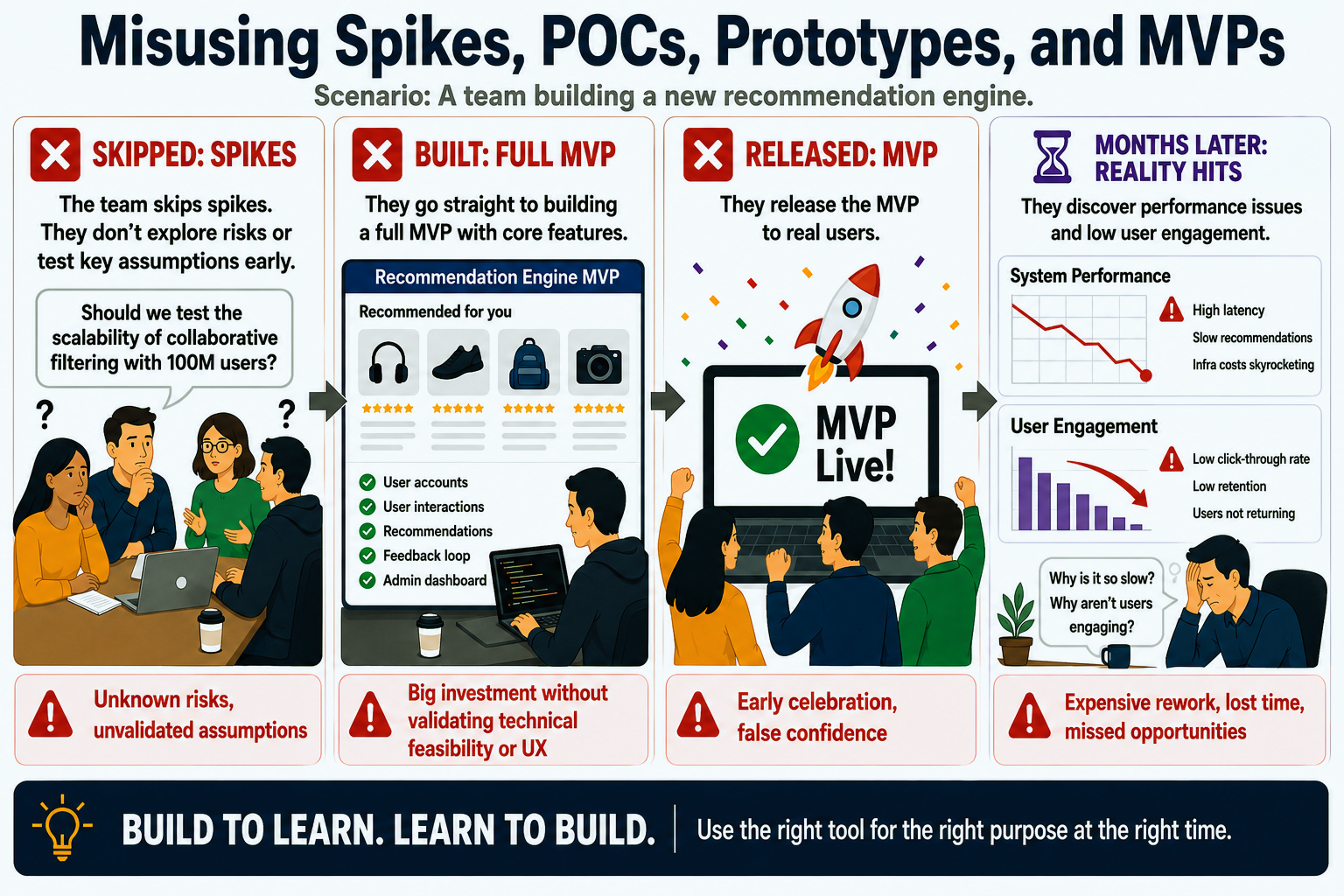
Thus, the recommendation engine encounters major issues due to the misuse of exploration tools.
Scenario B (Proper Use)
- Run spikes to test algorithms
- Build a POC to validate the architecture
- Create prototypes to test user interaction
- Launch a lean MVP to measure engagement
The pictorial representation of the scenario is shown here:
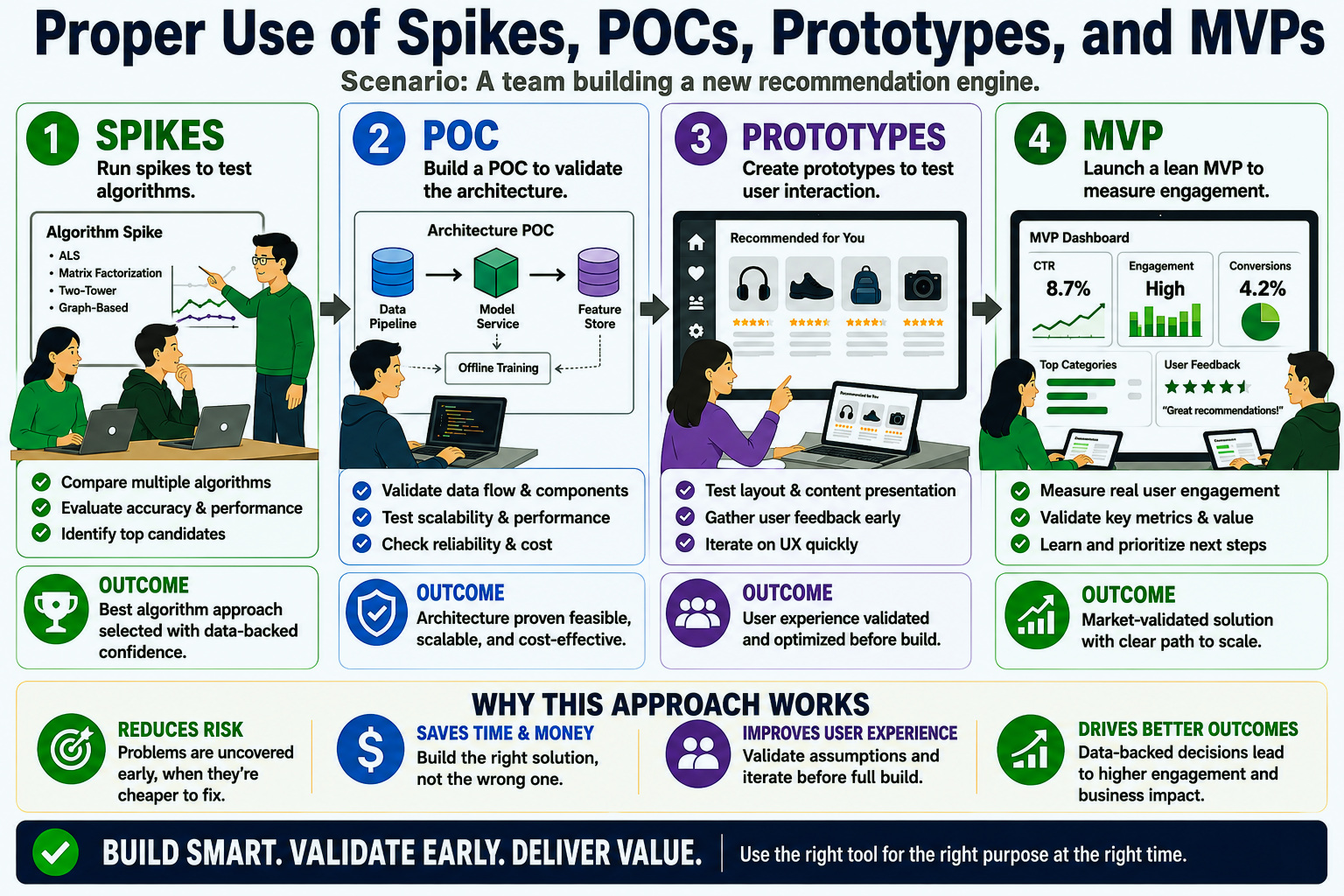
As you can see, the second approach reaches the same destination faster, with less waste and better outcomes.
Conclusion
As a product developer, your ultimate goal should not be just to build, but to learn what to build. The exploration tools, Spikes, POCs, prototypes, and MVPs, accelerate this learning. However, when you misuse these tools, the consequences are the opposite of learning.
Developer teams don’t fall behind because they’re slow or not skilled. They fall behind because they’re learning inefficiently.
Hence, the fix is not more effort or faster execution. It’s how you use these exploration tools. Using spikes to explore, POCs to prove technical feasibility, prototypes to understand users, and MVPs to validate market value will help you learn fast and efficiently.
When you align your methods with your questions, learning speeds up. And when learning speeds up, everything else follows: better products, smarter decisions, and true agility.
Frequently Asked Questions (FAQs)
- What is the main reason teams don’t learn fast enough?
Teams often confuse activity with learning. They focus on building outputs, like spikes, POCs, and MVPs, without clearly defining the questions they need to answer, leading to slow or ineffective learning.
- Why do POCs sometimes give a false sense of confidence?
POCs are often optimized for demos rather than real-world conditions. They may ignore edge cases, scalability, or constraints, leading teams to believe a solution is more viable than it actually is.
- How can teams improve their learning speed?
By starting with clear questions, time-boxing experiments, focusing on insights rather than outputs, and capturing learnings effectively, teams can significantly accelerate decision-making.
- Why do organizations encourage the misuse of these practices?
Stakeholder expectations, fear of failure, and metrics focused on outputs (such as features delivered) often push teams to prioritize visible progress over meaningful learning.
- What does “learning fast” actually mean in product development?
It means quickly reducing uncertainty by validating or invalidating assumptions, enabling teams to make better decisions with less wasted effort.
 |