
Attended and Unattended Agents
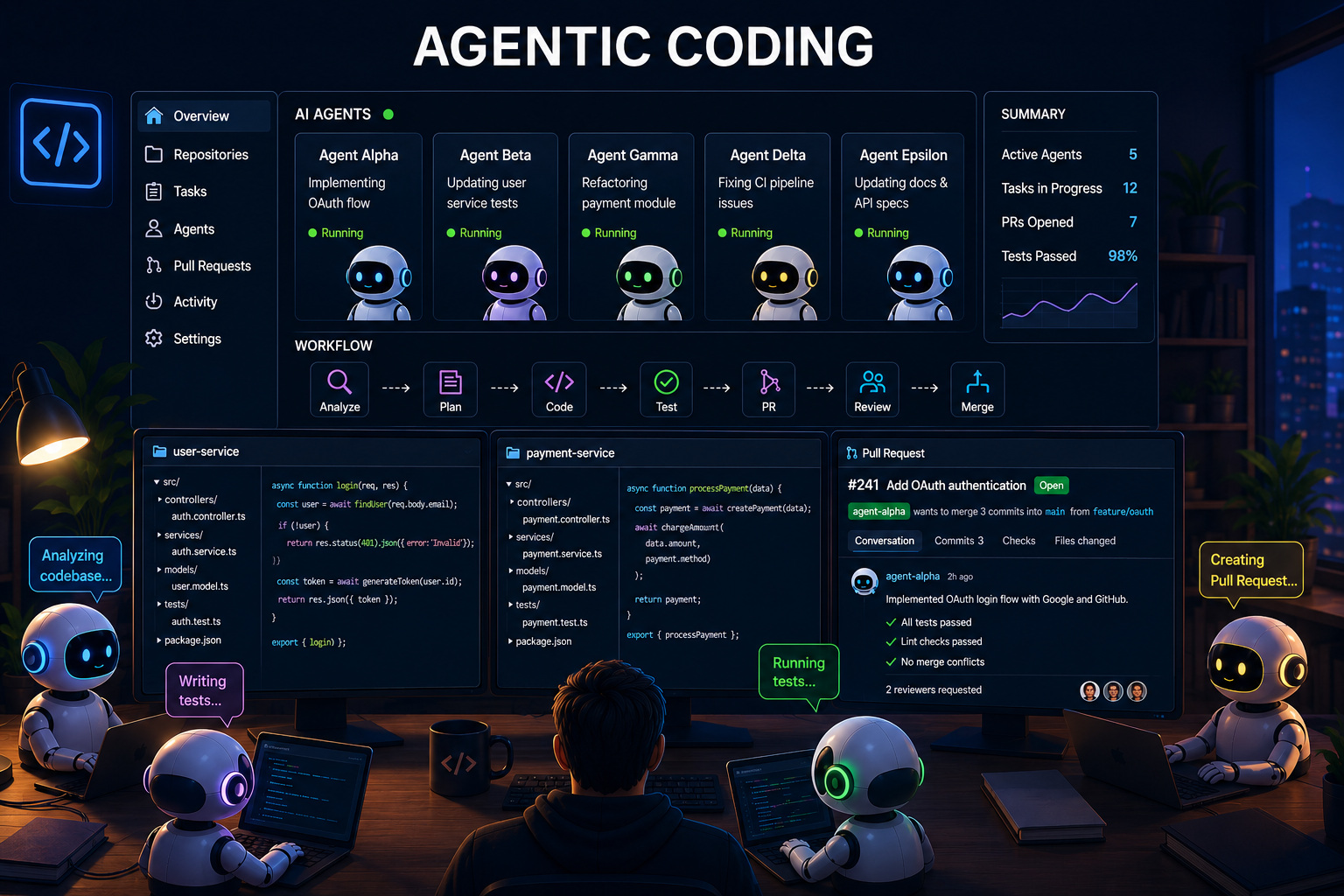
With LLMs rapidly evolving, the modern software development industry, especially the AI-driven development platforms, is reaching beyond simple AI-assisted autocomplete systems. They are now looking into systems that are capable of planning and executing much more complex tasks. Referred to as Agentic AI systems, they serve more of a role as collaborators with developers. They help developers to build functionalities in seconds, which earlier took weeks or months to conceptualize.
| Key Takeaways: |
|---|
|
What is Agentic Coding?
The newer generation of AI-driven developer tools is not just assisting in writing code; they actively participate in software development workflows. They analyze repositories, reason through tasks, execute terminal commands, edit multiple files, run tests, and respond to and resolve failures. They are even capable of opening pull requests without constant monitoring.
This shift is called agentic coding.
The difference is quite obvious once you start working with these systems. You’re no longer communicating with a chatbot that answers coding questions. You’re delegating work to a system that operates more like an engineer.
The difference matters as it changes the developer’s role itself.
Rather than manually implementing each functionality, the developers now increasingly also act as reviewers, orchestrators, architects, and supervisors of AI agents.
- Unattended agents
- Attended agents
Both these types are rapidly changing and becoming more important. These are instrumental in shaping how modern software is built.
If you would like to know more about agentic coding and the basic concepts around it, read the blog here.
How Does Agentic Coding Work?
Traditional AI coding platforms answered prompts. Agentic systems strive towards goals.
This sounds subtle, but it helps build a completely different workflow.
A typical AI assistant would maybe help you build a React component or explain an error message. On the other hand, an agentic system can take a broader prompt like:
"Add GitHub authentication to the application, update the backend schema, write tests, and create a pull request."
At this point, the system starts understanding things on its own.
It might affect the repository structure, search for authentication logic, catch dependencies, execute commands, run tests, retry failures, and repeatedly improve the implementation until it finally reaches the working state.
The core idea is autonomy.
Of course, it’s not full autonomy in every case. There is enough autonomy that the system can navigate through multi-step engineering processes without needing continuous prompting.
This is one of the main reasons why phrases such as AI coding agents, autonomous software engineering, AI developer agents, and agentic workflows are the buzzwords currently.
Developers have acknowledged that the industry has started shifting from “AI-assisted coding” and more towards “AI-assisted execution.”
Read: Agentic Coding vs. Vibe Coding: Comparing AI-Coding Paradigms for Developers.
Best Practices for Agentic Coding
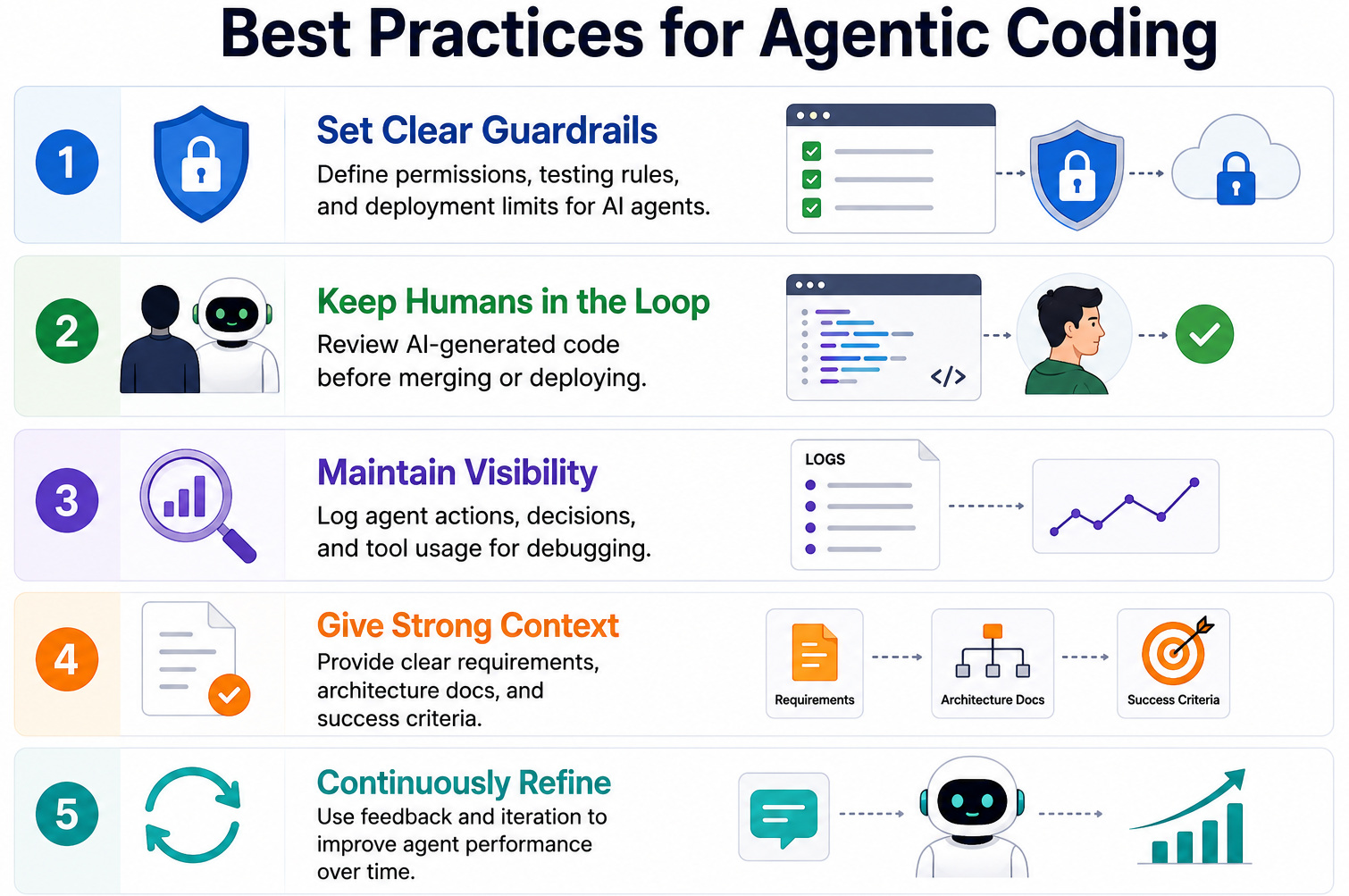
Set Clear Guardrails
AI agents should function within defined boundaries. Establish permissions around what actions they can perform, set testing requirements before code is merged, and define deployment rules to avoid unintended changes.
Keep Humans in the Loop
Even highly efficient AI systems benefit from human oversight. Reviewing AI-generated code before merging or deployment helps catch errors, validate business logic, and maintain quality standards.
Maintain Visibility
Teams should be able to understand the reason behind AI actions. Logging agent actions, decisions, and tool usage makes troubleshooting easier and improves transparency.
Give Strong Context
AI performs better when it has the right information. Clear requirements, updated architecture documentation, and defined success criteria help reduce ambiguity and improve output quality.
Continuously Refine
Agentic systems improve through feedback and iteration. Reviewing results and providing corrections over time helps optimize performance and align outputs more closely with project goals.
Why Developers are Paying Attention
A lot of buzz around agentic coding is due to the power of delegation.
- wiring APIs,
- fixing migrations,
- updating dependencies,
- writing boilerplate,
- refactoring old modules,
- repairing failing tests,
- or synchronizing changes across multiple repositories.
Now, these are types of tasks that AI agents are extremely good at. The appeal isn’t necessarily that AI writes more efficient code than humans. In truth, most of the time, it doesn’t.
The main attraction is that developers can hand off the operational engineering tasks while concentrating more on product logic, architecture, and system design.
This shift is quite a massive change from the original “autocomplete for developers” mindset.
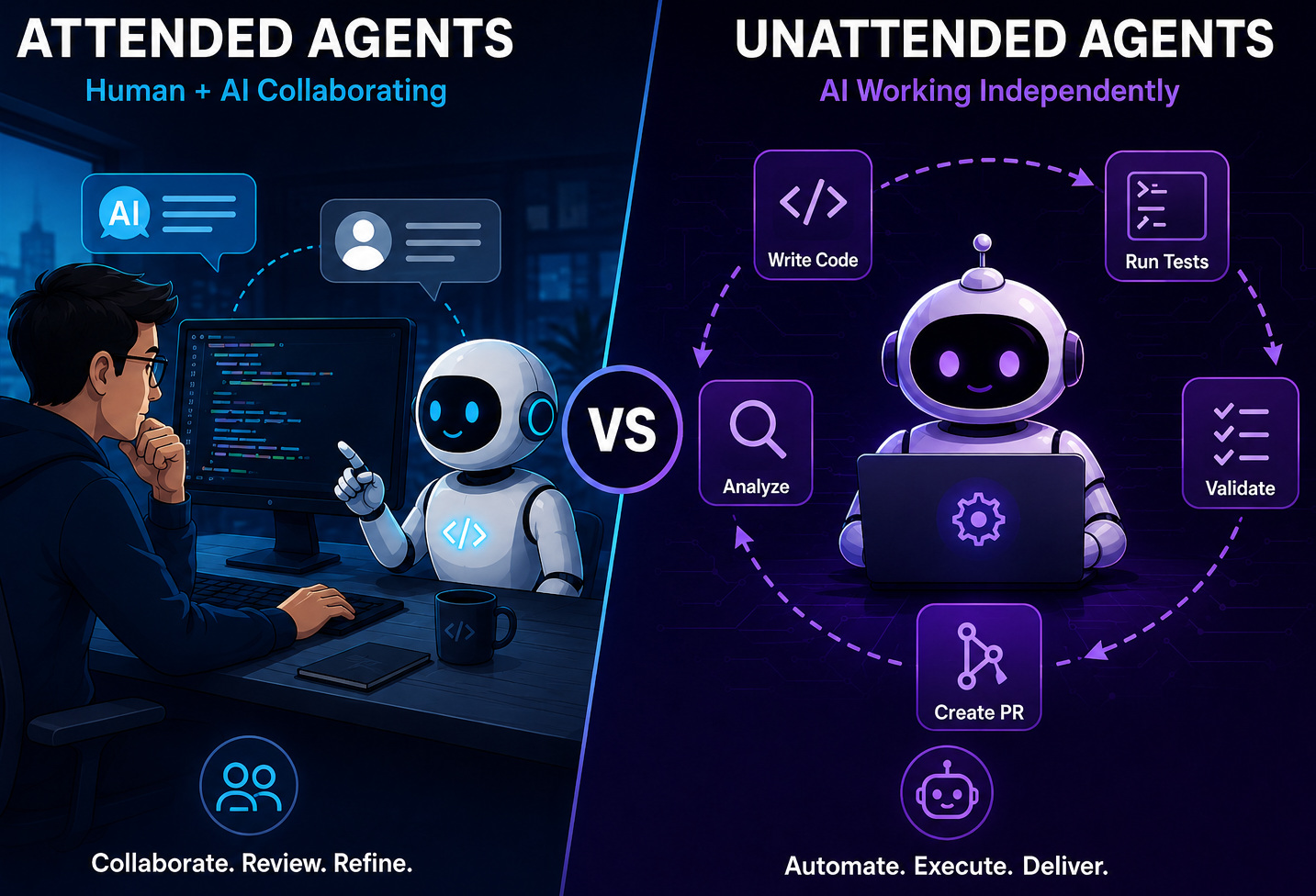
Attended Agents: AI Pair Programming at Scale
Attended agents are like virtual assistants, helping users with their tasks to improve productivity. The main power of attended agents lies in their capability to add on to human capabilities and optimize user productivity.
Most AI coding tools of today are still attended systems. This means that humans are actively involved throughout execution. The AI may suggest changes, write code, execute commands, or debug problems. However, there is still human supervision, also called a human-in-the-loop (HITL) mechanism.
Tools such as GitHub Copilot, Claude Code, Cline, etc., all work within this attended workflow model.
You delegate and assign tasks, review plans, authorize commands, check edits, and intercept when required. For a lot of engineering teams, this is currently the sweet spot.
The AI manages complicated implementation details while humans handle architectural oversight and quality control.
And honestly, most developers are still more comfortable and trust this model.
Even advanced coding agents still hallucinate APIs, misunderstand business logic, or make erroneous implementation decisions. Large production systems contain years of undocumented assumptions that AI systems often struggle to reason about correctly.
That’s why attended workflows feel practical right now. Developers gain speed without fully surrendering control.
Claude Code and the Rise of Interactive Agents
Anthropic’s Claude Code is one of the better examples of this attended-agent method.
- repository awareness,
- terminal access,
- iterative reasoning,
- and tool usage.
You’re not simply talking with an LLM anymore. You’re working with a system that can actively work inside a development environment.
A lot of engineers describe the experience as: “pair programming with an AI that never gets tired.”
That sounds dramatic, but it’s highly accurate.
The system can analyze bugs, forage through files, suggest architectural changes, and retry failed implementations in ways that feel much more akin to working with another engineer than simply using autocomplete.
Still, attended systems keep humans firmly in the loop. Human monitoring remains important because current AI agents are powerful but far from reliable.
Unattended Agents: When AI Starts Working Independently
Unattended agents work on the concept of automation without human intervention. In these scenarios, a designated server or computer is set up to execute automation in place of a user. This is where things start getting genuinely interesting.
Unattended agents operate with far less human supervision.
Instead of validating every command or approving every edit, developers assign a goal and allow the system to execute independently for extended periods.
"Help me code this."
"Handle this task and come back when it's done."
That’s a massive conceptual leap.
An unattended coding agent may investigate a repository, implement changes, run tests, debug failures, rerun CI, create documentation, and open pull requests without continuous human involvement.
It is not restricted to just coding assistance. It starts looking much closer to delegated software work.
Stripe’s Minions: A Real Enterprise Example
One of the best real-world examples of unattended agentic coding comes from Stripe and its internal system called “Minions.”
Stripe recently explained that its coding agents autonomously generate more than 1,000 merged pull requests every week. That number alone is huge and worth taking note of.
What makes the system especially important is that it works inside a real enterprise engineering environment, not a demo repository built for marketing videos.
- modify repositories,
- run tests,
- validate implementations,
- retry failures,
- and create production-ready pull requests.
Humans still verify and approve the final code, but the implementation work itself is heavily automated. This changes the developer workflow significantly.
Instead of manually implementing every task, engineers increasingly monitor teams of autonomous workers handling operational development tasks in parallel.
That parallelization may end up being one of the biggest long-term impacts of agentic coding.
Benefits of Attended and Unattended Agents
| Feature | Attended Agents | Unattended Agents |
|---|---|---|
| Human Involvement | Needs active human supervision | Operates independently after task assignment |
| Best Use Cases | Code reviews, pair programming, production changes | Repetitive workflows, bulk automation, and long-running tasks |
| Speed | Faster than manual coding but review-heavy | High-speed execution with minimal intervention |
| Risk Level | Reduced risk due to continuous oversight | Higher risk if guardrails are weak |
| Developer Role | Collaborator and reviewer | Supervisor and orchestrator |
| Reliability | Easier to check during execution | Relies heavily on testing and validation systems |
| Scalability | Restricted by human review capacity | Can scale across multiple tasks simultaneously |
The Problem of Reliability
Generating code is quite easy now. But creating reliable code in a large enterprise system is the challenge now.
- misunderstand requirements,
- introduce subtle bugs,
- break hidden dependencies,
- misuse APIs,
- or create security vulnerabilities.
As the codebase becomes older and more extensive, the harder the issue becomes. This is why a lot of enterprise teams remain speculative about completely autonomous development workflows.
The real challenge was never just producing syntax. It was about properly understanding intent, behavior, edge cases, and system constraints.
That’s exactly where a different category of agentic tooling becomes highly interesting.
Read: Prompt Engineering for Developers: How to Generate Better Code with AI.
Specification-Driven Agentic Coding
As developers, we are aware that most AI-coding tools of today work with prompts, tickets, or high-level objectives. But there are platforms that are approaching the problem at a different angle. Rather than asking, “What code should the AI system build?” they ask, “What behavior should the software display?”
This difference is understated, but critical.
One example is codeCake, built by testRigor. It takes the specification-driven development strategy to agentic software engineering. Rather than relying only on prompts, codeCake leverages executable test plans as the base for code generation.
So with codeCake, teams explain desired functionality using testRigor’s plain-English test cases. codeCake then generates or changes application code until those tests pass.
That creates a very different workflow compared to prompt-first coding agents. Rather than starting with implementation, the process starts with behavior.
- a previously passing test that now fails after a regression,
- or a new test describing functionality that does not yet exist.
codeCake uses those behavioral specifications to determine what application changes are needed. That strategy aligns closely with Test-Driven Development (TDD), Specification-Driven Development (SDD), and behavior-first engineering workflows. This is already quite similar to how expert engineers and teams consider production systems.
The Industry is Still Figuring This Out
Right now, there’s no singular definition of what AI-powered software engineering should look like.
Some teams want fully unattended coding agents. Others are more interested in systems that prioritize reliability, testing, and reviewability. That’s why methods like specification-driven development are gaining attention; they feel easier to trust in real production environments.
The space still feels new, a bit like the first wave of DevOps or cloud adoption. Everyone can see the direction things are moving, but the workflows are still taking shape.
But what is concrete is that the role of developer is evolving. Developers waste less time writing iterative implementation code. And more time is spent on defining requirements, validating results, and pushing intelligent systems towards the right goals.
Working with Unattended and Attended Agents
Attended and unattended agents work well when used together. Attended agents keep humans in the loop for review, decision-making, and collaboration. At the same time, unattended systems manage repetitive or long-running tasks independently.
For many organizations, the ideal setup is a combination of both. AI agents can automate regular workflows in the background, while developers or operators intervene where monitoring, approvals, or business context are needed.
Teams gain flexibility with this combination. They are able to scale work efficiently without disturbing existing processes. Also, organizations are able to move faster while still ensuring reliability, control, and quality.
Frequently Asked Questions (FAQs)
- What is agentic coding?
A: It refers to AI-driven software development where AI agents can independently schedule and run engineering tasks. This includes designing, writing code, changing repositories, executing tests, debugging problems, and opening pull requests.
- Are unattended AI coding agents fully autonomous?
A: Not fully. Even advanced unattended agents usually work within guardrails such as testing pipelines, permission systems, CI validation, and human code review before deployment.
- What is Specification-Driven Development (SDD) in AI coding?
A: Specification-Driven Development is an approach where software behavior is defined first through executable tests or specifications. AI systems then generate or modify code until those specifications pass, improving reliability and alignment with business requirements.
- Why are developers interested in agentic coding?
A: Developers are interested because agentic systems can automate repetitive engineering tasks like debugging, migrations, dependency updates, boilerplate generation, and test execution, allowing teams to focus more on architecture and product development.
- What is the difference between attended and unattended agents?
A: Attended agents work with continuous human supervision, while unattended agents operate more autonomously after receiving a task or objective. Attended systems focus on collaboration, whereas unattended systems focus on execution and automation.
 |