
Reliable AI Agents: Why Infrastructure Matters More Than Models
AI infrastructure is now the single largest area of AI investment globally, with worldwide AI spending expected to reach $2.59 trillion in 2026, with AI infrastructure accounting for more than 45% of total spending. Every few months, we are bombarded with the news of a new model launch, say Gemini Ultra, Claude 3.7, etc.
At each of these launches, these models promise to be more capable, faster, and smarter than the previous ones. The next few weeks are filled with experts going off on Twitter and LinkedIn with their “unpopular” opinions, which model and different benchmarks. Developers are saddled with writing and rewriting their apps to make maximum advantage of the newest functionalities.
Some time later, these no longer matter.
This is not because the models are unimpressive. They are. It is because the durability of the AI app has minimal connection with which model was being used. In fact, teams building AI systems in production have started to accept something important. The model is rarely the first component to break.
Most AI agent failures are rarely due to raw intelligence. These failures occur due to the surrounding weak infrastructure. Workflows lose state, APIs crash, tools return unreliable outputs, prompt drifts, or automated actions that run without sufficient guardrails.
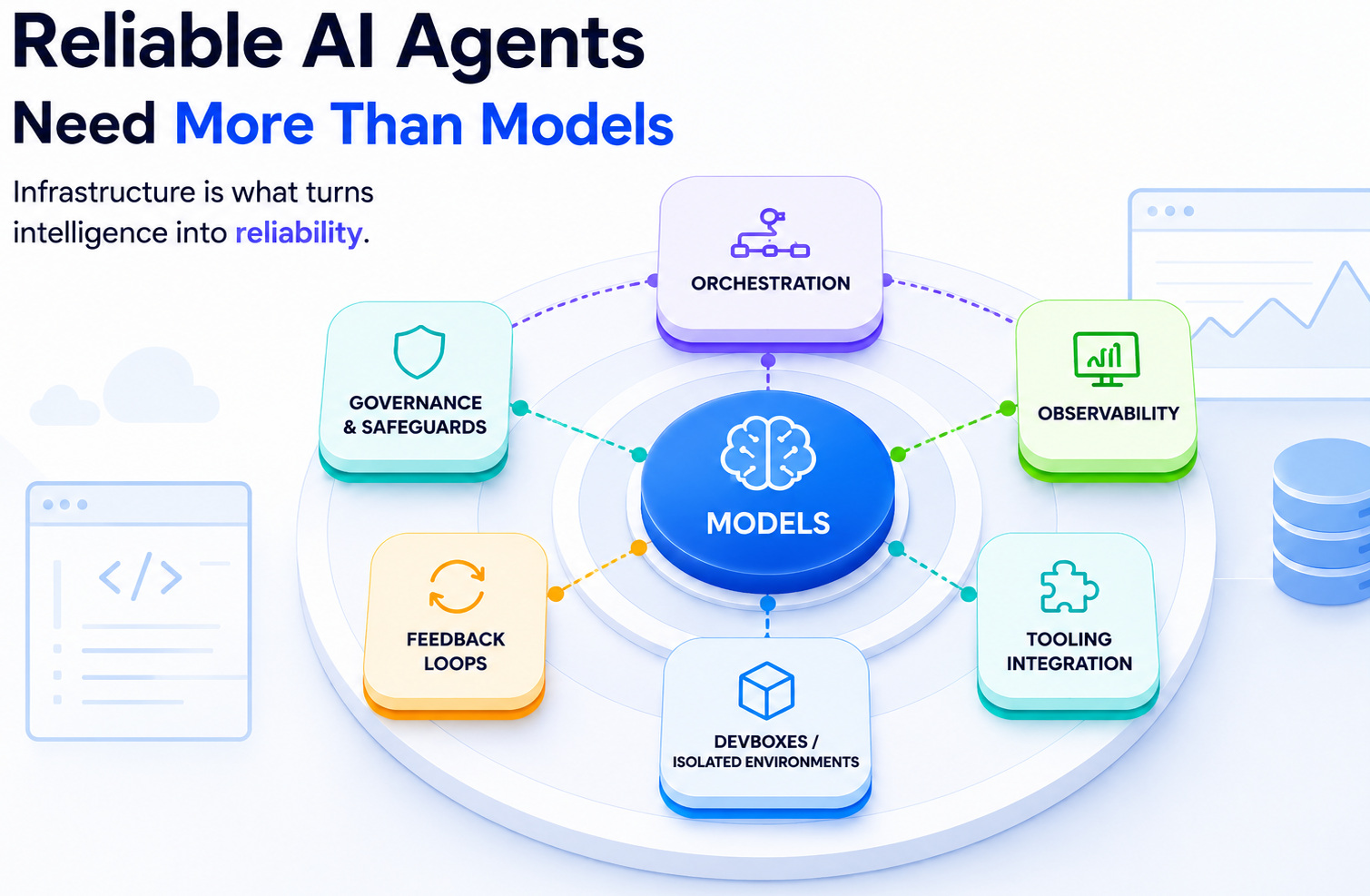
This is why the conversation around AI agents has experienced a change. The actual change is not building intelligent agents. It’s more about building reliable ones. An exceptional model can make sure of an impressive demo in a controlled environment. But orchestration is necessary for a production-ready AI agent. In addition, it needs observability, isolated execution environments, continuous feedback loops, and tooling integration. In the absence of these layers, even the smartest model becomes unreliable in real-life scenarios.
This is often the point in the journey where many teams reach after the excitement of early experimentation fades. The part where engineers are flummoxed is not making it work right once, but making it work consistently, safely, and at scale.
| Key Takeaways: |
|---|
|
Why AI Agent Demos Fall Apart in Production
One of the biggest myths related to AI agents is that they operate independently. This is not true; modern agents are deeply integrated with external systems. They fetch data from databases; communicate with APIs, write code, update CRMs, automate workflows, explore documentation, and coordinate across multiple services.
The model by itself is only one layer of a much bigger operational stack. That stack is where reliability is either built or destroyed.
Most developers understand this the moment they shift from prototypes to production. In a demo environment, the agent usually works under controlled conditions with predictable inputs. The production environment is far more chaotic. APIs timeout unexpectedly. Tool results vary in structure. Retrieval pipelines return old information. Longer-running workflows have lost context. User behavior is quite unpredictable.
As a result, the agent that appeared intelligent during testing starts showing inconsistent behavior in production. This is why infrastructure is far more important than most teams initially expect.
The issue is not restricted to hallucination or reasoning quality. It’s operational reliability. AI agents are increasingly working like distributed systems. This means that they inherit a lot of the same engineering challenges that modern backend systems already face.
Hidden Challenges in Production
The biggest problems with AI agents rarely show up during testing. They begin appearing when systems function continuously at scale. Long-running workflows lose context between steps, retrieval systems return stale information, and tool chains fail when one dependent service breaks unexpectedly.
As agents become more autonomous, teams also run into retry loops, duplicated actions, concurrency issues, and state persistence failures across multi-step workflows. At that point, the challenge is no longer model intelligence; it becomes an infrastructure engineering problem.
Read: Context Engineering for AI Agents: A Step-by-Step Guide.
Difference Between App Infrastructure and Agent Infrastructure
Traditional app infra is developed around deterministic systems. Provided with the same input, APIs, databases, and backend services are expected to produce the same result every single time. AI agents do not function that way. Their behavior is probabilistic, context-dependent, and often directed by external tools, memory layers, and changing retrieval pipelines.
This leads to engineering challenges that traditional application infrastructure was never meant to handle. An API server does not suddenly change behavior because context shifted halfway through execution, but an AI agent can. Multi-step reasoning, dynamic tool selection, memory persistence, and non-deterministic outputs make reliability markedly harder to guarantee.
In reality, building AI agents needs infrastructure that transcends traditional app engineering. Systems need orchestration layers, context management, validation pipelines, fallback mechanisms, and continuous evaluation frameworks because, unlike conventional applications, agent behavior cannot always be predicted in advance.
This is exactly why agent infrastructure is emerging as its own engineering category rather than simply an extension of existing application infrastructure.
The Importance of Devboxes and Isolated Environments
Infrastructure plays an important role in execution environments. Modern AI agents are no longer restricted to writing text. They can execute code, manipulate files, automate workflows, communicate with cloud systems, and trigger external actions automatically. This creates major security and operational problems if those tasks execute directly against live systems.
This is why devboxes and isolated environments are becoming an important part of modern AI architecture.
Rather than allowing agents unrestricted access to production infrastructure, many organizations now run tasks inside sandboxed environments where actions can be monitored, restricted, and rolled back if necessary. These isolated environments enable AI agents to safely validate workflows, process documents, run scripts, and interact with tools without sacrificing broader systems.
For developers, this change is normal. It reflects the growth of cloud-native infrastructure and containerized applications. Nobody wants unauthorized code running directly in production anymore. AI agents are now in the same operational reality.
The more independent agents become, the more important these isolated execution layers will be. Reliability is not only about bringing down hallucinations. It’s also about restricting the blast radius when something inevitably goes wrong.
Read: Why AI Reliability Depends on Strong Consistency (Not Just Better Models).
Tooling Integration Improves AI Agent Power
The ability to interact with external systems is what makes the majority of AI agents useful.
An agent that cannot access live business data, trigger workflows, update records, or coordinate with software tools has limited practical value. The real value of AI agents comes from their capability to integrate into operational systems and automate meaningful work.
However, an entirely new layer of engineering complexity is revealed due to tooling integration.
Developers suddenly need to consider authentication, retry logic, schema validation, permissions management, API versioning, state persistence, and workflow recovery. In many production systems, the orchestration layer becomes more complex than the model itself.
Also, one of the major reasons why orchestration frameworks gained popularity so quickly is that teams understood that building reliable workflows around the model was often harder than generating outputs from the model.
Tooling integration is also where AI systems begin to mimic distributed systems engineering more than traditional application development. Once agents depend on multiple APIs, asynchronous tasks, retrieval pipelines, and external services, reliability becomes an infrastructure problem.
The industry is slowly learning that intelligence alone does not create dependable systems.
Read: Why Every Engineering Team Needs Version Control: Ensuring Safe, Collaborative, Traceable Code.
Observability is the Missing Layer in Most AI Systems
Typical software systems depend heavily on logs, metrics, and monitoring. AI agents need even in-depth visibility as their behavior is probabilistic and heavily reliant on prompts, retrieval pipelines, and external tools.
Without observability, debugging becomes extremely complicated. When an agent fails, teams need to backtrack prompts, retrieve context, workflow steps, tool calls, and memory state to comprehend what went wrong.
- prompt tracing
- execution logs
- workflow monitoring
- retrieval analytics
- latency tracking
- evaluation pipelines
AI agents cannot work as black boxes in enterprise environments. Reliability demands visibility.
Feedback Loops are what Actually Optimize AI Agents
Reliable AI agents improve through continuous feedback, not just better models.
Production environments constantly change: APIs evolve, workflows become more complicated, and user behavior changes over time. Without feedback loops, agent performance deteriorates quickly.
Human-in-the-loop systems continue to be important for sensitive actions like infrastructure changes, financial operations, or customer data updates. These approval layers help organizations implement AI safely at scale.
Feedback loops also help teams improve prompts, optimize workflows, improve retrieval systems, and identify repetitive failures. In practice, operational iteration often optimizes AI systems more than model upgrades alone.
Also, teams are moving toward specification-driven AI workflows where tests, validation layers, and operational requirements define how agents behave instead of relying entirely on prompts alone.
Read: In the Age of AI, Are We Skipping the Learning Phase?
The Hidden Cost of Weak AI Infrastructure
The actual cost of weak AI infrastructure usually doesn’t show up during early experimentation. It starts adding up when systems start scaling.
Many teams try to improve model quality first and infrastructure later. This approach gets expensive fast. Without caching, agents repeatedly produce the same outputs. Without routing layers, expensive models manage tasks that smaller models could solve more efficiently. Without guardrails, sudden traffic spikes can lead to massive increases in inference costs.
In production systems, infrastructure decisions often impact cost more than model selection itself.
The same problem appears during testing. AI systems are inherently non-deterministic, which makes testing difficult without the right tooling. Teams need controlled testing environments, reproducible outputs, usage tracking, and evaluation pipelines to reliably ship AI features at scale.
There’s also the issue of vendor lock-in. Applications built tightly around a single model provider become difficult to evolve. Every API change, pricing update, or model migration creates additional engineering overhead.
Infrastructure abstraction layers try to handle this by segregating application logic from model providers. That makes it easier to switch models, introduce fallback systems, test new providers, and maintain long-term flexibility without rewriting core workflows.
Over time, reliable infrastructure reduces operational cost, simplifies maintenance, and makes AI systems far easier to scale.
A good way to understand and validate if the AI infrastructure is ready is by checking if the AI stack includes model routing, response caching, fallback mechanisms, evaluation pipelines, provider abstraction layers, security controls, and usage monitoring at the workflow level. Without these systems in place, scaling AI often becomes expensive, difficult to test, and increasingly hard to maintain over time.
Read: Prompt Engineering for Developers: How to Generate Better Code with AI.
AI Coding Agents Need Infrastructure Too
Instead of depending only on prompts to write application code, codeCake uses a test-driven approach where requirements are defined through testRigor test cases written in plain English.
The system can either fix existing functionality when a previously passing test fails or build entirely new application code for features that do not yet exist. What makes this strategy interesting is that the tests become the operational specification for the AI system.
That changes the role of the model significantly. The AI is no longer generating code in isolation; it works inside a structured workflow that covers validation, tooling integration, pull requests, and human review. codeCake can even work across multiple repositories and respond to reviewer comments before updating the PR again.
This highlights how reliable AI systems are built on the foundation of infrastructure, feedback loops, and engineering workflows in place of standalone model capability.
Infrastructure as the Real Competitive Edge
As AI agents advance to production, reliability is becoming more relevant than raw model capability. Strong models are relevant; however, orchestration, observability, isolated environments, tooling integration, and feedback loops help make AI systems usable at scale.
The organizations building reliable AI workflows, and not only better prompts, have the competitive edge.
Frequently Asked Questions (FAQs)
- Why do AI agents fail in production?
A: Often, AI agents fail due to infrastructure issues rather than model restrictions. Common problems include unreliable APIs, workflow failures, poor state management, weak observability, and missing validation layers.
- Why are isolated environments important for AI agents?
A: Devboxes and sandboxed environments enable AI agents to safely run code, process files, and interact with systems without directly affecting production infrastructure. They bring down security and operational risks.
- How do feedback loops improve AI systems?
A: Feedback loops help teams improve prompts, optimize workflows, better retrieval systems, and catch recurring failures. Human-in-the-loop review systems also make AI deployments safer and more reliable.
- What is AI observability?
A: AI observability refers to monitoring and tracing AI workflows using tools like prompt tracing, execution logs, retrieval analytics, latency tracking, and workflow monitoring. It helps teams debug and optimize AI systems.
- What makes an AI agent reliable?
A: Reliable AI agents depend on orchestration, observability, isolated execution environments, tooling integration, feedback loops, and proper governance controls.
 |