
Can AI Handle the Entire SDLC?
The software delivery life cycle (SDLC) has gained significant benefits with the introduction of AI to it. A few years ago, the concept of from ticket to production sounded absurd. In 2026, this idea is not ridiculous. It is already transpiring in parts.
Today, we can have a scenario where a JIRA ticket is created in the morning, and by evening, an AI system has already built the feature, opened the pull request, and built tests. It has deployed the service, monitored production, and resolved its own deployment problem before anyone on the team caught it.
AI has progressed far beyond autocomplete. We are now treading into the area of AI agentic workflows, where multiple AI systems work together across SDLC, managing tasks that previously needed complete engineering teams.
AI can write code. Often extremely well, no one denies that.
However, engineering teams have never been limited to only writing code. The hard part is always about understanding intent, reducing ambiguity, balancing compromises, and making decisions when the requirements are incomplete.
| Key Takeaways: |
|---|
|
AI in Software Development Lifecycle (SDLC)
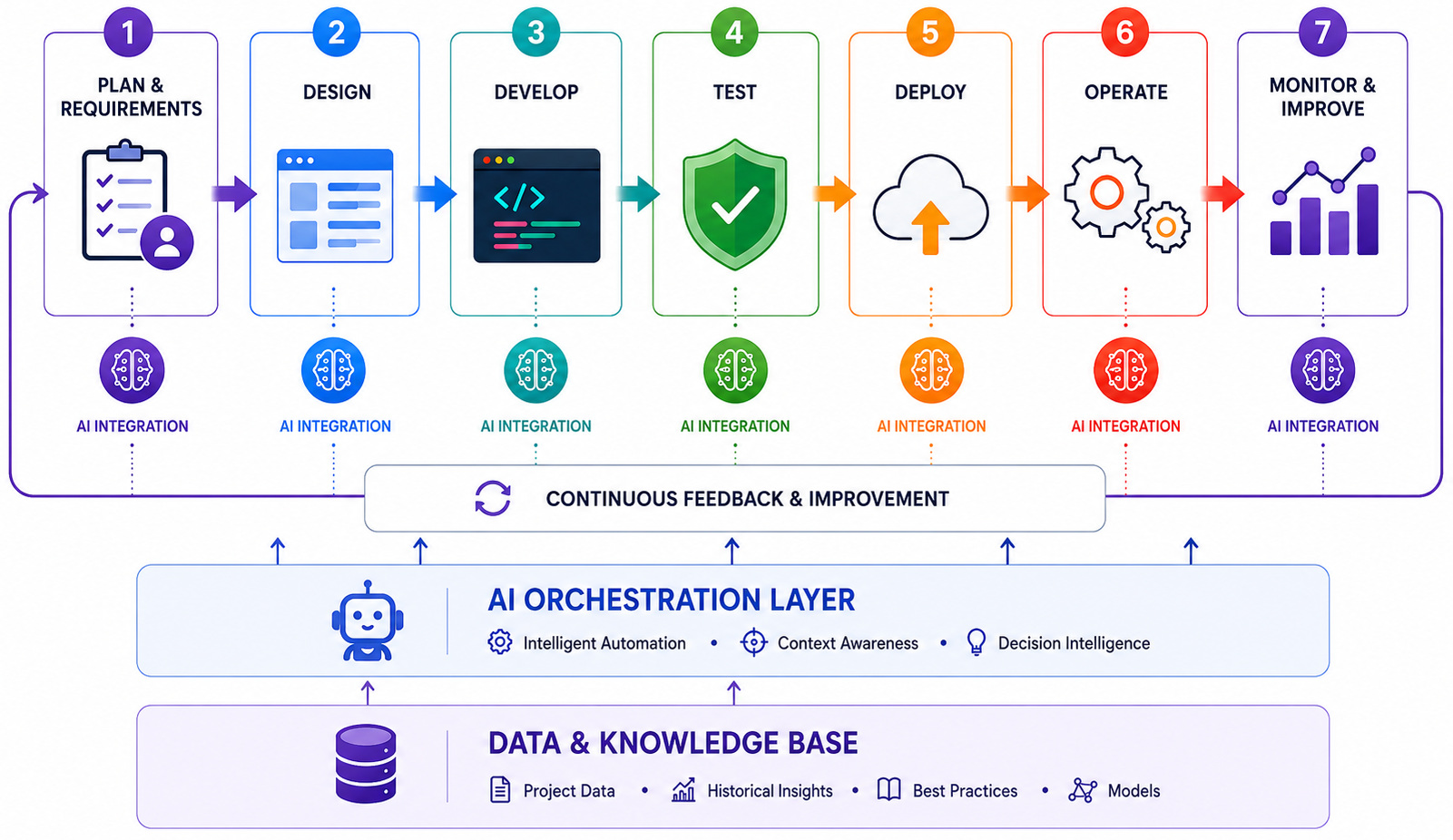
The new AI-driven SDLC still follows the familiar path of Requirement → Code → Test → Deploy.
Earlier product requirements became a Jira ticket. A developer would be assigned the task. They take it up, write code, open a pull request, wait for feedback, execute tests, deploy to staging, and finally push to production.
Now the change is that AI is used in each of these stages. In fact, some organizations even refer to this as AI-DLC.
Planning and Requirements Gathering
AI is already capable of analyzing tickets, documents, meeting transcripts, and user feedback to improve requirements, catch ambiguities, and structure backlogs. NLP-driven systems also help generate user stories and prioritize requests automatically.
Common use cases are: building use stories from meetings, ticket classification and prioritizations, and sentiment analysis for product feedback, after human review.
Read: What is Requirement Engineering Process?
Design and Architecture
AI can propose architectural approaches, verify system consistency, and recommend scalable design patterns based on already existing codebases and architectural data.
Examples include: UML (Unified Modeling Language) diagram generation, architecture impact analysis, and recommendations for event-driven systems or patterns like DDD (Domain Driven Design).
Implementation and Coding
AI has the biggest impact in this stage. Tools such as GitHub Copilot, Claude Code, Codex, codeCake, etc., can write code, recommend refactors, build tests, and speed up development workflows.
AI can now also change text prompts or UI mockups into fully functional frontend code using tools such as Figma Make and Google Stitch.
- Full or partial code generation
- Context-aware autocomplete
- Refactoring suggestions
- Automated unit test generation
- Converting UI designs into Flutter or React code
Read: Code Generation: From Traditional Tools to AI Assistants.
Testing and Validation
AI helps automate test generation, catch high-risk scenarios, and detect bugs during testing. It can also increase coverage analysis and uncover edge cases more efficiently.
Common use cases include: creating tests from user flows or specifications, detecting anomalies in performance metrics, and suggesting testing strategies from historical bugs.
Read: Ralph Loop Explained: A Smarter Agentic Loop for Building and Testing Software.
Deployment and Operations
In DevOps, AI supports predictive monitoring, incident detection, and automated remediation by checking logs, traces, and metrics in real time.
Usual use cases are: predictive incident detection, automated alert categorization, and rollback and escalation recommendations.
Maintenance and Continuous Evolution
AI also helps with long-term maintenance by recognizing code smells, suggesting refactors, tracking technical debt, and keeping documentation updated automatically.
Examples of this include: AI-powered static analysis tools, complexity and hotspot detection, and auto-generated technical documentation.
Read: In the Age of AI, Are We Skipping the Learning Phase?
AI is Getting Better at Understanding Context
One of the biggest cons of early AI coding tools was understanding context. They could write functions, but they struggled to comprehend large codebases.
This is exponentially changing with codebase contextual embedding systems. Modern AI tools can now understand architecture patterns, dependencies, logging standards, and implementation conventions directly from repositories.
For developers, it means less time defining structure and more time monitoring execution. Additionally, engineers define intent while AI manages iterative implementation work.
Read: Context Engineering for AI Agents: A Step-by-Step Guide.
Where AI Works Really Well in SDLC
AI works best in environments with clear, repeatable patterns. Tasks such as CRUD APIs, REST endpoints, Terraform templates, Kubernetes manifests, and boilerplate tests are highly expedited by AI-driven workflows.
Refactoring is another important use case. A lot of teams use agentic code refactoring tools to modernize legacy services, update older APIs, and optimize architecture consistency across bigger codebases.
For example, AI can transform a simple legacy endpoint like:
app.get('/users', async (req, res) => {
  const users = await db.query("SELECT * FROM users");
  res.send(users);
});
router.get('/users', asyncHandler(async (req, res) => {
  const users = await userService.getAllUsers();

  logger.info('Users fetched successfully');

  return ApiResponse.success(res, users);
}));
Testing is another area that has experienced automation. Modern systems can generate unit tests, identify edge cases, build mocks, and suggest regression coverage based on previous commits. More on this later.
For engineers, this drastically decreases implementation and testing overhead.
Read: How to Refactor Legacy Code for AI Compatibility.
DevOps is becoming more Independent
DevOps is undergoing some of the biggest AI-driven changes. Modern CI/CD systems are changing into self-healing infrastructure pipelines that have functionality to analyze logs, identify deployment failures, trigger rollbacks, and open remediation pull requests automatically.
AI systems are able to catch bugs in production, correlate traces and deployment diffs, classify incidents, and isolate risky commits before they sneak into production.
Read: GitLab vs. GitHub: Which Platform Wins for DevOps, CI/CD & Team Workflow.
But, AI Still Lacks Judgment
Understanding hidden business complexity is one area that AI still struggles with. A generated feature may compile successfully and pass tests while solving the completely wrong problem.
Expert engineers are well aware that most production issues don’t come from syntax errors. They usually come from misunderstood requirements, edge cases, or operational requirements. AI often misses out on invisible constraints unless specifically defined.
This is why Humans-in-the-Loop (HITL) becomes a necessity. The best engineering teams are not fully replacing developers; they are mixing AI-driven execution strategically with human judgment and review.
Read: Prompt Engineering for Developers: How to Generate Better Code with AI.
Specification-driven AI Code Development
AI-assisted code generation is moving away from prompt-driven coding to specification-driven code generation.
Tools such as codeCake, built by testRigor, adopt a different approach from typical AI coding assistants.
For instance, a failing test in plain English (Test-Driven Development) can function as both the requirement and validation layer. The AI then generates or updates application code until the test passes. In practice, this builds a workflow that is closer to real software engineering than simple autocomplete.
What makes this approach technically interesting is that the system can work across multiple repositories, use Jira tickets or documentation as additional context, and still follow standard engineering practices by opening pull requests instead of pushing directly to production.
Even in highly automated AI Agentic Workflows, Human-in-the-loop (HITL) gatekeeping remains essential. Human engineers are still needed to review architecture decisions, verify edge cases, and approve production changes. Despite this, the implementation workload is reduced drastically.
So, Can AI Handle the Complete SDLC?
SDLC is not going anywhere anytime soon; however, its process is changing. As AI gets embedded more deeply into the development phases, teams need to reconsider how they plan, build, test, and deploy. AI is not here to replace humans; it only helps them expand their capacity. The impact of AI is real and will grow at an exponential scale, especially with the models becoming more contextual, integrable, and secure. Software engineering of the future is expected to be collaborative rather than fully autonomous. The shift is not just automation but also better orchestration.
Frequently Asked Questions (FAQs)
- What is an AI Agentic Workflow in software development?
A: AI Agentic Workflows involve multiple AI systems collaborating across different stages of the SDLC. One agent may write code, another may build tests, while others validate pull requests or monitor deployments.
- How does AI improve software testing?
A: AI can automatically write unit tests, identify edge cases, create mocks, analyze regression risks, and detect anomalies during performance testing. This drastically reduces manual QA overhead.
- What is Human-in-the-Loop (HITL) in AI-driven SDLC?
A: Human-in-the-Loop (HITL) refers to workflows where AI handles iterative execution tasks while engineers remain responsible for review, approvals, architecture validation, and production decision-making.
- What are self-healing CI/CD pipelines?
A: Self-healing CI/CD pipelines use AI to automatically detect deployment failures, analyze logs, trigger rollbacks, isolate risky commits, and recommend remediation steps without waiting for manual intervention.
- Can AI fully replace software engineers in the SDLC?
A: AI can automate coding, testing, deployments, and parts of DevOps, but human engineers are still needed for architecture decisions, business logic validation, security reviews, and handling ambiguous requirements.
 |